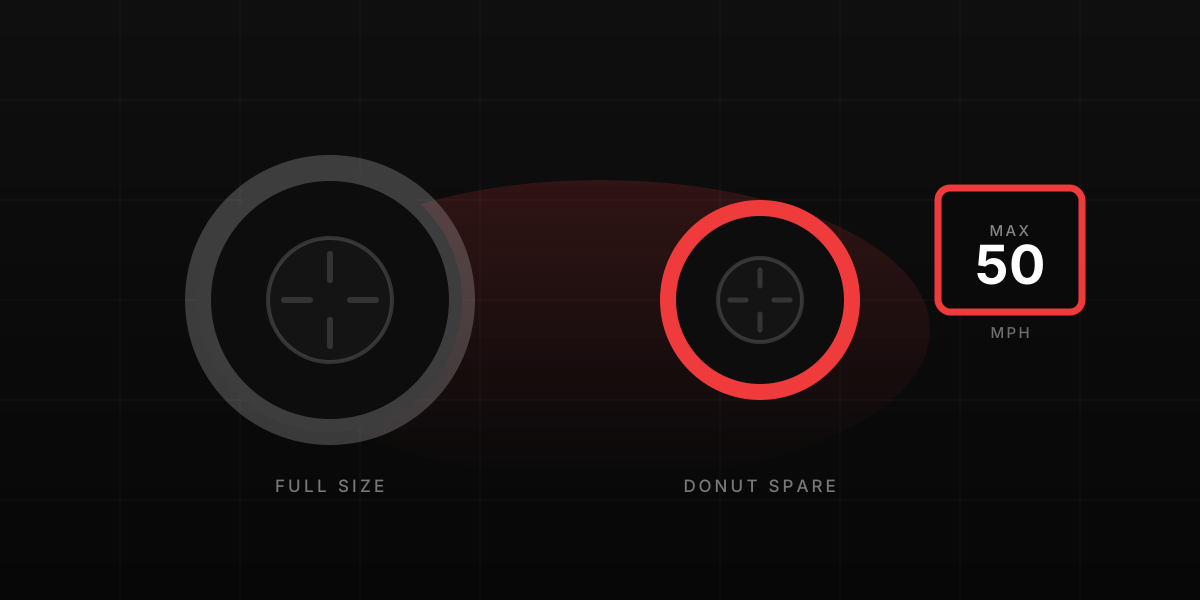
50 mph, or 80 km/h. That number is remarkably consistent across owner's manuals, and it is usually printed on the spare itself. The distance is less settled than most articles suggest. The familiar "50 to 70 miles" figure comes from tire retailers rather than from manufacturers, and most manuals publish no mileage at all. They just tell you to get the real tire back on as soon as you can.
The short answer
A compact temporary spare, the thing everyone calls a donut, is a narrow, lightweight, shallow-tread tire on a small wheel, inflated to around 60 psi. Two rules cover almost every vehicle sold in the United States:
- Do not exceed 50 mph. This is stated in the manual for essentially every mainstream brand, and it is molded or labeled on the spare.
- Do not treat it as a tire. Drive to the nearest place that can fix the original. If you need a number for planning, 50 to 70 miles is reasonable, but it is convention rather than a published specification.
What the manuals actually say, by brand
The table below reflects published owner's manual text. Where a manufacturer does not state a distance, the cell says so rather than borrowing a number from elsewhere. Wording varies by model and year, so your own manual is the authority for your car.
| Manufacturer | Stated max speed | Stated max distance | Notes from the manual |
|---|---|---|---|
| Toyota / Lexus | 50 mph (80 km/h) | Not stated | Compact spare is not designed for driving at high speeds |
| Honda / Acura | 50 mph (80 km/h) | Not stated | Wording is do not exceed 50 mph under any circumstances |
| Ford / Lincoln (T-type mini-spare) | 50 mph (80 km/h) | Not stated | No snow chains on the axle carrying the spare |
| Ford / Lincoln (full-size dissimilar spare) | 70 mph (113 km/h) | Not stated | Warns that all-wheel driving capability may be impaired |
| Chevrolet / GMC | 50 mph (80 km/h) | Not stated | 60 psi; chains do not fit; never run two compact spares |
| Nissan / Infiniti | 50 mph (80 km/h) | Not stated | Labeled temporary use only; tread wears faster than normal |
| Hyundai | 50 mph (80 km/h) | Not stated | 60 psi; do not use continuously; do not tow a trailer |
| Kia | 50 mph (80 km/h) | Not stated | Emergency use only; repair the original tire promptly |
| Subaru | 50 mph (80 km/h) | Not stated | AWD automatics: fit the FWD fuse to deactivate AWD first |
| Mazda | 50 mph (80 km/h) | Not stated | Ground clearance drops about 10 mm; no automatic car washes |
| Volkswagen / Audi | 50 mph (80 km/h) | 125 miles (200 km) on the drive axle | No hard acceleration, heavy braking or fast cornering |
| Jeep / Ram / Chrysler / Dodge | 50 mph (80 km/h) | Not stated | Replace when the tread wear indicators appear |
| BMW (run-flat, no spare) | 50 mph (80 km/h) | Up to 50 miles (80 km) | Distance depends on load, speed, road and temperature |
Two things stand out. First, the speed rule is industry consensus. When a dozen independent engineering organizations converge on the same number, it is not marketing caution, it is the limit of what the construction tolerates.
Second, the distance rule is much weaker than its reputation. If you go looking for "70 miles" in a manual you will usually not find it. Volkswagen is the standout with a real published figure, and the phrasing is instructive: the 125 mile limit applies specifically when the compact spare is on the drive axle, which tells you where the engineering concern actually is.
Why the limit exists
The core of it is rotational speed. Road speed is the wheel's circumference multiplied by how fast it turns, so a tire with a smaller circumference has to turn faster to keep up. A compact spare a few percent smaller in diameter than the tire it replaced is spinning a few percent faster at every moment you are driving.
Every rotation flexes the sidewall, and flexing rubber generates heat. That is the fundamental failure mode for any tire: heat accumulates faster than the tire can shed it, the rubber degrades, the belts separate, and the tire fails suddenly rather than gradually. A compact spare has a lighter carcass and less material than a normal tire, so it reaches that danger point at a lower speed.
The spare is also worse at everything a tire is supposed to do. The tread is narrower and shallower, so the contact patch is smaller, grip is lower and wet weather performance is poor. The inflation pressure is high, commonly 60 psi where a normal tire runs in the low 30s, which shrinks the contact patch again. Chevrolet states plainly that running more than one compact spare at a time can cause a loss of braking and handling, and Volkswagen asks you to avoid hard acceleration, heavy braking and fast cornering entirely. Mazda adds a geometry note: the spare drops ground clearance at that corner by about 10 mm, or four tenths of an inch.
What it does to your speedometer and odometer
This is our particular corner of the subject, and it is genuinely counterintuitive to most people. A smaller tire makes your speedometer read high, not low.
The mechanism: your speedometer does not measure motion across the ground. It counts wheel rotations, usually via the ABS sensors or a transmission output sensor, and multiplies by a constant the factory derived from the rolling circumference of the original tires. Shrink the tire and each rotation covers less ground, so the wheel turns more times per mile. The car cannot know that. It sees extra rotations and reports extra speed and extra distance.
The magnitude is directly proportional to the circumference difference. If the spare is 3 percent smaller, the reading runs about 3 percent high: a true 50 mph displays as roughly 51.5 mph, and 100 true miles adds about 103 to the odometer. Using Mazda's published 10 mm ground clearance drop as a proxy for a 20 mm smaller diameter, 3 percent is a realistic ballpark. You can put real numbers on your own combination with our tire size calculator.
One qualification, and it is the part most articles get wrong. Only one wheel is wrong, not all four, so what you see depends on where the car takes its reading. From the corner carrying the spare, you get the full error. From the transmission or differential, you get about half, because an open differential spins its carrier at the average of the two wheel speeds on that axle. And if the spare sits on a non-driven axle of a car that reads the driven axle, the needle may not move at all. Where there is an effect, the direction is always the same: high, never low.
Practically, an inflated reading errs on the safe side. Hold the needle at 50 and your true speed is a little under 50, which is exactly where you want to be. The odometer side matters more. Over the 50 or 70 miles of a normal spare-tire trip the phantom mileage is about two miles, which is noise. Over months on a mismatched tire, or on a vehicle with permanently fitted non-original tires, the same effect quietly inflates recorded mileage and pulls service intervals forward. Our online odometer measures distance from GPS position rather than wheel rotation, so tire size cannot bias it.
That is also why GPS is the right reference for checking a speedometer at all: satellite positioning measures movement over the ground and is independent of what your tires are doing. Run our car speed test or keep a live GPS speedometer visible while you drive on the spare. If you have permanently changed tire or wheel sizes, our speedometer recalibration guide covers what can and cannot be adjusted.
AWD and 4WD: the part that costs money
On a front-wheel-drive or rear-wheel-drive car, a donut is mostly a tire problem. On an all-wheel-drive or four-wheel-drive vehicle it is also a drivetrain problem, and this is where manufacturers stop being vague.
An all-wheel-drive system detects slip by comparing wheel speeds. A tire with a smaller rolling circumference turns faster than its neighbors permanently, at every speed, on perfectly dry pavement. The system cannot distinguish that from a wheel spinning on ice, so the coupling meant to engage briefly during a slip event instead engages continuously for the entire drive. Clutch packs and viscous units are designed for intermittent duty. Run them constantly and they build heat and wear.
Subaru's manuals confirm this is a real mechanism and not an internet rumor. For AWD models with automatic transmissions, the instruction is to deactivate all-wheel drive before driving on the temporary spare by placing a spare fuse in the FWD connector in the cabin and confirming the AWD warning light comes on. A manufacturer does not build a dedicated procedure for disabling its signature feature unless the alternative is genuine damage. Subaru also warns that a temporary spare other than the original size can cause severe mechanical damage to the drivetrain.
Ford makes the same point from the other direction, warning that a dissimilar spare can impair all-wheel driving capability.
Part-time four-wheel drive on trucks and body-on-frame SUVs is a sharper version of the problem. In 4H or 4L there is no center differential at all: the front and rear driveshafts are locked to turn at the same rate. On loose surfaces the tires slip a little and absorb the difference. On dry pavement they cannot, so a rolling diameter mismatch loads the driveline with torque that has nowhere to go. That is driveline windup, and it stresses transfer case chains, U-joints and axle shafts. The rule is simple: with a compact spare fitted, stay in two-wheel drive on pavement.
Even without AWD, the mismatch works on the open differential of a normal driven axle. The two wheels on that axle now turn at permanently different rates, so the spider gears inside the differential spin continuously instead of sitting essentially still as they do in straight-line driving, and a limited-slip unit reads the difference as slip and fights it. None of this destroys a differential in 50 miles. It is a strong argument against leaving a donut on for weeks.
Compact spare, full-size spare and run-flat
The answer to "how fast" depends on which of these you have, and most drivers do not know until they open the trunk.
- Compact temporary spare (donut). Narrow, small wheel, 60 psi, shallow tread. 50 mph, shortest practical distance. Everything above applies.
- Full-size dissimilar spare. Ford's term for a full-size spare that does not match the road tires in wheel type or tread. Ford caps it at 70 mph rather than 50, but still warns about handling and all-wheel-drive capability. Better than a donut, not equivalent to a matching tire.
- Full-size matching spare. Same size and construction as the other four, so no special speed limit applies. Common on pickups and body-on-frame SUVs, and the only kind that is genuinely fine on an AWD or 4WD vehicle. Check its pressure, because an underinflated full-size spare has a smaller rolling circumference and reintroduces the mismatch.
- Run-flat tires. Common on BMW, and the reason those cars carry no spare. Reinforced sidewalls let you continue on a deflated tire. BMW's guidance is up to about 50 miles at up to 50 mph, with the caveat that actual range depends on load, speed, road surface and outside temperature. A run-flat driven on while flat must be replaced, not repaired.
- Inflator and sealant kit. Many cars now ship with a compressor and sealant instead of any spare. These fix small tread punctures and do nothing for a sidewall tear or a blowout.
When to stop driving on it
The 50 mph limit is a ceiling, not a target. Several conditions call for well under it, or for stopping entirely.
- Any vibration, wobble, pull or new noise. Stop and look. A spare that has sat in a trunk for eight years may have lost pressure or aged out, and the pressure to check for is around 60 psi, not the 32 to 35 psi you use on the road tires.
- Rain, snow or ice. A narrow contact patch and a shallow tread are a poor combination in weather. Go well below 50.
- Tread wear indicators showing. Stellantis manuals call this out: a temporary spare that has reached its wear bars is finished and needs replacing, spare or not.
- Towing anything. Hyundai states directly not to tow a trailer with the compact spare installed. The extra load and heat are exactly what the tire cannot take.
- Interstate driving you can avoid. 50 mph in a 70 zone makes you an obstacle. Take surface routes where reasonable, and stay in the right lane where not.
- Snow chains and automatic car washes. Chains do not fit a compact spare, and the reduced ground clearance can catch on car wash guide rails. Both appear as explicit warnings in GM, Ford and Mazda manuals.
The takeaway
50 mph is the number, and it is one of the most consistently published limits in the whole owner's manual. The distance is softer than the internet implies: most manufacturers do not name one, Volkswagen's 125 miles on the drive axle is the clearest published figure, and 50 to 70 miles remains sound practice. Both limits come from the same physics. A smaller wheel has to turn faster, and turning faster makes heat.
That same smaller circumference is why your speedometer reads a little high and your odometer collects a few phantom miles while the spare is on, and why an AWD or part-time 4WD system sees a permanent slip that is not there. None of it is dangerous for the short trip a donut is designed for. All of it becomes a problem if you treat the spare as a tire.