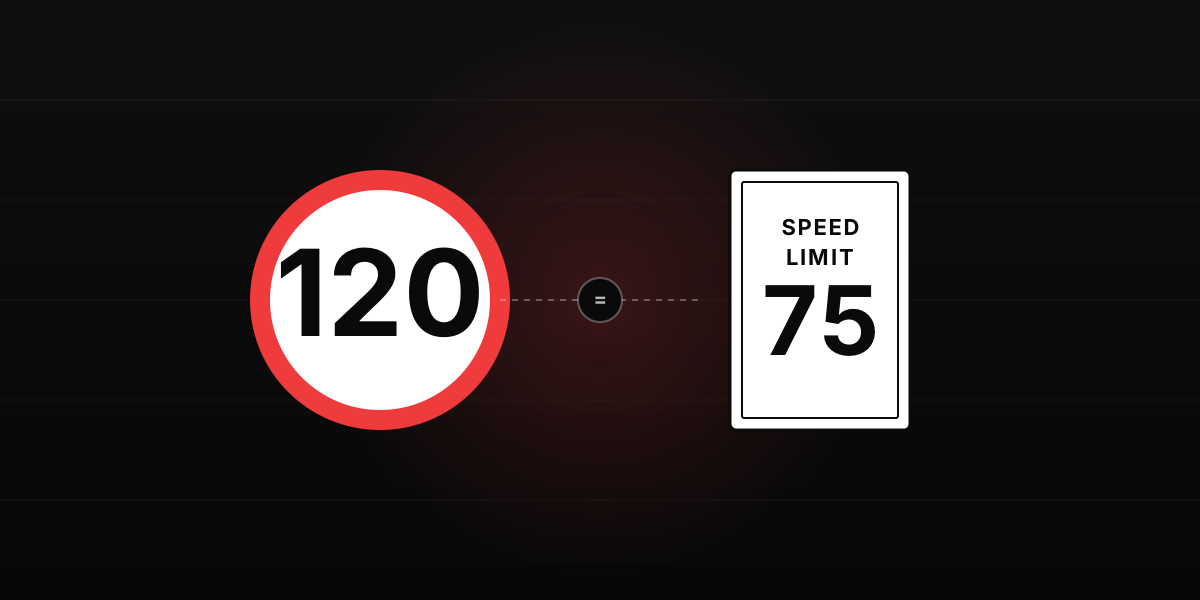
Victoria allows 110 km/h on rural freeways such as the Hume and defaults to 100 km/h on country roads and 50 km/h in town. What sets the state apart is enforcement: a dense fixed and mobile camera network with a published tolerance of just 2 to 3 km/h, no warning signs for camera cars, and automatic licence suspension from 25 km/h over the limit.
Victoria speed limits at a glance
| Road type | Limit |
|---|---|
| Built-up areas (default) | 50 kph (31 mph) |
| School zones | 40 kph (25 mph) |
| Rural roads and highways | 100 kph (62 mph) |
| Motorways / freeways | 110 kph (68 mph) |
About speed limits in Victoria
Victoria posts 110 km/h on its major rural freeways, including the Hume toward Sydney, the Western Freeway past Ballarat and the Goulburn Valley Freeway, while undivided country highways default to 100 km/h. Inside built-up areas the default is 50 km/h, Melbourne's CBD grid is capped at 40 km/h, and several inner councils have introduced 30 km/h streets. School zones are 40 km/h, typically during 8:00 to 9:30 am and 2:30 to 4:00 pm on school days, though many outside busier schools run permanently. Urban freeways such as the Monash and West Gate use variable electronic limits that change with congestion, and the displayed limit is fully enforceable.
Victoria has cultivated the tightest tolerance culture in Australia, summed up by the Transport Accident Commission's long-running Wipe Off 5 campaign, which argued that shaving 5 km/h saves lives. It is the only state that publishes its camera thresholds: fixed cameras deduct just 2 km/h from the measured speed, and mobile cameras allow 3 km/h or 3 percent, whichever is greater. In practice a fixed camera in a 60 zone can fine you at 63 km/h. Drivers detected less than 10 km/h over with a clean record can sometimes receive an official warning instead of a fine, but there is no legal margin of any kind.
The camera program, run under the Cameras Save Lives banner and scrutinised by an independent Road Safety Camera Commissioner, issues well over a million fines a year. Hundreds of fixed cameras cover freeway gantries and intersections, 34 fixed units enforce 40 km/h pedestrian and school precincts, and point-to-point average speed systems operate on the Hume Freeway, EastLink and Peninsula Link. Unlike NSW, Victoria posts no warning signs for its mobile cameras, which operate from unmarked cars parked among ordinary traffic, and sessions are scheduled across thousands of approved sites so that no corridor is predictably safe from enforcement.
Excessive speeding in Victoria means 25 km/h or more over the limit, or any speed above 130 km/h, and it takes the matter beyond demerit points. Instead of points, the infringement carries automatic licence suspension: three months for 25 to 34 over, six months for 35 to 44 over and twelve months for 45 or more over. High-end offences can also engage hoon legislation, allowing police to impound the vehicle. For ordinary offences the state uses a 12 point threshold over three years, and because camera density is so high, many Victorian drivers lose their licence through accumulated low-range camera fines rather than a single dramatic stop.
Enforcement
Victoria Police pair highway patrols with one of the heaviest camera programs in the world: unsigned mobile cameras in unmarked cars, fixed gantry and intersection cameras, 40 km/h zone cameras and point-to-point systems on the Hume Freeway, EastLink and Peninsula Link. An independent Road Safety Camera Commissioner audits the system, and all camera fines go to the vehicle owner unless nominated.
Tolerance
Victoria is the only Australian state that publishes its tolerance, and it is tiny: fixed cameras deduct 2 km/h and mobile cameras 3 km/h or 3 percent. Fines at 3 km/h over the limit are routine, the Wipe Off 5 culture treats low-level speeding as the core road safety problem, and only clean-record drivers under 10 over can hope for an official warning.
Speeding fines in Victoria
From 1 July 2025 the scale ran $254 for under 10 km/h over with 1 point, $407 for 10 to 24 over with 3 points, then $560, $661, $763, $865 and $1,018 as the excess climbs to 45 km/h or more, indexed again each July. From 25 over, automatic suspension replaces demerit points: three months to twelve months depending on speed. Court-heard cases can reach 20 penalty units, about $4,070.
Frequently asked questions
What is the maximum speed limit in Victoria?
110 km/h, posted on rural freeways such as the Hume, Western and Goulburn Valley freeways. Undivided country highways default to 100 km/h, and no Victorian road is signed above 110 km/h.
What is the speed camera tolerance in Victoria?
Fixed cameras deduct just 2 km/h from the measured speed and mobile cameras allow 3 km/h or 3 percent, whichever is greater. Victoria is the only Australian state that publishes these thresholds, and fines a few km/h over the limit are routine.
What speed triggers licence suspension in Victoria?
25 km/h or more over the limit, or any speed above 130 km/h, counts as excessive speeding. It brings automatic suspension instead of demerit points: three months for 25 to 34 over, six months for 35 to 44, and twelve months for 45 or more.
Are there warning signs for speed cameras in Victoria?
No. Mobile cameras operate from unmarked cars with no advance signage, and fixed cameras are generally unsigned as well. The policy is deliberate: enforcement is meant to feel possible anywhere, in contrast to the signposted approach used in NSW.
Speed limits in nearby states
- New South Wales speed limit — highway, rural, and school-zone limits.
- South Australia speed limit — highway, rural, and school-zone limits.
- Tasmania speed limit — highway, rural, and school-zone limits.
Related tools
- Convert KPH to MPH — convert any speed reading between units.
- Car speed test — verify your speedometer accuracy.
- Live GPS speedometer — see your actual speed in the browser.
- Stopping distance calculator — how far you need to brake from each speed.
- Australia speed limits overview — national defaults and how states differ.