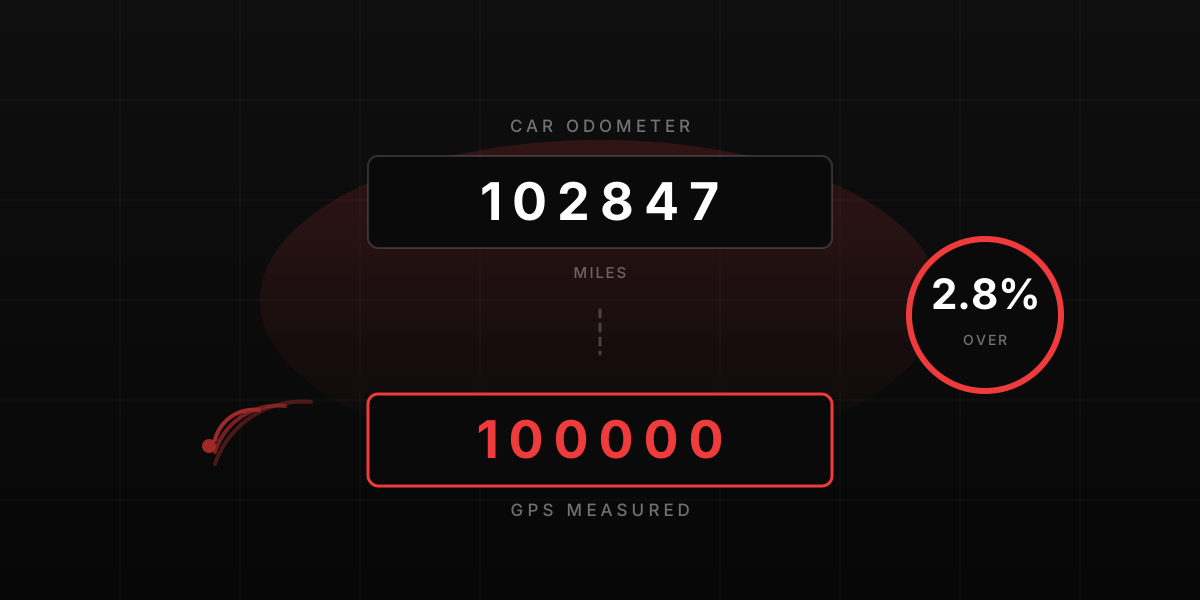
Probably not exactly, and it is very likely reading high. There is no federal accuracy standard for the odometer in a privately owned car in the United States, only a rule about disclosing mileage honestly when the car changes hands. The industry reference figure is 4 percent, and real cars typically over-read by 1 to 3 percent. You can measure your own number in an afternoon with a GPS trip meter and a long stretch of highway.
Is there even a legal standard?
This is the part that surprises people. The regulation everyone cites is 49 CFR Part 580, and its title is the giveaway: Odometer Disclosure Requirements. Its scope section says it prescribes rules requiring transferors and lessees of motor vehicles to disclose the odometer mileage at transfer, under the Motor Vehicle Information and Cost Savings Act. Its purpose section says it exists to give buyers mileage information to help them judge a vehicle's condition and value, and to preserve records needed to investigate violations.
Read that carefully and you will notice what it does not say. It does not specify how close to the truth the instrument has to be. It governs what the seller must write down and keep on file, not how the device counts. The federal machinery around odometers in the United States is built to stop rollback fraud, and it is effective at that. It was never built to certify accuracy.
Accuracy standards do exist. They just apply to narrower cases, or they are voluntary. Here is what is actually on the books.
| Standard | What it covers | Tolerance |
|---|---|---|
| 49 CFR Part 580 | Disclosure of mileage at sale or lease return, US | No accuracy figure. Disclosure rules only |
| NIST Handbook 44, section 5.53 | Odometers used to determine charges for rent or hire of passenger vehicles, trucks and buses | 4 percent, applied to both under and over-registration |
| NIST Handbook 44, section 5.53, T.2.1 | Unloaded trucks tested without cargo | 5 percent under-registration, 3 percent over-registration |
| SAE J678 | Industry recommended practice for speedometers and odometers. Voluntary, not law | 4 percent of actual distance, at 20, 40 and 50 mph |
| 49 CFR 393.82 | Speedometers, not odometers, on buses, trucks and truck-tractors in interstate commerce | 5 mph when measured at 50 mph |
| Hawaii Revised Statutes 486-75 | Passenger cars operated in Hawaii, the one state that addresses odometers as a measurement matter | Statute requires a "properly functioning and correctly calibrated odometer" with no percentage in the text |
The NIST tolerance is real and enforceable, but only for meters that generate a charge. If a rental company bills you by the mile, that odometer is a commercial measuring device and falls under the weights and measures inspector in your state. Your own car, which bills nobody, does not. Handbook 44 also describes how such a device should be tested, and it is worth borrowing: at least two test runs, tires stabilised by driving five miles first, and tire pressure checked at the end against the placard.
SAE J678 is where the widely quoted 4 percent figure comes from. It is a Society of Automotive Engineers recommended practice, first issued in 1939, and it advises that the distance indication should be within 4 percent of actual distance travelled at 20, 40 and 50 mph. A recommended practice is a professional convention, not a regulation. No agency enforces it, but engineers design to it and courts have treated it as the industry benchmark.
Hawaii is regularly cited, including in published forensic engineering work, as the one state requiring odometer accuracy to within 3.75 percent. The statute itself, HRS 486-75, requires only that a passenger car have "a properly functioning and correctly calibrated odometer". We could not locate the 3.75 percent figure in the statutory text, so treat that number as commonly reported rather than confirmed, while the requirement to have a correctly calibrated odometer is plainly there.
Why odometers read high
The mechanism is simple once you see it. Your car has no way of knowing how far it has moved across the ground. What it has is a sensor counting wheel or driveshaft rotations, usually the same ABS wheel sensor the brakes use, and a fixed number in software that says how many pulses make a mile. That number was derived from the rolling circumference of the tire the car left the factory on.
So the reading is only as good as that assumed circumference, and several things shrink the real one:
- Tread wear. A new tire loses several millimetres of tread depth over its life. Less radius means a smaller circumference, more rotations per mile, and a higher count. This is why the same car can measure slightly differently in year one and year five.
- A different tire size. Fitting a shorter overall diameter makes the odometer over-read by the same proportion, and this is the one change big enough to push you well past 4 percent. Our tire size calculator shows the exact percentage for any pair of sizes.
- Load and pressure. Both squash the tire and slightly reduce rolling circumference. Controlled testing found the effect of a 6 psi pressure difference to be very small, smaller than the run to run scatter of the test itself, so pressure matters for test discipline rather than as a real-world cause.
- Speed. At higher speed a tire grows very slightly from centrifugal force, which cuts rotations per mile. The same forensic testing found odometer error about half a percent larger in stop-and-go city driving than at 70 mph on the highway.
Notice that almost every one of those pushes the reading in the same direction: high. Add to that the fact that manufacturers set the calibration deliberately, and they have a clear reason to prefer a positive bias. An odometer that reads low would extend every warranty and every service interval at the maker's expense. Published testing of production cars found designed-in positive bias of 2 to 4 percent on some models, consistent across many vehicles of the same model, and class action litigation has followed on exactly that point.
How to test yours with GPS
GPS measures your position over the ground and never touches a wheel, which makes it the natural reference. Over a long drive the small errors in individual position fixes average out, and a trip meter that resolves to a hundredth of a mile contributes far less uncertainty than the effect you are trying to measure. Highway mile markers are the traditional alternative and they are worse: an individual marker can be off by 50 feet or more, which makes any test shorter than 20 miles unreliable.
Here is the protocol. Run it with our online odometer, which is a GPS trip meter in the browser, so there is nothing to install and it will run on the phone already in your mount.
- Set your tires to the placard pressure when they are cold. The placard is on the driver's door jamb. This is the baseline condition every published test method assumes.
- Drive five miles before you start counting. Tire pressure rises as the tires warm and settles after a few miles. Handbook 44 requires this stabilisation run before any odometer test, and skipping it adds noise for no reason.
- Pick a route of 50 miles or more on open highway with a clear view of the sky. Avoid long tunnels, which GPS bridges with a straight line, and avoid dense city centres where reflected signals can add phantom distance. Fifty miles is not a legal requirement, it just makes the arithmetic clean: at that length a 0.1 mile reading error is only 0.2 percent.
- Reset both meters at the same fixed point. A junction, an overpass, a specific sign. Zero the car trip meter and tap reset on the GPS odometer while stationary at that spot.
- Drive the route. Keep the odometer page in the foreground. It holds the screen awake by itself, but if the browser is suspended, distance covered in that gap is lost and the test is void.
- Stop at another identifiable fixed point and read both numbers. A trick from forensic testing: at the end, roll forward slowly and stop at the exact moment the tenth-of-a-mile digit flips. That removes the rounding uncertainty in the dash reading.
- Compute the error. The formula is:
error % = (odometer miles − GPS miles) ÷ GPS miles × 100
A positive answer means your odometer over-reads. Example: the dash shows 51.4 miles, the GPS odometer shows 50.2. That is (51.4 − 50.2) ÷ 50.2 × 100, which is 2.4 percent high. - Repeat in the opposite direction and average. Handbook 44 calls for at least two test runs, and running both directions on the same road cancels out any gradient or wind asymmetry.
While you are at it, glance at the speed. On most cars the odometer and the speedometer are fed by the same distance signal, so an odometer that over-reads by 2.4 percent usually comes with a speedometer that over-reads similarly. The car speed test compares your dash speed against true GPS speed directly, and the live GPS speedometer is the quickest way to hold both numbers side by side on a drive.
What error is normal, and what is worth acting on
Interpret your result against three bands.
Zero to 3 percent high. Normal. This is where most cars land, and it is the manufacturer's intended bias plus whatever your tread wear adds. Nothing is wrong with your car. Do adjust your expectations for anything you calculate from the odometer, including mileage claims and fuel economy, which will read slightly optimistic for the same reason.
Three to 5 percent high. At the edge. You are at or past the SAE J678 recommendation and past the tolerance NIST would apply to a rental meter. Almost always this means a tire or wheel size that is not what the car was calibrated for, especially if you bought the car used and inherited someone else's wheel choice. Check your fitted size against the placard and run it through the calculator.
More than 5 percent, or reading low. Investigate. A large over-read points to a significantly undersized tire. Reading low is genuinely unusual, since nothing in the normal chain of causes produces it, and the usual explanation is an oversized tire fitted for lift or looks. Under-reading is the direction that costs you real money, because it hides mileage that warranty and service intervals are counted from.
One caveat on the test itself. If your result is wild, suspect the test before the car. Tunnels, a suspended browser tab, a reset taken while rolling, or a route through a city with tall buildings will all contaminate the number. Repeat it on a cleaner stretch before drawing conclusions.
What to do about it
For an error inside the normal band, nothing. Note your percentage and apply it when the exact figure matters. If you claim business mileage, use a GPS-measured distance rather than the dash: it is the defensible number, and it is the smaller one, which is the direction a tax authority would prefer anyway.
For an error caused by a tire or wheel change, the fix is calibration rather than repair. On most modern cars the tire size is a parameter in a control module, and correcting it fixes the odometer and the speedometer together because they share the same signal. Dealers can do it with the factory tool on many makes, and aftermarket recalibration modules exist for common platforms. Our speedometer recalibration guide covers the options and their trade-offs in detail.
One clear line: calibrating the distance-per-rotation figure is legitimate maintenance. Altering the accumulated mileage total is not. Federal law prohibits disconnecting, resetting or altering an odometer with intent to change the indicated mileage, and that prohibition is the part of the odometer statute with real teeth behind it.
Buying a used car, the same test is worth 40 minutes of the test drive. It will not detect a rollback, because a rolled back odometer still counts forward correctly from wherever it was set. It will tell you whether the wheels currently fitted match the car's calibration.
The takeaway
No federal rule requires a car odometer in the United States to be accurate. The rules that exist govern disclosure at sale, and the accuracy figures that get quoted come from a voluntary SAE practice and from NIST rules that apply to meters used for rent or hire. Left to itself, the design errs high, and 1 to 3 percent over is the ordinary outcome. Measuring your own figure needs one long drive, two meters reset at the same point, and one division. Start with the GPS odometer, keep the number, and use it whenever the distance actually has to be right.
If you landed here from a form rather than from curiosity, the companion question is which number the form actually wants: what is an odometer reading covers the odometer-versus-trip-meter trap that causes most of the trouble.