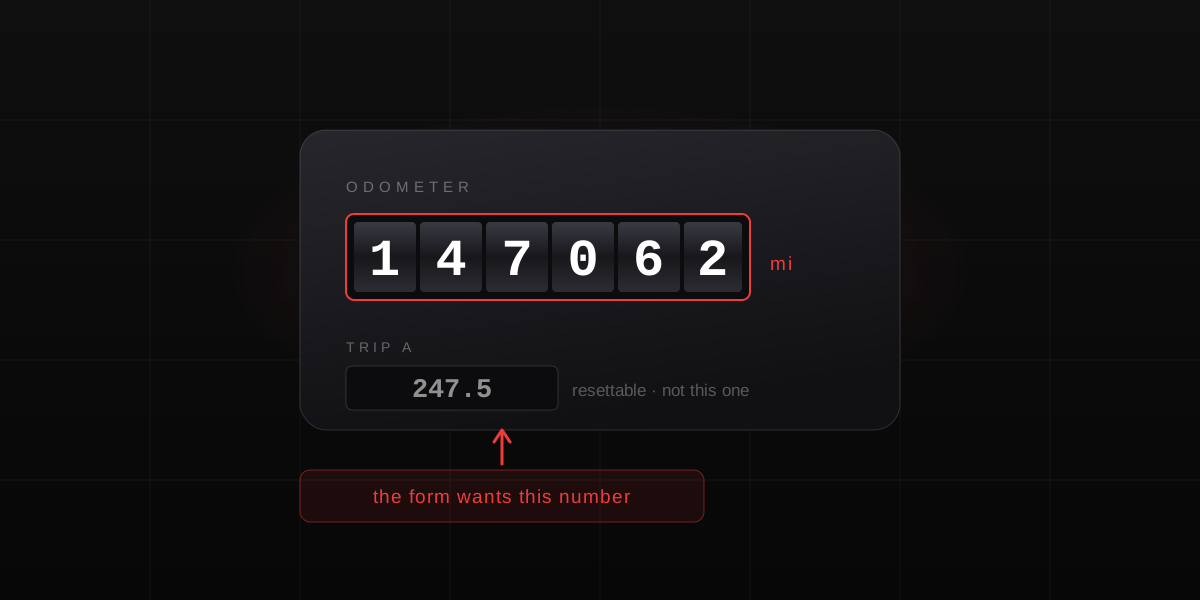
Almost nobody looks this up out of curiosity. You are part way through an insurance quote, a title transfer or a lease return, a box wants your odometer reading, and you are staring at a dashboard with three numbers on it wondering which one is the right one. Here is the answer, plus the mistake that turns a two-minute form into a problem.
The short answer
Your odometer reading is the total distance your car has travelled since it was built. One running number, counting up the whole life of the vehicle, never reset. On most dashboards it is the longest number in the cluster, six or seven digits, and forms want it rounded down to the whole mile or kilometre. No decimals.
Where to find it
Put the ignition in accessory or start the engine first. Most digital clusters show nothing at all until the car has power, which catches people out when the car is parked and they are filling in a form on their phone.
On an analog dashboard the odometer is a row of small mechanical drums, tucked below the speedometer needle or inside the dial itself. On a digital cluster it is a line of digits in roughly the same place. Some cars hide it behind a display menu, so you cycle through with a stalk button or a control on the steering wheel until the total mileage comes up.
The mistake that costs people money
Nearly every car shows two distance numbers, and only one of them is the odometer.
| Odometer | Trip meter | |
|---|---|---|
| Counts | the car's whole life | since you last reset it |
| Label | usually none | TRIP, TRIP A, TRIP B |
| Decimal | no | usually one |
| Resettable | no | yes, hold the button |
The rule that settles it: if you can zero it, it is not your odometer reading. Writing 247.5 on a title transfer when the car has done 147,000 miles is not a small slip. It understates the mileage by six figures, and on a sale document that is the kind of error that gets read as fraud rather than as a typo.
Miles or kilometres?
The odometer counts in whatever unit the car was built for, and the cluster says which somewhere near the number. A US-market car reads in miles, a European or Japanese domestic car in kilometres. Forms normally state the unit they expect, and where the car and the form disagree, convert and note that you did. An imported car with a kilometre cluster sold in the United States is the usual case, and the conversion is worth doing carefully: 160,000 km is about 99,400 miles, not 160,000.
Who asks for it, and why
- Insurers. Annual mileage changes your premium, because a car that covers 4,000 miles a year is exposed to less risk than one covering 20,000. Some policies price on it directly.
- Vehicle title transfers. Federal law requires a mileage disclosure when ownership changes hands, which is the point of the odometer statement on the paperwork. We went through what the rules do and do not cover in is my odometer accurate.
- Buyers and valuation tools. Mileage is the second thing after age that sets a used car's price.
- Lease returns. Contracts set an annual allowance and charge per mile over it, so the closing reading is the number the bill is built from.
- Service records and warranties. Intervals are written in miles, and warranty cover usually ends at a mileage figure as well as a date.
Rollovers, replacements and broken clusters
Older cars with five-digit mechanical odometers run out of digits at 99,999 and start again from zero. A 1980s car showing 34,000 miles has very likely covered 134,000. That is not fraud, it is arithmetic, but it has to be declared rather than quietly passed on.
If the cluster has been replaced, or the odometer has stopped, the honest move is to write what the dashboard shows and flag the problem. US transfer paperwork carries tick boxes for both situations, one for a reading past the mechanical limit and one for a reading that is not the actual mileage. Ticking a box is a formality. Inventing a number to fill the gap is not.
If your speedometer has died and you are trying to work out what is wrong with the cluster, speedometer not working runs through the same signal chain that drives the odometer.
The number is slightly generous
Worth knowing before you buy a car on its mileage. An odometer does not measure distance directly. It counts wheel rotations and multiplies by a tyre circumference stored when the car was built, so anything that makes the wheel turn more often than the factory assumed shows up as distance that was never travelled. Worn tyres are slightly smaller than new ones. Underinflated tyres are smaller still. Fit a replacement size that is a little shorter and every rotation counts a fraction more.
All of it pushes the same way, which is why most cars read roughly 1 to 3 percent high. On a car showing 100,000 miles that is one to three thousand miles that only ever existed on the dashboard. Nobody is going to argue with you about it on an insurance form. It matters when you are paying for mileage, whether that is a lease excess charge or a used car priced on a round number.
You can measure your own car's error in one drive. Run the GPS trip meter alongside the trip meter in the car over a reasonable distance, then compare. GPS works out distance from satellite positions rather than from your wheels, so worn tyres and the wrong tyre size do not touch it. A car reading two percent high will show it clearly over thirty miles.
The takeaway
The odometer reading is the big number, the one you cannot reset, and the form wants it whole. Turn the ignition on before you look. Check twice that you are not reading the trip meter, because that is the error that actually causes trouble. And if you are buying rather than filling in a form, remember the figure leans a percent or two in the seller's favour, for reasons that have nothing to do with anyone being dishonest.