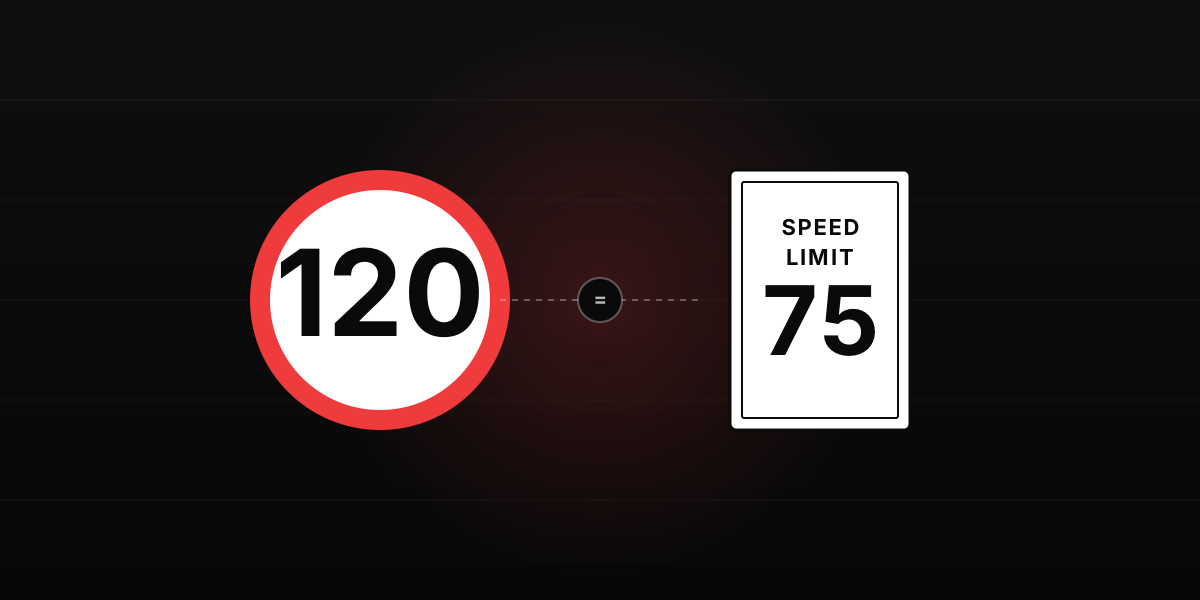
California posts a maximum of 65 mph on most freeways, with 70 mph on some rural interstate sections and 55 mph on undivided two-lane highways. The state is a "prima facie" jurisdiction: in business and residential districts the default is 25 mph unless a sign says otherwise, and the Basic Speed Law makes any unsafe speed illegal regardless of the posted number.
California speed limits at a glance
| Road type | Limit |
|---|---|
| Cities, towns, business districts | 25 mph (40 kph) |
| Residential / school zones | 25 mph (40 kph) |
| Rural highways | 55 mph (89 kph) |
| Interstates / freeways | 65 mph (105 kph) |
About speed limits in California
California caps most freeways at 65 mph. A limited set of rural interstate segments (parts of I-5, I-8, I-10, and SR-58) are posted at 70 mph. Two-lane undivided highways default to 55 mph. Unlike Texas or Utah, California has no 75 or 80 mph zones anywhere in the state, reflecting a long-standing safety-first posture from Caltrans and the CHP.
The Basic Speed Law (California Vehicle Code 22350) is the rule most drivers underestimate: you may never drive faster than is safe for current conditions, even if you are under the posted limit. In fog, rain, or heavy traffic an officer can cite you for doing 60 in a 65 zone if conditions made that unsafe. This is the legal basis for many California citations that surprise out-of-state drivers.
California uses "prima facie" limits in business and residential districts: 25 mph is presumed unless posted otherwise, 15 mph near uncontrolled railroad crossings, blind intersections, and in alleys. School zones drop to 25 mph (sometimes 15) when children are present. These presumed limits apply even where no sign is visible, so the 25 mph residential default is statewide.
California banned automated speed cameras for decades, but a 2023 pilot law (AB 645) authorized speed-safety cameras in six cities including San Francisco, Los Angeles, and Oakland, starting in 2024. Outside those pilot zones, enforcement is officer-based: the CHP patrols freeways and uses radar, LIDAR, and aircraft pacing on marked "Enforced by Aircraft" corridors.
Enforcement
The California Highway Patrol enforces freeways with radar, LIDAR, and aircraft speed-timing on posted corridors. Radar use requires an up-to-date engineering and traffic survey on the road, or the citation can be challenged. The 2023 AB 645 pilot added fixed speed-safety cameras in six cities; elsewhere photo speed enforcement remains prohibited.
Tolerance
There is no official grace margin. Because of the Basic Speed Law, an officer can cite at the limit or even below it in poor conditions. In practice CHP often targets 10+ mph over on open freeway, but school zones, work zones, and the new camera-pilot cities are enforced much more tightly.
Speeding fines in California
A first California speeding ticket typically runs $230 to $360 once state and county penalty assessments are added to the base fine (the base fine alone is small, but assessments multiply it). 100+ mph is a specific enhanced offense with fines up to $500 and possible 30-day license suspension. Fines roughly double in work zones and school zones.
Frequently asked questions
What is the maximum speed limit in California?
65 mph on most freeways, with 70 mph on a limited set of rural interstate sections (parts of I-5, I-8, I-10, and SR-58). Two-lane undivided highways are 55 mph. California has no 75 or 80 mph zones anywhere, unlike many western states.
What is the Basic Speed Law in California?
California Vehicle Code 22350 says you may never drive faster than is safe for current conditions, regardless of the posted limit. In fog, rain, or congestion you can be cited for a speed below the posted number if conditions made it unsafe. It is the legal basis for many citations that surprise visitors.
What is the residential speed limit in California?
25 mph is the prima facie (presumed) limit in business and residential districts, even where no sign is posted. It drops to 15 mph near uncontrolled rail crossings, blind intersections, and in alleys. School zones are 25 mph (sometimes 15) when children are present.
Does California use speed cameras?
Only in a limited pilot. A 2023 law (AB 645) authorized speed-safety cameras in six cities including San Francisco, Los Angeles, San Jose, and Oakland, starting in 2024. Outside those pilot zones automated speed enforcement is still prohibited and citations are officer-issued.
City speed limits in California
- Los Angeles speed limit — city defaults, school zones, and camera enforcement.
- San Diego speed limit — city defaults, school zones, and camera enforcement.
Speed limits in nearby states
- Arizona speed limit — interstate, rural highway, and city limits.
- Nevada speed limit — interstate, rural highway, and city limits.
- Oregon speed limit — interstate, rural highway, and city limits.
Related tools
- Convert MPH to KPH — convert any speed reading between units.
- Car speed test — verify your speedometer accuracy.
- Live GPS speedometer — see your actual speed in the browser.
- Stopping distance calculator — how far you need to brake from each speed.
- US speed limits overview — federal background and national patterns.