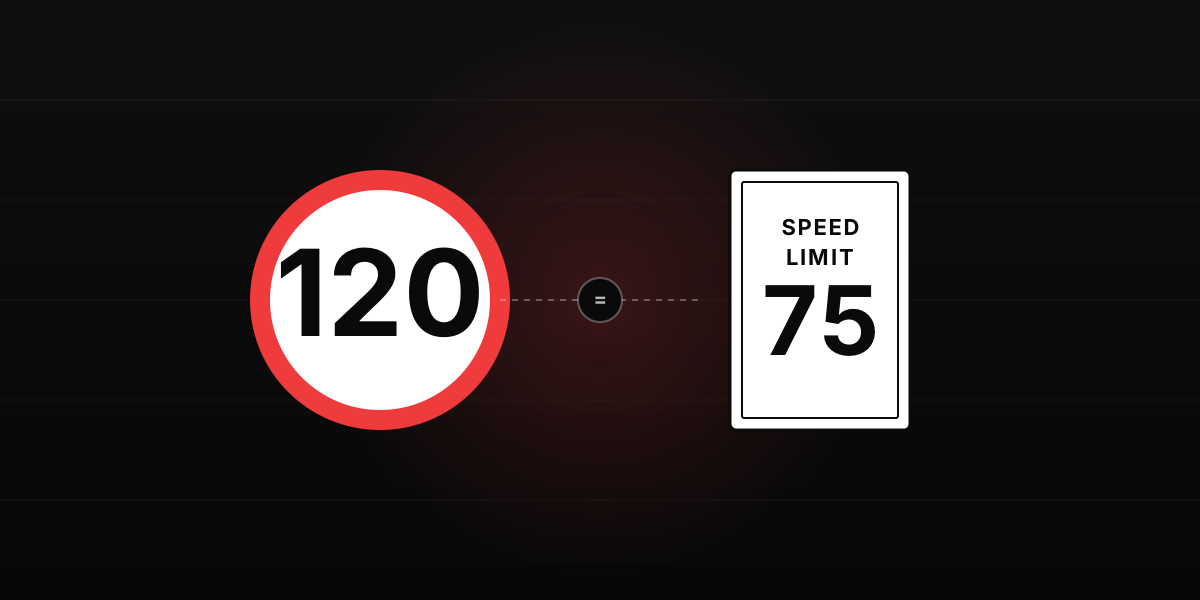
The United States has no single national speed limit. Each state sets its own, with maximums ranging from 60 mph on Hawaii interstates to 85 mph on a single tolled stretch of Texas SH 130 — the highest posted limit in the country. Most urban arterials sit at 30 to 45 mph; interstates outside cities run 65 to 80 mph.
Speed limits at a glance
| Road type | Limit |
|---|---|
| In built-up areas (cities, towns) | 25-35 |
| Residential / school zones | 20-25 |
| Outside built-up areas (rural) | 55-65 |
| Motorways / expressways | 65-85 |
About speed limits in United States
The National Maximum Speed Limit law (1974, set at 55 mph nationwide) was repealed in 1995, returning speed-limit authority to states. Since then most western states have raised rural interstate limits: Texas, Utah, Idaho, Wyoming, South Dakota, Nevada, and Montana now post 80 mph on long stretches. Texas SH 130 between Austin and San Antonio is unique at 85 mph (137 kph) — the highest in the US since 2012.
Cities use a default urban limit between 25 and 35 mph. New York City lowered the default residential limit to 25 mph in 2014, with school zones at 20 or 15 during posted hours. Portland and Seattle have moved to 20 mph defaults in residential neighborhoods. Most US cities still default to 30 mph residential, 35 mph arterial.
Rural two-lane roads typically post 55 mph, dropping through small towns and around schools. Interstate spurs into cities often drop to 55 mph at the urban boundary, then return to the higher rural limit beyond. Construction zones double or triple posted fines and lower the limit by 10 to 20 mph.
School zones are a separate category enforced strictly: 15 to 25 mph when posted active (typically morning drop-off and afternoon pickup). Fines in active school zones are double or triple base, and points on the license stack faster.
Enforcement
Enforcement varies wildly by state and locality. Texas and Florida use radar and laser heavily; Pennsylvania allows only state police to use radar (municipal officers must use VASCAR or pacing). Photo enforcement is patchwork: legal in some states (Iowa, Maryland, DC), banned outright in others (Texas, New Jersey, Wisconsin).
Tolerance
There is no official national tolerance. Most officers issue tickets at 5 to 10 mph over, but local practice varies. Some jurisdictions ticket at 1 mph over in school zones or work zones. Highway patrol on rural interstates frequently lets 10 to 15 mph over pass for steady cruise traffic.
Fines for speeding
Fines vary by state and severity. Typical: $100 to $200 for 10 mph over, $200 to $400 for 20 mph over, $400 to $800+ plus possible license suspension for 25+ over. Reckless driving (often automatic at 25+ mph over) is a misdemeanor in most states and stays on record. Virginia treats 80+ mph as reckless regardless of limit.
Frequently asked questions
What is the highest speed limit in the US?
Texas State Highway 130 between Austin and San Antonio posts 85 mph (137 kph) on a 41-mile tolled section. This is the highest posted limit in the United States. Several other Texas, Utah, and Wyoming interstates post 80 mph.
Why is the US speed limit different from Europe?
European limits are set in kph and tend to be higher numerically (130 kph = 81 mph). In actual speed, the US 70-80 mph range is close to the European 110-130 kph range. The main difference is that Germany has no general motorway limit, while the US has at least state-level limits everywhere.
Can a US officer ticket me at 1 mph over?
Legally yes, but practically rare outside school and work zones. Most highway patrol let 5 to 10 mph slide on rural interstates if traffic is moving at the same pace. Local enforcement in suburban areas tends to be stricter than rural patrol.
What is the speed limit in US national parks?
Generally 25 to 45 mph depending on the road. Yellowstone main loop is 45 mph maximum, dropping to 25 through villages. Yosemite is 35 mph on most park roads. Grand Canyon south rim is 35 mph. Federal park rangers enforce strictly.
Speed limits by US state
Each state sets its own limits. Pick a state for its interstate, city, and school-zone limits, enforcement style, and fines:
- California speed limits
- Texas speed limits
- Florida speed limits
- Georgia speed limits
- New York speed limits
- Pennsylvania speed limits
- Ohio speed limits
- Illinois speed limits
- Michigan speed limits
- North Carolina speed limits
- Virginia speed limits
- Arizona speed limits
- Washington speed limits
- Colorado speed limits
- Utah speed limits
- Nevada speed limits
- New Mexico speed limits
- Montana speed limits
- Wyoming speed limits
- Idaho speed limits
- North Dakota speed limits
- South Dakota speed limits
- Oregon speed limits
- Alaska speed limits
- Hawaii speed limits
- Kansas speed limits
- Nebraska speed limits
- Minnesota speed limits
- Wisconsin speed limits
- Iowa speed limits
- Missouri speed limits
- Indiana speed limits
- Kentucky speed limits
- Tennessee speed limits
- Alabama speed limits
- South Carolina speed limits
- Louisiana speed limits
- Mississippi speed limits
- Arkansas speed limits
- Oklahoma speed limits
- West Virginia speed limits
- Maryland speed limits
- Delaware speed limits
- New Jersey speed limits
- Connecticut speed limits
- Rhode Island speed limits
- Massachusetts speed limits
- New Hampshire speed limits
- Vermont speed limits
- Maine speed limits
Speed limits by US city
Big cities set their own defaults, often lower than the state limit. Pick a city for its street, school-zone, and highway limits plus camera enforcement:
- New York City speed limits
- Los Angeles speed limits
- Chicago speed limits
- Houston speed limits
- Phoenix speed limits
- Philadelphia speed limits
- San Antonio speed limits
- San Diego speed limits
- Dallas speed limits
- Atlanta speed limits
- Miami speed limits
- Seattle speed limits
Speed limits in other countries
Limits, tolerances and fines differ sharply across borders. These pages cover the same ground for every country we have researched.
- Australia
- Austria
- Belgium
- Canada
- Denmark
- France
- Germany
- Italy
- Japan
- Netherlands
- Norway
- Portugal
- Spain
- Sweden
- Switzerland
- Turkey
- United Kingdom
Related tools
- Convert MPH to KPH — convert any speed reading between units.
- Car speed test — verify your speedometer accuracy.
- Live GPS speedometer — see your actual speed in the browser.
- Stopping distance calculator — how far you need to brake from each speed.