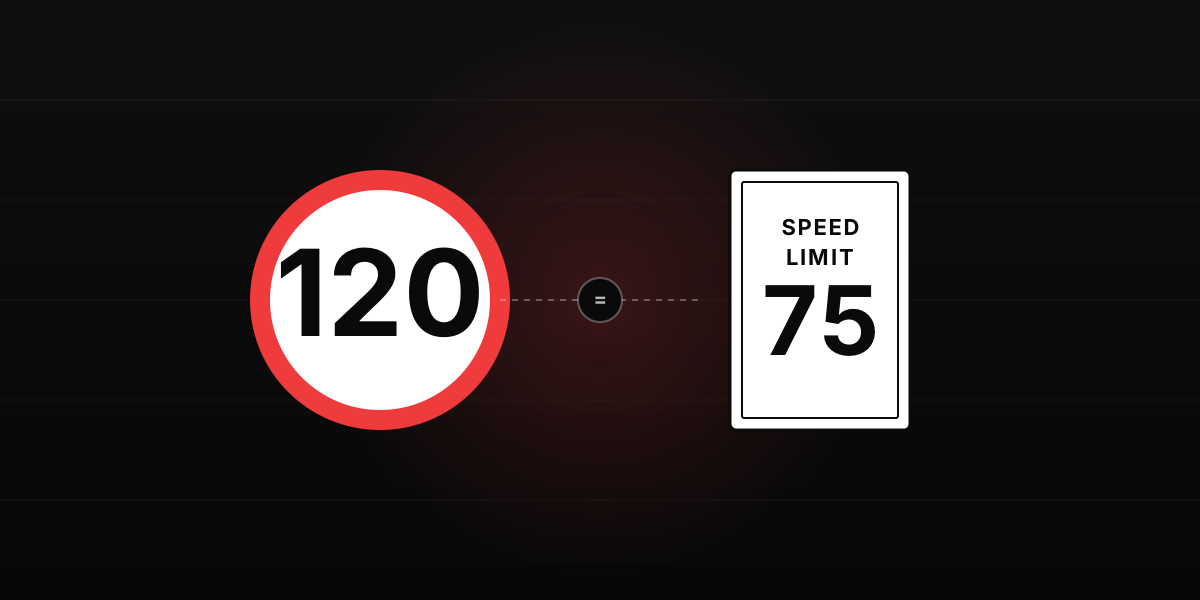
Maryland caps speed at 70 mph, posted on rural I-68 in Western Maryland and on I-95 north of Baltimore, with 65 mph on most other interstates and 30 mph the default in town.
Maryland speed limits at a glance
| Road type | Limit |
|---|---|
| Cities, towns, business districts | 30 mph (48 kph) |
| Residential / school zones | 30 mph (48 kph) |
| Rural highways | 55 mph (89 kph) |
| Interstates / freeways | 70 mph (113 kph) |
About speed limits in Maryland
Maryland law caps every highway in the state at 70 mph, and that ceiling is actually used: rural Interstate 68 between the West Virginia line and LaVale carries a 70 mph limit (except a hilly seven-mile segment around Cumberland), and stretches of I-95 northeast of Baltimore toward Delaware are also posted at 70. Most other freeways, including the Capital Beltway (I-495) and the Baltimore Beltway (I-695), stay at 55 to 65 mph. Off the interstates, Maryland statute sets 55 mph on divided highways, 50 mph on undivided two-lane roads, and 30 mph in business districts and on undivided residential streets, so the working assumption on an unposted Maryland road is considerably lower than the freeway numbers suggest.
Maryland runs one of the most extensive automated enforcement programs on the East Coast. The statewide SafeZones program places speed cameras in highway work zones, and fines double when workers are present. A 2024 law replaced the old flat work-zone fine with a tiered schedule that took effect January 1, 2025, so the penalty now climbs sharply with the speed recorded.
In cities and suburbs, the statutory 30 mph default applies in business and residential districts, though Baltimore City and many counties post 25 mph on local streets. School zones are typically 15 to 25 mph when flashing, and Maryland allows local jurisdictions to operate school-zone speed cameras on weekdays; a tiered fine schedule for those cameras took effect October 1, 2025.
Camera enforcement is the headline change of recent years. School-zone and residential cameras trigger at 12 mph or more over the limit across Montgomery, Prince George's, Baltimore and other jurisdictions, while SafeZones work-zone cameras operate statewide around the clock. Citations are civil penalties with no license points, but the tiered amounts introduced in 2025 make repeat high-speed passes expensive.
Enforcement
Maryland pairs heavy automated enforcement with traditional patrols: SafeZones cameras cover highway work zones statewide, local jurisdictions run school-zone and residential speed cameras, and Maryland State Police work I-95, I-70 and I-68 with radar and laser.
Tolerance
Speed cameras only trigger at 12 mph or more over the limit, which is a codified margin. Officers on patrol have full discretion, and tickets in the 5-10 mph range are uncommon but entirely possible, especially in work and school zones.
Speeding fines in Maryland
Officer-issued speeding fines commonly run from around 80 dollars to over 500 dollars depending on speed and zone, with the top amounts reserved for large excesses in 65 mph zones. Camera citations are civil fines that since 2025 scale in tiers with the recorded speed, and work-zone amounts double when workers are present.
Frequently asked questions
What is the maximum speed limit in Maryland?
70 mph, which state law sets as the absolute ceiling. It is posted on rural I-68 in Western Maryland and on sections of I-95 northeast of Baltimore, while most other Maryland interstates are signed at 55 to 65 mph.
How do Maryland's work-zone speed cameras work?
The SafeZones program places automated cameras in highway work zones statewide. They photograph vehicles going 12 mph or more over the limit, fines follow a tiered schedule introduced in 2025, and amounts double when workers are present. Citations are civil, with no points.
What is the residential speed limit in Maryland?
The statutory default is 30 mph in business districts and on undivided residential roads, but Baltimore City and many counties post 25 mph on local streets, so watch the signs. School zones drop to 15-25 mph during posted hours.
Does Maryland use speed cameras?
Yes, extensively. Work-zone cameras operate statewide under SafeZones, and local jurisdictions run school-zone and residential cameras that trigger at 12 mph over the limit. Maryland is one of the most camera-heavy states in the country.
Speed limits in nearby states
- Virginia speed limit — interstate, rural highway, and city limits.
- Pennsylvania speed limit — interstate, rural highway, and city limits.
- Delaware speed limit — interstate, rural highway, and city limits.
- West Virginia speed limit — interstate, rural highway, and city limits.
Related tools
- Convert MPH to KPH — convert any speed reading between units.
- Car speed test — verify your speedometer accuracy.
- Live GPS speedometer — see your actual speed in the browser.
- Stopping distance calculator — how far you need to brake from each speed.
- US speed limits overview — federal background and national patterns.