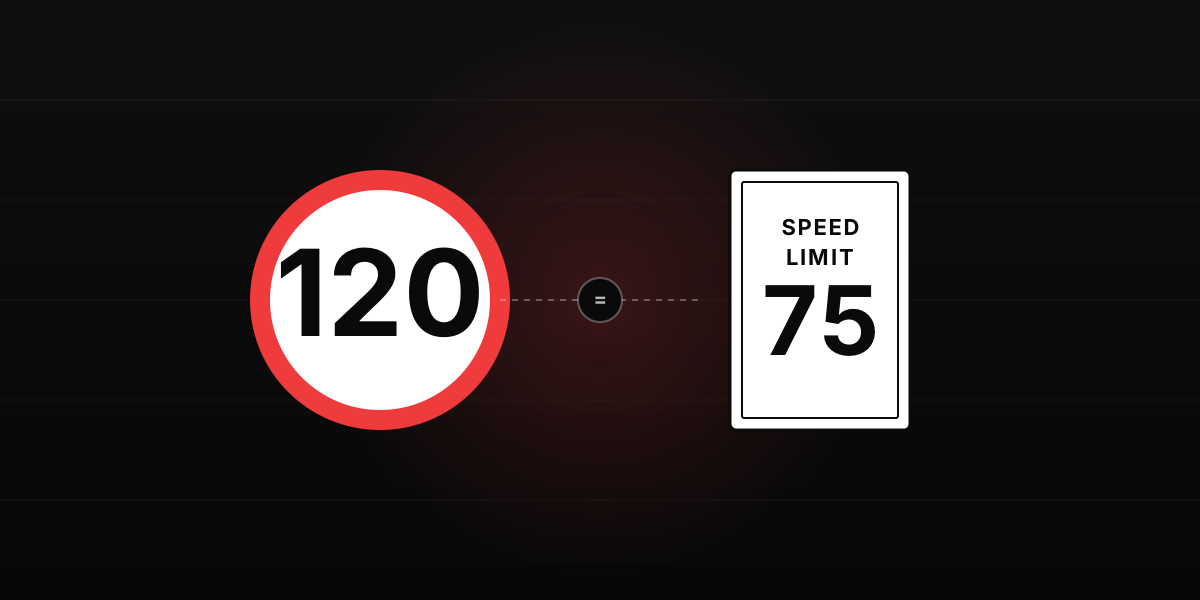
New York posts a statewide maximum of 65 mph, one of the lowest top limits in the country, on the Thruway and rural interstates. Most other state highways run at 55 mph, which is also the default limit outside cities and villages where no sign is posted. New York City sets a citywide default of 25 mph.
New York speed limits at a glance
| Road type | Limit |
|---|---|
| Cities, towns, business districts | 30 mph (48 kph) |
| Residential / school zones | 30 mph (48 kph) |
| Rural highways | 55 mph (89 kph) |
| Interstates / freeways | 65 mph (105 kph) |
About speed limits in New York
New York caps every road in the state at 65 mph, so there is no 70 mph or 75 mph section anywhere, including the New York State Thruway and the interstates that cross the Adirondacks and the Southern Tier. Two-lane state highways and rural roads without a posted sign default to 55 mph, and a statewide minimum of 55 mph applies where signs require it on limited-access highways. A bill to raise the ceiling to 70 mph has been floated in Albany but has not become law, so drivers should not expect anything above 65 mph in 2026.
New York City is the clearest example of the state's Vision Zero approach: the citywide default is 25 mph, and under Sammy's Law the city may lower individual streets to 20 mph, or 10 mph on streets undergoing a full safety redesign. In 2026 the city is pushing 15 mph school slow zones to more than 1,300 school locations, one of the largest speed-reduction rollouts in the country.
Statewide, city and village streets typically default to 30 mph unless posted lower, while unmarked rural roads default to 55 mph. School zones range from 15 to 25 mph and are usually active on school days, commonly from around 7 a.m. to 6 p.m., though camera-enforced zones may run around the clock.
New York City runs a very large automated speed-camera program concentrated in school zones. The cameras operate 24 hours a day, seven days a week, and ticket vehicles traveling at least 11 mph over the limit; the city reports roughly a 94 percent drop in speeding where cameras are installed.
Enforcement
Outside the five boroughs, State Police and county sheriffs rely heavily on radar and marked and unmarked patrol cars. New York City leans on hundreds of fixed school-zone speed cameras that operate around the clock, plus red-light cameras, rather than roadside stops.
Tolerance
There is no legal grace margin, and New York is known for writing tickets for very small overages, including 1 mph over in principle. School-zone cameras issue a violation only once you are at least 11 mph over the posted limit.
Speeding fines in New York
Speeding 1-10 mph over typically runs about $138 to $243 in combined fine and surcharge, while 11-30 mph over is roughly $183 to $393, before any local costs. Points scale sharply, from 3 points for 1-10 mph over up to 11 points for 41 mph or more, and camera tickets in NYC are a flat monetary fine with no points.
Frequently asked questions
What is the maximum speed limit in New York?
The statewide maximum is 65 mph, which applies to the New York State Thruway and rural interstates. New York does not have any 70 mph or 75 mph sections, making it one of the lowest top speed limits in the United States.
Why is New York City limited to 25 mph?
New York City adopted a 25 mph citywide default as part of its Vision Zero road-safety program. Under Sammy's Law the city can lower individual streets to 20 mph, and streets under safety redesign can drop to 10 mph.
What is the residential speed limit in New York?
In most cities and villages the default is 30 mph unless a sign says otherwise, while New York City uses a 25 mph default. Unmarked rural roads default to 55 mph.
Does New York use speed cameras?
Yes. New York City operates a large school-zone speed-camera network that runs 24/7 and tickets vehicles going at least 11 mph over the limit. Camera tickets carry a fixed fine and no license points.
City speed limits in New York
- New York City speed limit — city defaults, school zones, and camera enforcement.
Speed limits in nearby states
- New Jersey speed limit — interstate, rural highway, and city limits.
- Pennsylvania speed limit — interstate, rural highway, and city limits.
- Connecticut speed limit — interstate, rural highway, and city limits.
- Massachusetts speed limit — interstate, rural highway, and city limits.
- Vermont speed limit — interstate, rural highway, and city limits.
Related tools
- Convert MPH to KPH — convert any speed reading between units.
- Car speed test — verify your speedometer accuracy.
- Live GPS speedometer — see your actual speed in the browser.
- Stopping distance calculator — how far you need to brake from each speed.
- US speed limits overview — federal background and national patterns.