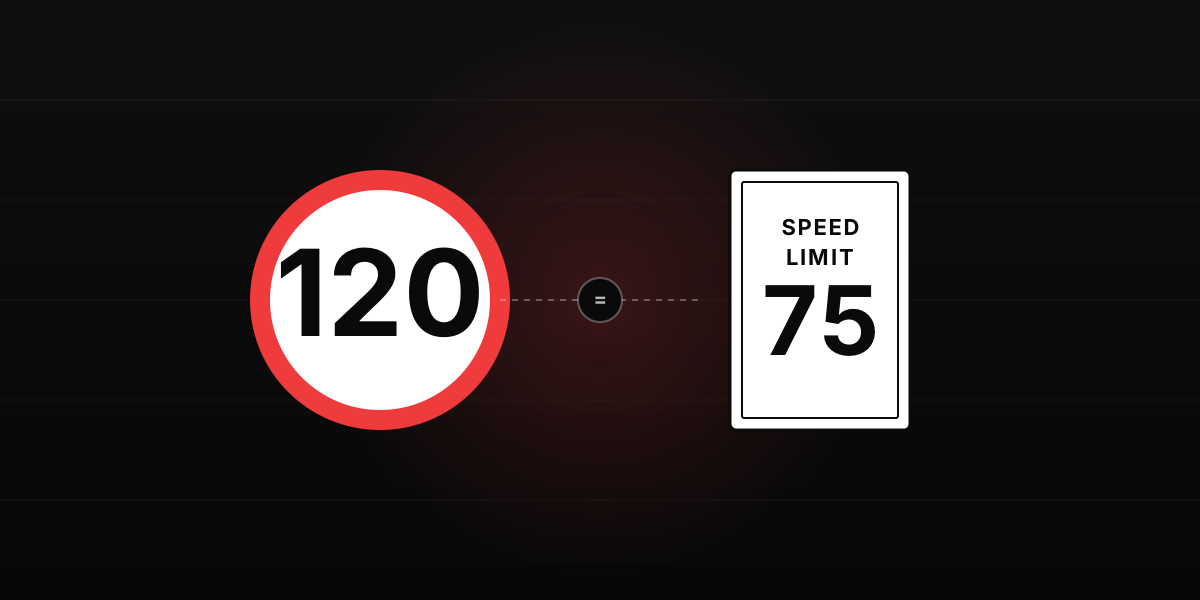
Ontario posts 110 km/h on most of its 400-series freeway network after a permanent expansion that began in July 2024, while the congested Toronto core of Highway 401 stays at 100 km/h. Other highways default to 80 km/h outside built-up areas and 50 km/h inside them. The province is best known for its stunt driving law, which triggers an immediate 30-day licence suspension and 14-day vehicle impound at the roadside.
Ontario speed limits at a glance
| Road type | Limit |
|---|---|
| Cities and towns (default) | 50 kph (31 mph) |
| School / playground zones | 40 kph (25 mph) |
| Rural two-lane highways | 80 kph (50 mph) |
| Major highways / freeways | 100-110 |
About speed limits in Ontario
Ontario freeways were posted at 70 mph, roughly 113 km/h, until the province cut limits during the 1976 oil crisis, and the 400-series then sat at 100 km/h for nearly five decades. A 110 km/h pilot launched on three sections in September 2019, was made permanent on six sections in April 2022, and in July 2024 the government began rolling 110 km/h out across most of the network. That expansion covered long runs of Highway 401 east of the Greater Toronto Area, Highway 416 from the 401 to Ottawa, and Highway 69 south of Sudbury, among others. The heavily congested 401 through Toronto and Mississauga remains at 100 km/h, and two-lane provincial highways stay at 80 or 90 km/h.
Ontario's stunt driving law is one of the toughest speeding regimes in North America. Driving 40 km/h or more over the limit on a road posted below 80 km/h, 50 km/h or more over on faster roads, or 150 km/h anywhere counts as stunt driving under the Highway Traffic Act. Since the MOMS Act took effect in July 2021, police impose an immediate 30-day licence suspension and a 14-day vehicle impound at the roadside, before any court date. Conviction brings a fine of $2,000 to $10,000, six demerit points, a licence suspension of one to three years for a first offence, and possible jail time of up to six months.
Inside cities and towns the default limit is 50 km/h unless a sign says otherwise, and the default on unposted rural roads is 80 km/h. Toronto has lowered most residential streets to 30 or 40 km/h under its Vision Zero plan, and Ottawa, Hamilton and many other municipalities have followed with 40 km/h neighbourhood zones. School zones are typically posted at 30 or 40 km/h during school hours, and fines are doubled in designated community safety zones near schools, parks and seniors' residences, as well as in construction zones when workers are present.
Ontario reversed course dramatically on automated enforcement. Municipalities, led by Toronto with about 150 cameras, had built large automated speed enforcement programs in school and community safety zones, but the province passed Bill 56 and banned municipal speed cameras effective November 14, 2025. Tickets issued before the ban remain valid and must still be paid or disputed. In place of cameras the province announced a $210 million Road Safety Initiatives Fund for speed humps, raised crosswalks, roundabouts, high-visibility signage and extra police enforcement in the zones where cameras used to operate. Red-light cameras were not affected and continue to run.
Enforcement
The Ontario Provincial Police patrol the 400-series with radar, laser and unmarked vehicles, and aircraft speed timing is still used on some corridors. Since the November 2025 provincial ban on municipal speed cameras, all speeding tickets are officer-issued; local police concentrate on school areas, community safety zones and known stunt driving corridors.
Tolerance
There is no legal grace margin, though traffic on the 400-series commonly flows 10 to 15 km/h over the limit and enforcement on open freeway often starts beyond that. The stunt driving thresholds of 40 over on slower roads and 50 over elsewhere are absolute lines with zero tolerance, and community safety zones are policed tightly.
Speeding fines in Ontario
Set fines run about $2.50 per km/h over for 1-19 km/h above the limit, $3.75 per km/h for 20-29 over, and $6.00 per km/h for 30-49 over, so a 30-over ticket totals roughly $180 before the victim surcharge and court costs. Fines are doubled in community safety zones and in construction zones with workers present. At 40 or 50 over the ticket becomes a stunt driving charge with a court summons and a fine of $2,000 to $10,000 on conviction.
Frequently asked questions
What is the maximum speed limit in Ontario?
110 km/h, posted across most of the 400-series freeway network since the permanent expansion that began in July 2024. The 401 through Toronto and Mississauga remains 100 km/h, and two-lane provincial highways are generally 80 or 90 km/h.
What counts as stunt driving in Ontario?
Driving 40 km/h or more over the limit where the posted limit is below 80 km/h, 50 km/h or more over on faster roads, or reaching 150 km/h anywhere. Police impose an immediate 30-day licence suspension and 14-day vehicle impound, and conviction brings a $2,000 to $10,000 fine, six demerit points and a licence suspension of at least one year.
What is the residential speed limit in Ontario?
The default in cities and towns is 50 km/h unless posted otherwise, but Toronto has cut most residential streets to 30 or 40 km/h and many other municipalities use 40 km/h neighbourhood zones. School zones are typically 30 or 40 km/h during school hours.
Does Ontario use speed cameras?
Not anymore. The province banned municipal automated speed enforcement cameras effective November 14, 2025 under Bill 56, ending programs like Toronto's 150-camera network. Tickets issued before the ban remain valid, and red-light cameras still operate.
Speed limits in nearby provinces
- Quebec speed limit — highway, rural, and city limits.
- Manitoba speed limit — highway, rural, and city limits.
Related tools
- Convert KPH to MPH — convert any speed reading between units.
- Car speed test — verify your speedometer accuracy.
- Live GPS speedometer — see your actual speed in the browser.
- Stopping distance calculator — how far you need to brake from each speed.
- Canada speed limits overview — national background and how provinces differ.