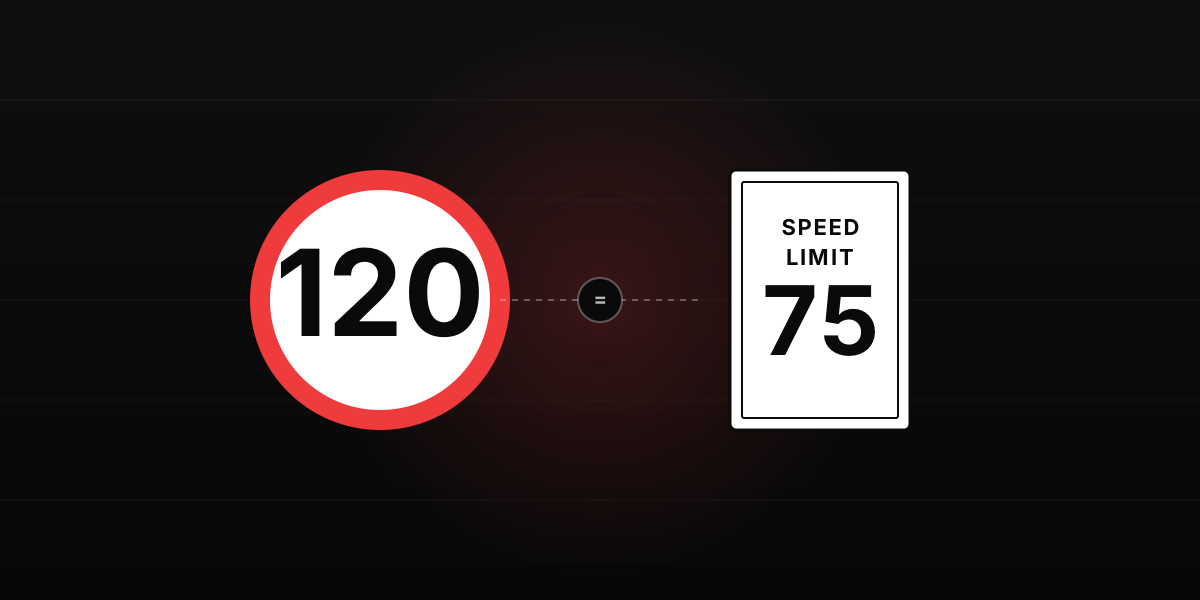
Manitoba allows up to 110 km/h on the twinned Trans-Canada Highway between Winnipeg and the Saskatchewan border, the fastest roads in the province. Most other divided highways run at 100 km/h, rural roads default to 90 km/h where no sign is posted, and city streets drop to 50 km/h. Winnipeg backs those limits with the most active photo-enforcement program on the Prairies.
Manitoba speed limits at a glance
| Road type | Limit |
|---|---|
| Cities and towns (default) | 50 kph (31 mph) |
| School / playground zones | 50 kph (31 mph) |
| Rural two-lane highways | 90 kph (56 mph) |
| Major highways / freeways | 100-110 |
About speed limits in Manitoba
Manitoba's Highway Traffic Act framework caps every road in the province at 110 km/h, a ceiling reserved for the twinned sections of the Trans-Canada Highway. The 110 km/h zone took effect on June 2, 2015 and covers most of Highway 1 from Winnipeg west to the Saskatchewan border, though slower limits remain posted around Virden, Brandon, Carberry, Portage la Prairie, Elie and Headingley because of road geometry and traffic signals. Other divided routes, including Highway 75 running south to the US border, are generally posted at 100 km/h, and undivided rural highways typically carry 90 to 100 km/h signs. Where no limit is posted at all, the default outside urban areas is 90 km/h.
Inside cities and towns the default limit is 50 km/h unless a sign says otherwise, and that number covers most residential streets in Winnipeg and Brandon. Winnipeg enforces 30 km/h reduced-speed school zones on designated streets from September 1 to June 30, Monday through Friday between 7:00 a.m. and 5:30 p.m., one of the most clearly defined school-zone schedules in Canada. Playground areas and construction zones carry their own reduced limits, and fines are doubled for speeding in construction zones when workers are present and in active school zones. Several Manitoba municipalities have debated 40 km/h residential limits in recent years, but 50 km/h remains the standard default across the province.
Winnipeg is the only jurisdiction in Manitoba authorized to run photo enforcement, and it uses the tools heavily. Mobile photo radar vehicles patrol school zones, playground zones and construction zones, while fixed intersection safety cameras at dozens of Winnipeg intersections capture both red-light running and speeding. School-zone photo radar alone has generated millions of dollars in fines in a single school year. A photo ticket is issued to the vehicle's registered owner, so it carries a fine but no demerit consequences and no effect on the owner's Driver Safety Rating, which is one reason photo tickets are so frequently contested. Outside Winnipeg, enforcement is handled entirely by RCMP and municipal officers using radar and laser.
Manitoba ties speeding directly to insurance through Manitoba Public Insurance's Driver Safety Rating scale. A standard officer-issued speeding conviction moves a driver down two levels on the scale, eroding the premium discounts that come with a clean record, while being caught 50 km/h or more over the limit drops a driver ten levels and triggers a serious driving offence review that can bring licence sanctions. Set fines under the Provincial Offences Regulation run from $119.10 for 1 to 15 km/h over the limit up to $419.10 and beyond for 46 km/h or more over, before any doubling in school or construction zones, so a heavy foot on Highway 1 gets expensive quickly.
Enforcement
RCMP patrol the provincial highway network with radar and laser, while Winnipeg pairs traditional patrols with mobile photo radar in school, playground and construction zones plus fixed intersection safety cameras that ticket speeding as well as red-light running. Photo tickets go to the registered owner and carry no demerits or Driver Safety Rating impact.
Tolerance
There is no official grace margin in Manitoba. On rural highways many drivers assume roughly 10 km/h of slack and police often focus on larger overages, but Winnipeg's photo radar is calibrated tightly, and school and construction zones are enforced with next to no tolerance.
Speeding fines in Manitoba
Set fines start at $119.10 for 1 to 15 km/h over, rise to $199.10 for 16 to 30 over and $304.10 for 31 to 45 over, and begin at $419.10 from 46 km/h over, with amounts doubled in construction and school zones. A conviction at 50 km/h or more over also drops your Driver Safety Rating ten levels and prompts a serious offence review, so the true cost can pass $1,000 once insurance effects are counted.
Frequently asked questions
What is the maximum speed limit in Manitoba?
The maximum is 110 km/h, posted on the twinned Trans-Canada Highway between Winnipeg and the Saskatchewan border since June 2015. Sections near Virden, Brandon, Carberry, Portage la Prairie, Elie and Headingley stay lower, and most other divided highways are 100 km/h.
What is the default speed limit in Manitoba?
Where no sign is posted, the limit is 50 km/h in cities and towns and 90 km/h on rural roads. Most residential streets across the province therefore run at 50 km/h unless posted otherwise.
Does Manitoba use photo radar?
Yes, but only in Winnipeg, which runs mobile photo radar in school, playground and construction zones plus fixed intersection safety cameras that catch speeding and red-light running. Photo tickets go to the vehicle owner and carry no demerits or Driver Safety Rating penalty.
What are Winnipeg's school zone rules?
Designated school zones are 30 km/h from September 1 to June 30, Monday to Friday between 7:00 a.m. and 5:30 p.m. Speeding fines are doubled in these zones, and photo radar patrols them regularly.
Speed limits in nearby provinces
- Saskatchewan speed limit — highway, rural, and city limits.
- Ontario speed limit — highway, rural, and city limits.
- Nunavut speed limit — highway, rural, and city limits.
Related tools
- Convert KPH to MPH — convert any speed reading between units.
- Car speed test — verify your speedometer accuracy.
- Live GPS speedometer — see your actual speed in the browser.
- Stopping distance calculator — how far you need to brake from each speed.
- Canada speed limits overview — national background and how provinces differ.