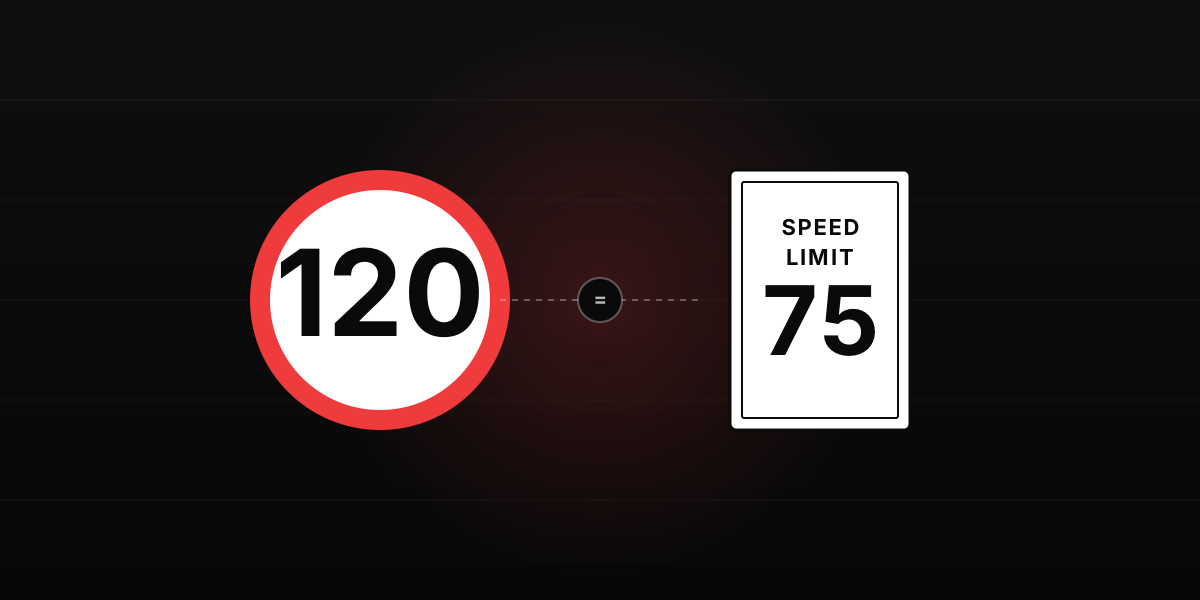
Alberta posts 110 km/h on rural divided highways such as the QEII between Calgary and Edmonton, 100 km/h on two-lane provincial highways, and 80 km/h on unposted rural roads. Cities default to 50 km/h, though Edmonton and Calgary have cut residential streets to 40 km/h. Since April 2025 the province has banned photo radar almost everywhere except school, playground and construction zones.
Alberta speed limits at a glance
| Road type | Limit |
|---|---|
| Cities and towns (default) | 50 kph (31 mph) |
| School / playground zones | 40 kph (25 mph) |
| Rural two-lane highways | 80 kph (50 mph) |
| Major highways / freeways | 110 kph (68 mph) |
About speed limits in Alberta
Alberta's Traffic Safety Act sets a layered structure: 110 km/h is the standard maximum on rural divided highways, including the QEII (Highway 2), Highway 1 and much of Highway 16, while undivided provincial highways default to 100 km/h and unposted rural roads, including gravel roads, to 80 km/h. Inside urban areas the default is 50 km/h unless posted otherwise. In 2026 the government publicly floated testing 120 km/h on select rural divided highways and surveyed Albertans on the idea, which would match British Columbia's Coquihalla as the highest in Canada, but as of mid-2026 no increase has been enacted and 110 km/h remains the ceiling.
Alberta was long considered the photo radar capital of Canada, with roughly 2,200 enforcement sites at the peak, more than any other province. That ended with an overhaul effective April 1, 2025: photo radar is now prohibited on all numbered provincial highways and connectors, speed-on-green intersection cameras are banned so intersection cameras only ticket red-light runners, and automated enforcement is restricted to school, playground and construction zones. The change eliminated about 70 percent of sites. Municipalities can apply to keep cameras at proven high-collision locations, with each exception audited every two years, and police forces have reported steep drops in ticket volumes since the ban took effect.
Edmonton lowered its default residential limit to 40 km/h in August 2021, and Calgary made the same move a few months earlier, so 40 km/h is now the practical residential standard in both major cities even though the provincial urban default remains 50 km/h. School and playground zones are 30 km/h, and both cities run merged playground zones that apply every day from 7:30 a.m. to 9 p.m. rather than only on school days. Banff and Canmore have gone further with 30 or 40 km/h town-wide limits, while many smaller municipalities keep the plain 50 km/h default on residential streets.
Fines rose sharply on March 13, 2026, when Alberta updated its specified penalty schedule: even 1 km/h over now carries a fine of about $88, climbing to roughly $467 at 40 km/h over and about $620 at 50 km/h over, with higher tiers for serious offences approaching $1,000. Anything more than 50 km/h over the limit requires a mandatory court appearance, where judges can impose discretionary fines and licence suspensions. Demerit points run from 2 points for up to 15 over, 3 points for 16 to 30 over, 4 points for 31 to 50 over, and 6 points beyond that, and fines double in construction zones when workers are present.
Enforcement
Alberta Sheriffs and RCMP patrol provincial highways with radar, laser and aircraft-assisted enforcement, while city police cover urban streets. Since April 1, 2025, photo radar is banned on numbered highways and limited to school, playground and construction zones, and intersection cameras only capture red-light running, so most tickets are again issued in person during traffic stops.
Tolerance
There is no official margin, but enforcement on rural highways traditionally starts around 10 km/h over, and traffic on the QEII commonly flows near 120. School and playground zones are enforced tightly, and the remaining photo radar in those zones tickets at small overages. Anything past 50 km/h over means a mandatory court summons.
Speeding fines in Alberta
Under the schedule in force since March 13, 2026, fines start at about $88 and reach roughly $467 at 40 km/h over and $620 at 50 km/h over, with construction zone fines doubled when workers are present. More than 50 over triggers a mandatory court appearance with fines at the court's discretion. Accumulating 15 demerit points within two years suspends a full licence.
Frequently asked questions
What is the maximum speed limit in Alberta?
110 km/h on rural divided highways such as the QEII between Calgary and Edmonton. Two-lane provincial highways default to 100 km/h and unposted rural roads to 80 km/h. A 120 km/h trial was floated by the government in 2026 but has not been enacted.
Is photo radar still legal in Alberta?
Only in limited zones. Since April 1, 2025 photo radar is banned on all numbered provincial highways, speed-on-green cameras are gone, and automated enforcement is restricted to school, playground and construction zones, cutting about 70 percent of the former 2,200 sites. Municipalities can apply for audited exceptions at high-collision spots.
What is the residential speed limit in Alberta?
The provincial urban default is 50 km/h, but Edmonton and Calgary both lowered residential streets to 40 km/h in 2021. School and playground zones are 30 km/h, and in the two big cities playground zones apply daily from 7:30 a.m. to 9 p.m.
How much is a speeding ticket in Alberta?
Under the fine schedule effective March 13, 2026, tickets start around $88 and rise to roughly $467 at 40 km/h over and $620 at 50 km/h over, doubled in construction zones with workers present. More than 50 km/h over requires a court appearance, and demerit points range from 2 to 6 depending on speed.
Speed limits in nearby provinces
- British Columbia speed limit — highway, rural, and city limits.
- Saskatchewan speed limit — highway, rural, and city limits.
- Northwest Territories speed limit — highway, rural, and city limits.
Related tools
- Convert KPH to MPH — convert any speed reading between units.
- Car speed test — verify your speedometer accuracy.
- Live GPS speedometer — see your actual speed in the browser.
- Stopping distance calculator — how far you need to brake from each speed.
- Canada speed limits overview — national background and how provinces differ.