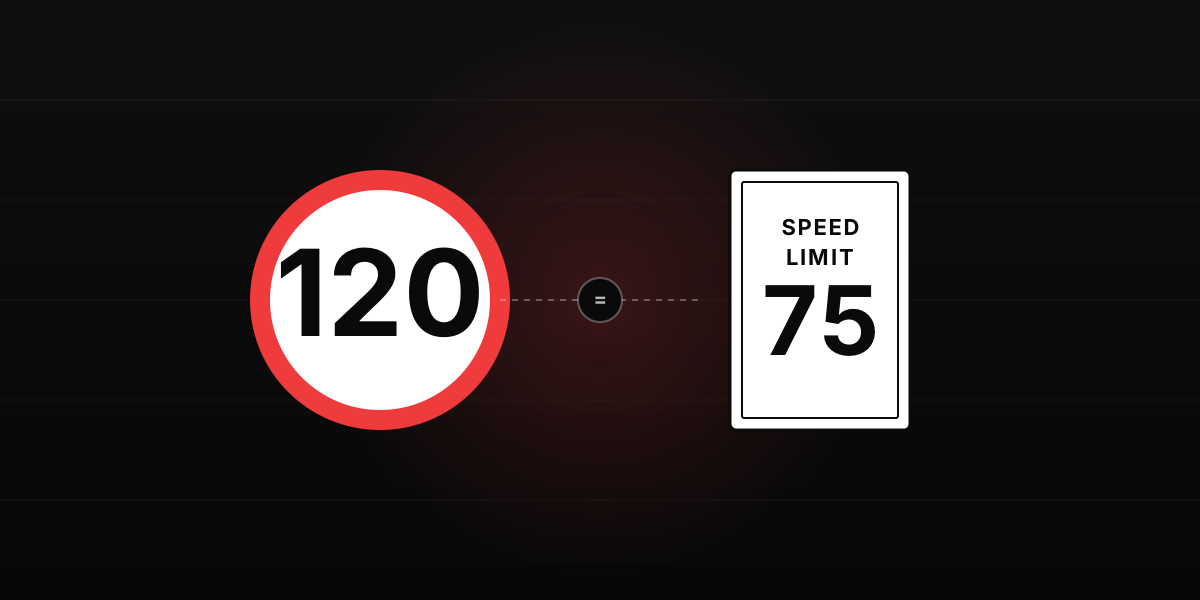
Saskatchewan posts 110 km/h on its divided highways, including the Trans-Canada (Highway 1) and the Yellowhead (Highway 16), with 100 km/h standard on most other paved routes. Where no sign is posted the default is 80 km/h, and cities run at 50 km/h with 30 km/h school and playground zones. The province also operates one of Canada's longest-standing photo speed enforcement programs.
Saskatchewan speed limits at a glance
| Road type | Limit |
|---|---|
| Cities and towns (default) | 50 kph (31 mph) |
| School / playground zones | 50 kph (31 mph) |
| Rural two-lane highways | 80 kph (50 mph) |
| Major highways / freeways | 110 kph (68 mph) |
About speed limits in Saskatchewan
Saskatchewan's fastest roads are its divided highways, posted at 110 km/h. That covers the Trans-Canada Highway 1 across the south, Highway 11 between Regina and Saskatoon, and the twinned stretches of the Yellowhead Highway 16 toward Alberta. Most other paved provincial highways carry 100 km/h signs, while thin-membrane surface and gravel grid roads are typically 80 km/h. Under The Traffic Safety Act the default where no sign is posted is 80 km/h, a number worth remembering on the vast rural grid network, where many municipal roads carry no signage at all. Distances between communities are long and traffic is light, which is exactly why police concentrate patrols on the small number of high-volume corridors.
Cities and towns post their limits at the community entrance, and 50 km/h is the standard urban and residential default inside those boundaries. School and playground zones are set by municipal bylaw at 30 km/h in most communities. Saskatoon keeps its 30 km/h school and playground zones in effect year-round rather than only during the school term, and Regina enforces 30 km/h school zones every day of the week, so drivers cannot assume summer holidays or weekends suspend the limit. Fines in these zones are calculated with a higher base amount and a steeper per-kilometre charge than ordinary speeding, making a school-zone ticket one of the costlier routine violations in the province.
Saskatchewan runs a provincial Photo Speed Enforcement Program that began as a pilot and was made permanent after tickets started flowing in 2015. Cameras operate in school zones in Saskatoon, Regina and Moose Jaw, at designated high-speed locations such as the Regina Ring Road, Circle Drive in Saskatoon and Highway 1 through Moose Jaw, and in highway work zones. Violations are mailed to the vehicle's registered owner, carry no Safe Driver Recognition penalty, and photo fines start around $110 plus $1 for every km/h over at high-speed locations and $190 plus $2 per km/h over in school zones. Camera revenue above costs is directed to traffic-safety initiatives.
Penalties for serious speeding tightened in May 2024. Drivers caught at more than 50 km/h over the limit, or at double the limit, now face an immediate 7-day licence suspension plus a 30-day vehicle impoundment, stretching to 60 days for a second occurrence within two years, with towing and storage billed to the registered owner. Stunting and street-racing fines start at $580 and climb to $1,400 and $2,100 for repeat offences within a year. Separately, drivers must slow to 60 km/h when passing stopped emergency vehicles, tow trucks or highway equipment with workers present, and work-zone speeding fines start around $240 with per-kilometre charges of $6 to $12 that produce totals over $700.
Enforcement
RCMP and combined traffic services patrol the highway network while municipal police cover the cities, supplemented by the permanent Photo Speed Enforcement Program in school zones in Saskatoon, Regina and Moose Jaw, at high-speed locations like the Regina Ring Road and Circle Drive, and in work zones. Photo tickets are mailed to the registered owner and carry no Safe Driver Recognition points.
Tolerance
Prairie driving culture assumes a modest cushion and police on open 110 km/h highways often focus on drivers well past the limit, but the photo cameras are set tighter than most drivers expect. In school zones, work zones and when passing emergency vehicles the practical tolerance is effectively zero.
Speeding fines in Saskatchewan
Photo enforcement fines start around $110 plus $1 per km/h over at high-speed locations and $190 plus $2 per km/h over in school zones, while officer-issued tickets scale similarly with speed and add Safe Driver Recognition penalties. Work-zone fines start near $240 with $6 to $12 added per km/h over, commonly topping $700, and exceeding the limit by more than 50 km/h brings a 7-day licence suspension and 30-day vehicle impoundment on top of the fine.
Frequently asked questions
What is the maximum speed limit in Saskatchewan?
The maximum is 110 km/h on divided highways such as the Trans-Canada Highway 1, Highway 11 between Regina and Saskatoon, and twinned parts of the Yellowhead Highway 16. Most other paved provincial highways are 100 km/h.
What is the speed limit when no sign is posted in Saskatchewan?
The default is 80 km/h where no sign is posted, which applies to much of the rural grid network. Inside cities and towns the posted community limit, normally 50 km/h, applies everywhere unless a zone is signed differently.
Does Saskatchewan use photo radar?
Yes. The permanent Photo Speed Enforcement Program covers school zones in Saskatoon, Regina and Moose Jaw, high-speed locations including the Regina Ring Road and Circle Drive, and highway work zones. Tickets go to the registered owner and carry no Safe Driver Recognition penalty.
What happens if you are caught 50 km/h over the limit in Saskatchewan?
Since May 2024, driving more than 50 km/h over the limit or at double the limit brings an immediate 7-day licence suspension and a 30-day vehicle impoundment, with the owner paying towing and storage. A second occurrence within two years extends the impoundment to 60 days.
Speed limits in nearby provinces
- Alberta speed limit — highway, rural, and city limits.
- Manitoba speed limit — highway, rural, and city limits.
- Northwest Territories speed limit — highway, rural, and city limits.
Related tools
- Convert KPH to MPH — convert any speed reading between units.
- Car speed test — verify your speedometer accuracy.
- Live GPS speedometer — see your actual speed in the browser.
- Stopping distance calculator — how far you need to brake from each speed.
- Canada speed limits overview — national background and how provinces differ.