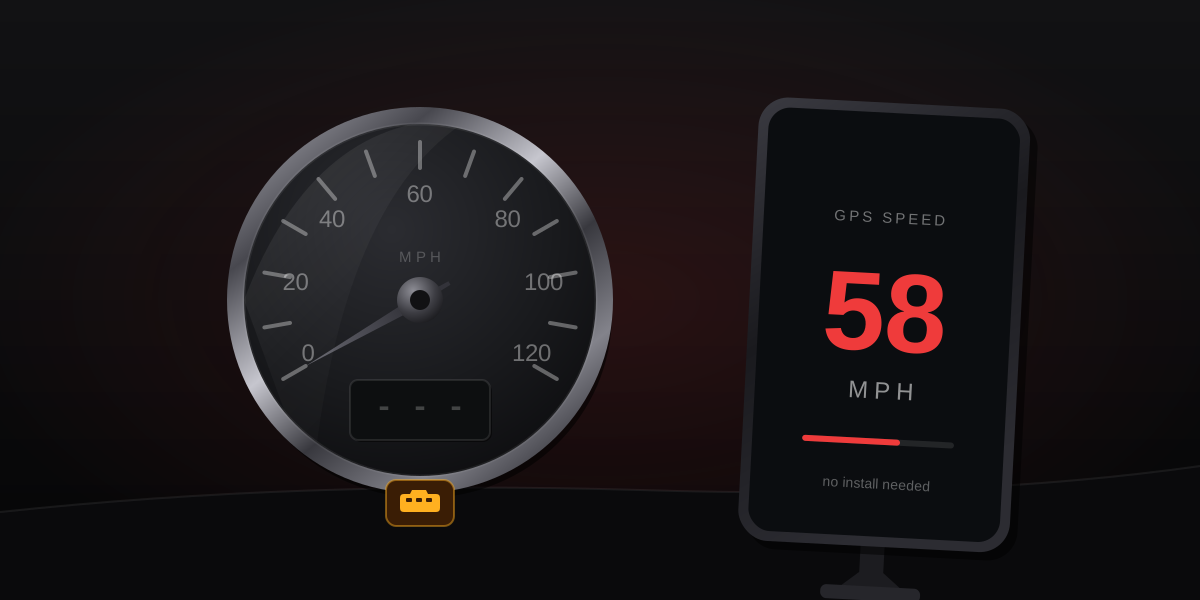
A speedometer that has gone dead is almost never a broken speedometer. On any car built in the last few decades the needle is only a display; the number comes from a sensor somewhere else, travels through wiring and a module, and any break along that path drops the needle to zero. That is good news, because the cheap possibilities sit at the start of the chain. Here is how to narrow it down before you pay anyone, and how to keep driving safely in the meantime.
Start here: three questions that narrow it down fast
Before opening anything, answer these. They separate a signal problem from a display problem, which is most of the diagnosis.
- Does the odometer still count miles? If it does, the speed signal is reaching the cluster and the fault is likely inside the cluster or its gauge motor. If the odometer is frozen too, the signal itself is missing.
- Did a warning light come on? A check engine, ABS or traction control light appearing at the same moment is a strong hint, because those systems share the same wheel speed data.
- Did anything else stop working? Cruise control refusing to engage, or an automatic gearbox shifting harshly or late, points firmly at the speed signal rather than the gauge.
The usual causes, cheapest first
1. A blown fuse
The least likely to be the answer and the cheapest to check, which is exactly why it goes first. Find the fuse for the instrument cluster in your owner's manual, pull it, and look at the metal strip inside. If other cluster functions died at the same time, a fuse becomes considerably more plausible than if the speedometer alone is out.
2. The vehicle speed sensor
This is the most common culprit on cars that use one. The VSS sits on the transmission or transaxle and counts the rotation of the output shaft. It lives in a hot, dirty place and eventually fails, or its tip collects enough metal debris to blur the signal. Part cost is usually modest; the labour depends entirely on whether the sensor is reachable from above or requires getting the car in the air.
3. Wheel speed sensors and the ABS module
Many newer cars have no dedicated VSS at all. They take wheel speed from the ABS sensors and pass it around the network, which is why a single failing wheel sensor can knock out the speedometer, the ABS light and traction control together. A scan tool that reads ABS codes, not just engine codes, is what identifies which corner is at fault.
4. Wiring and connectors
Unglamorous and genuinely common. Sensor wiring runs near heat and suspension movement, so chafed insulation, a connector full of corrosion or a pin backed out of its housing all produce the same symptom as a failed sensor at a fraction of the price. Worth inspecting before replacing parts, especially on an older car or one that has recently had work done in the area.
5. The instrument cluster
If the odometer keeps counting while the needle stays at zero, the data is arriving and the cluster is not acting on it. The usual failure is the small stepper motor that drives the needle. This is the expensive end of the list, and on many cars the cluster is coded to the vehicle, so a replacement needs programming rather than a straight swap.
6. A mechanical cable, on older cars
Cars from before the widespread switch to electronic sensors drive the needle with a spinning cable from the gearbox. When it dries out or frays, the classic symptom is a needle that jumps and wavers with a whirring noise behind the dashboard; when it snaps, the needle simply drops. Cable replacement is mechanical work with no electronics involved.
What the OBD-II codes tell you
A basic code reader is worth borrowing before any parts are bought. The relevant family is short:
| Code | Meaning |
|---|---|
| P0500 | Vehicle speed sensor A malfunction |
| P0501 | Signal present but out of range or implausible |
| P0502 | Input too low |
| P0503 | Intermittent, erratic or high |
One caveat that saves wasted time: no code does not mean no fault. A signal that has disappeared completely sometimes logs nothing, and cluster faults usually log nothing at all, because from the engine computer's point of view everything is fine.
Can you drive with it?
Rarely a good idea, and often not permitted. Requirements for passenger cars are set locally rather than nationally in most countries, and a dead speedometer can fail a roadworthiness inspection; in the United States, commercial vehicles are explicitly required to have a working speedometer under FMCSA 393.82. We covered the surprisingly thin rulebook around dashboard instruments in is my odometer accurate.
The safety argument is stronger than the legal one. The signal that died usually feeds cruise control, ABS, traction control and the transmission's shift logic, so the gauge is often the visible part of a wider fault. Book the repair rather than living with it.
The stopgap: use GPS until it is fixed
Until the repair happens you still need to know your speed, and this is one of the few situations where a phone genuinely replaces the dashboard. Phone GPS calculates speed from the Doppler shift of satellite signals, not from your wheels, so it is completely unaffected by the sensor that just failed. Outdoors it typically lands within 0.5 to 2 mph of true ground speed — closer to reality, in fact, than the dial you have lost, since dashboards are calibrated to read 1 to 3 percent high on purpose.
Open the live GPS speedometer in any browser and it works immediately with nothing to install. Three practical notes: mount the phone where you can glance at it rather than holding it, expect the reading to trail by about a second under hard acceleration or braking, and remember it goes blank in tunnels and multi-storey car parks where there is no sky.
Once the car is repaired, it is worth confirming the new sensor reads correctly rather than assuming it. Run the car speed test and put the two numbers into the speedometer error calculator. A healthy result is a dash reading a couple of percent above GPS; anything wilder suggests the wrong part or the wrong calibration.
The takeaway
Work the chain from cheap to expensive: fuse, then sensor, then wiring, then cluster. Let the odometer tell you which half of the chain to suspect — still counting means the signal is fine and the cluster is not, frozen means the signal never arrived. Pull the codes before buying parts, and do not ignore it, because the gauge is usually the most visible symptom rather than the whole problem. In the meantime your phone gives you an honest speed for free.
One more symptom worth connecting: because cruise control holds a speed by reading the same signal, it usually stops working at the same moment. If that is what you are chasing, cruise control not working runs the same chain from the brake switch onward.