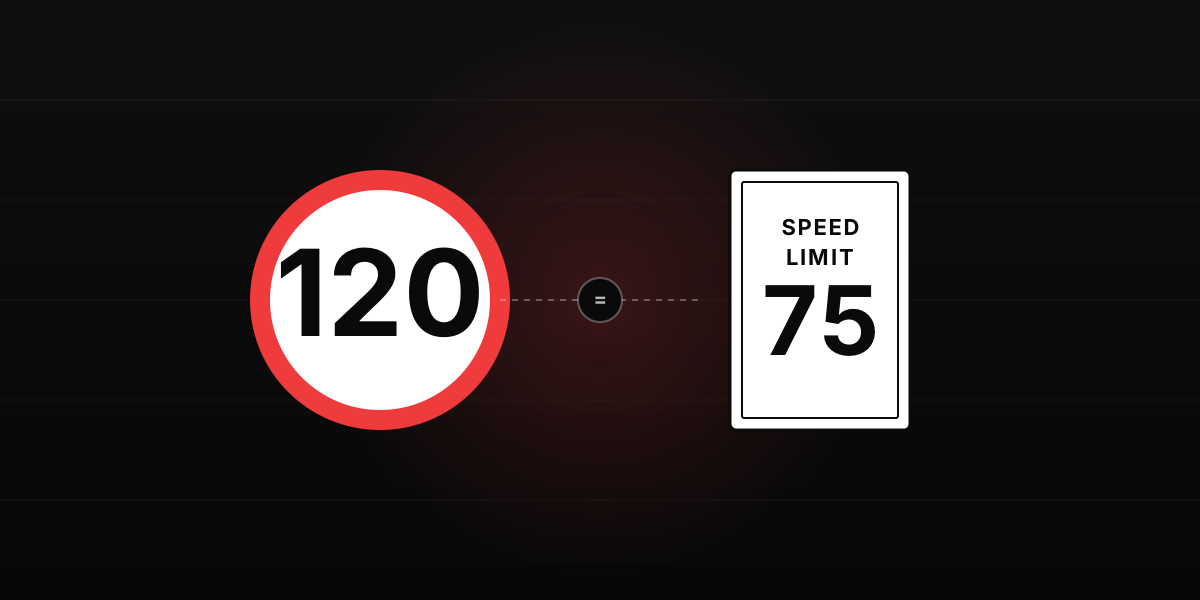
Kansas posts 75 mph on rural interstates and other separated multilane highways, 70 mph on divided highways, and 65 mph on two-lane state highways.
Kansas speed limits at a glance
| Road type | Limit |
|---|---|
| Cities, towns, business districts | 30 mph (48 kph) |
| Residential / school zones | 30 mph (48 kph) |
| Rural highways | 65 mph (105 kph) |
| Interstates / freeways | 75 mph (121 kph) |
About speed limits in Kansas
Kansas allows 75 mph on rural separated multilane highways, which covers most of I-70, I-35 and the Kansas Turnpike outside the cities, plus freeway-grade sections of routes like K-10 and US 81. Urban interstate segments around Wichita, Topeka and the Kansas City metro drop to 65-70 mph. Divided highways that are not fully separated carry 70 mph, and ordinary two-lane state highways default to 65 mph — one of the higher two-lane limits in the country. County and township roads default to 55 mph, and the statutory minimum on 75 mph freeways is 40 mph.
The Kansas Turnpike, the 236-mile tolled backbone from the Oklahoma line through Wichita to Kansas City, runs at 75 mph for most of its length and is patrolled by a dedicated Kansas Highway Patrol troop. Kansas also has a driver-friendly quirk: convictions for speeding 10 mph or less over the limit on highways posted 55 or above are generally kept off the record reported to insurers, softening the consequence of minor tickets.
The default limit in any urban district is 30 mph, higher than the 25 mph typical of neighboring states, though cities post many residential streets at 20-25 mph and school zones at 20 mph. Wichita, Overland Park and Topeka all sign arterials between 35 and 45 mph.
Kansas does not operate speed cameras — there is no statutory authorization for automated speed enforcement, and enforcement remains entirely officer-based. The Kansas Highway Patrol runs regular saturation patrols on I-70 and I-35 and doubles down on work-zone enforcement each construction season, where fines carry a $50 surcharge.
Enforcement
The Kansas Highway Patrol covers the interstates and turnpike with radar, lidar and aircraft-assisted patrols, and I-70 is a well-known enforcement corridor for through traffic. There is no automated camera enforcement in Kansas.
Tolerance
Troopers commonly allow a few mph of drift on 75 mph rural interstates, but there is no legal cushion. The practical softener is that convictions for 10 mph or less over the limit on high-speed highways are generally not reported to insurance companies.
Speeding fines in Kansas
Kansas fines scale with speed: roughly $105 total for 10 mph over and about $165 for 20 mph over including court costs, while speeds more than 25 mph over are fined at $10 per mph over the limit. Construction and school zone violations add a $50 surcharge, and extreme speeds can be charged as reckless driving.
Frequently asked questions
What is the maximum speed limit in Kansas?
75 mph on rural separated multilane highways, including most of I-70, I-35 and the Kansas Turnpike outside urban areas. Urban interstate sections drop to 65-70 mph, and two-lane state highways default to 65 mph.
Do small speeding tickets affect insurance in Kansas?
Kansas law generally keeps convictions for speeding 10 mph or less over the limit on highways posted 55 mph or above off the record sent to insurers. The fine still applies, but the minor violation typically will not raise premiums.
What is the city speed limit in Kansas?
The statutory default in any urban district is 30 mph, though cities post many residential streets at 20-25 mph and school zones at 20 mph. Major city arterials are commonly signed between 35 and 45 mph.
Does Kansas use speed cameras?
No. Kansas has no statutory authorization for automated speed enforcement, so there are no speed cameras. All speeding citations come from Kansas Highway Patrol or local police patrols.
Speed limits in nearby states
- Missouri speed limit — interstate, rural highway, and city limits.
- Colorado speed limit — interstate, rural highway, and city limits.
- Oklahoma speed limit — interstate, rural highway, and city limits.
- Nebraska speed limit — interstate, rural highway, and city limits.
Related tools
- Convert MPH to KPH — convert any speed reading between units.
- Car speed test — verify your speedometer accuracy.
- Live GPS speedometer — see your actual speed in the browser.
- Stopping distance calculator — how far you need to brake from each speed.
- US speed limits overview — federal background and national patterns.