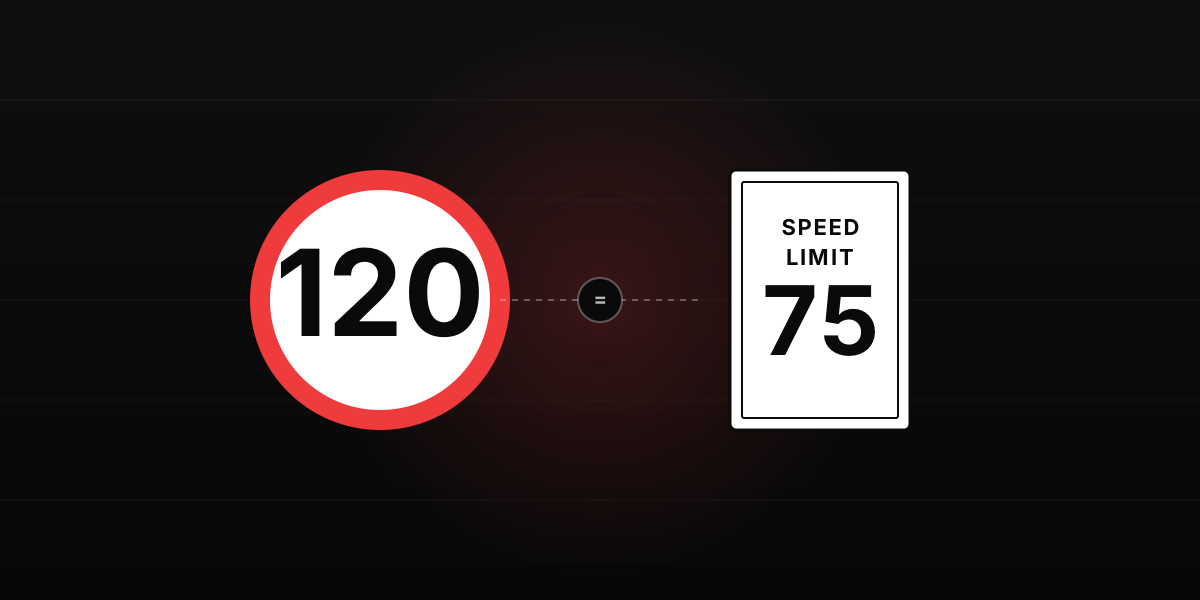
North Carolina posts a maximum of 70 mph on interstates and some four-lane divided highways. By statute the default limit is 55 mph outside municipal limits and 35 mph inside them unless signs say otherwise. The state is strict: exceeding the limit by more than 15 mph, or driving faster than 80 mph, can trigger a criminal reckless-driving-style charge.
North Carolina speed limits at a glance
| Road type | Limit |
|---|---|
| Cities, towns, business districts | 35 mph (56 kph) |
| Residential / school zones | 35 mph (56 kph) |
| Rural highways | 55 mph (89 kph) |
| Interstates / freeways | 70 mph (113 kph) |
About speed limits in North Carolina
North Carolina's top posted limit is 70 mph, applied to most rural interstates and select four-lane divided highways where NCDOT engineering studies support it. The statutory framework in G.S. 20-141 sets a default of 55 mph outside municipal corporate limits and 35 mph inside them, and these apply wherever no other limit is posted. Local authorities can raise or lower limits on non-state streets by ordinance but generally cannot authorize speeds above 55 mph on those roads. NCDOT sets and posts higher limits on the interstate and primary highway network.
The state's most distinctive rule ties speed directly to a criminal charge. Under G.S. 20-141, driving more than 15 mph over the posted limit, or exceeding 80 mph regardless of the limit, exposes a driver to a reckless or excessive-speed offense that can escalate to a Class 2 misdemeanor. A reckless-driving conviction can mean up to 30 days in jail, a fine, and license consequences, which is far more serious than an ordinary infraction. Legislators have also debated super-speeder measures for extreme cases.
Inside city limits the default speed is 35 mph unless posted otherwise, and residential streets commonly carry 25 to 35 mph limits set by local ordinance. School zones drop to reduced limits during posted hours when lights are flashing or children are present. North Carolina is an absolute-limit state, so there is no legal cushion above the posted number even if enforcement often allows a small margin.
North Carolina long barred automated speed enforcement, but Senate Bill 391, effective October 1, 2025, authorized speed safety cameras in school zones. Violations are civil, carry no license or insurance points, and are handled by mailed notice with a typical penalty around $250. Participation by local communities is voluntary, warning signs are required near the cameras, and the state constitution directs most fine revenue to local schools.
Enforcement
The State Highway Patrol enforces interstates and rural highways with radar, laser and aircraft-based timing on some corridors, and local police cover city streets. Automated cameras are limited to voluntary school-zone programs authorized in 2025 rather than general highway use.
Tolerance
As an absolute-limit state, North Carolina offers no legal grace, though officers often overlook speeds within a few mph of the limit. Crossing the 15-mph-over or 80 mph line changes the calculus sharply because it can trigger a criminal charge.
Speeding fines in North Carolina
A routine speeding ticket usually costs somewhere around $30 to $250 in fine and court costs combined, varying by county and speed. Speeding more than 15 mph over the limit or over 80 mph can be charged as reckless driving, a Class 2 misdemeanor with fines up to about $1,000 and possible jail. School-zone camera violations are civil penalties of roughly $250 with no points.
Frequently asked questions
What is the maximum speed limit in North Carolina?
The maximum posted limit is 70 mph on most interstates and some four-lane divided highways. By default the limit is 55 mph outside municipal limits and 35 mph inside city limits where nothing else is posted.
When does speeding become reckless driving in North Carolina?
Driving more than 15 mph over the posted limit, or faster than 80 mph regardless of the limit, can be charged as a criminal reckless or excessive-speed offense. This can be a Class 2 misdemeanor carrying fines, points and possible jail time.
What is the residential speed limit in North Carolina?
The default inside municipal limits is 35 mph unless posted otherwise, and many residential streets are set at 25 to 35 mph by local ordinance. School zones use lower limits during posted hours.
Does North Carolina use speed cameras?
North Carolina authorized speed safety cameras in school zones effective October 2025 under Senate Bill 391. These are voluntary, civil-penalty programs with no license points, and cameras are not used for general highway speed enforcement.
Speed limits in nearby states
- Virginia speed limit — interstate, rural highway, and city limits.
- South Carolina speed limit — interstate, rural highway, and city limits.
- Georgia speed limit — interstate, rural highway, and city limits.
- Tennessee speed limit — interstate, rural highway, and city limits.
Related tools
- Convert MPH to KPH — convert any speed reading between units.
- Car speed test — verify your speedometer accuracy.
- Live GPS speedometer — see your actual speed in the browser.
- Stopping distance calculator — how far you need to brake from each speed.
- US speed limits overview — federal background and national patterns.