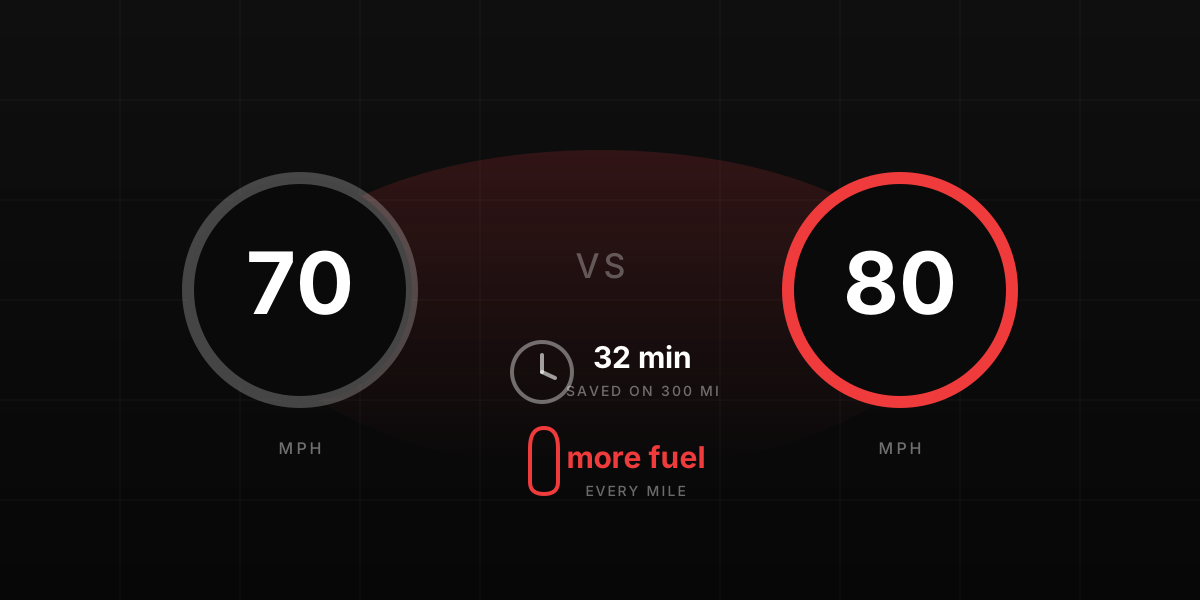
On a 300-mile drive, going 80 instead of 70 saves you about 32 minutes and costs about $7.25 more in fuel. That means you are buying your own time back at roughly $13.54 an hour. The surprising part is that this hourly rate is exactly the same on a 30-mile trip as on a 500-mile one, because both the minutes and the gallons scale with distance. What changes is whether the time you gain is enough to be worth anything.
The short answer
The trade is real but modest. You are not saving hours, and you are not burning a tank of fuel. For a typical midsize gasoline car at today's pump prices, the extra ten miles per hour costs you about 2.4 cents per mile and gives back about 0.107 minutes per mile. Divide one by the other and you get a fixed price per hour of time recovered.
Whether $13.54 an hour is a good deal is a personal question, not a technical one. Compare it to what an hour of your time is actually worth to you. For most people that number is higher than $13.54 on a long drive where 54 minutes changes when you arrive, and effectively meaningless on a short drive where the three minutes you save vanish at the first red light.
The assumptions behind every number here
Every figure below is reproducible from these five inputs. If you disagree with any of them, the arithmetic is simple enough to redo with your own values.
- Vehicle: a midsize conventional gasoline car, the most common case on a US interstate.
- Fuel economy at 70 mph: 35 mpg. Oak Ridge National Laboratory reports 38 mpg at 65 mph and 32 mpg at 75 mph for this vehicle class, so 70 mph is the midpoint.
- Fuel economy at 80 mph: 29 mpg. This extends the 65-to-75 mph slope of 0.6 mpg per mph out another 5 mph. The real curve steepens above 75 mph, so 29 mpg is slightly generous and the true cost of 80 mph is a little higher than shown.
- Fuel price: $4.09 per gallon, the AAA national average for regular unleaded on 4 August 2026. This moves constantly, so scale the dollar columns proportionally if your local price differs.
- Speeds are true ground speeds, not dashboard readings. Your speedometer reads high by design, so an indicated 80 is usually a true 76 to 78. That distinction matters more than people expect, and it is why the honest measurement comes from a GPS speedometer rather than the dial.
How much time you actually save
The time saved on a distance D is
D/70 - D/80 hours. That simplifies to
D/560 hours, or about 1.07 minutes for every 10 miles.
At 300 miles: 4 hours 17 minutes at 70 mph, 3 hours 45 minutes at
80 mph, a saving of 32 minutes. You can check any distance yourself
with the speed, distance and time
calculator, or read the worked example on
how long it takes to drive
100 miles.
The full comparison
Extra fuel is D/29 - D/35 gallons, which works out to
0.00591 gallons per mile. Multiply by $4.09 for the dollar column.
The last column divides the extra cost by the hours saved.
| Trip | At 70 mph | At 80 mph | Time saved | Extra fuel | Extra cost | Paid per hour saved |
|---|---|---|---|---|---|---|
| 30 mi | 25 min 43 s | 22 min 30 s | 3 min 13 s | 0.18 gal | $0.73 | $13.54 |
| 100 mi | 1 h 25 min 43 s | 1 h 15 min | 10 min 43 s | 0.59 gal | $2.42 | $13.54 |
| 300 mi | 4 h 17 min 9 s | 3 h 45 min | 32 min 9 s | 1.77 gal | $7.25 | $13.54 |
| 500 mi | 7 h 8 min 34 s | 6 h 15 min | 53 min 34 s | 2.96 gal | $12.09 | $13.54 |
What it costs in fuel
The 300-mile row is worth spelling out in full, because it is the one people picture when they imagine a long drive. At 35 mpg you burn 8.57 gallons, which is $35.06 of fuel. At 29 mpg you burn 10.34 gallons, which is $42.31. The difference is 1.77 gallons and $7.25. In percentage terms you are spending about 21 percent more on fuel to cut 12.5 percent off the driving time.
That asymmetry is the whole story. Fuel consumption rises faster than travel time falls, because aerodynamic drag grows with the square of speed while journey time only falls in inverse proportion to it. Push further and the asymmetry worsens sharply: the same 10 mph jump from 80 to 90 costs proportionally more than the jump from 70 to 80. If you want to run the numbers for your own car and your own local fuel price, the MPG calculator will convert your tank fills into a real observed figure rather than a modelled one.
The implied hourly rate, and why it never changes
The identical $13.54 in every row is not a rounding coincidence. The
time saved is D/560 hours and the extra cost is
D × 0.00591 × 4.09 dollars. Divide the second by the
first and every D cancels, leaving a constant. Trip
length does not affect the exchange rate at all, only the volume of
the transaction.
The practical consequence is that short trips are the worst deal, not because the rate is worse but because three minutes is not a usable quantity of time. You cannot do anything with it. On a 500-mile drive, 54 minutes is genuinely a different arrival window, an extra rest stop, or the difference between beating and missing a check-in deadline. The rate is the same; the utility of what you buy is not.
It is also worth noting that the rate is very sensitive to fuel price and not at all sensitive to how far you go. If pump prices rise to $5.00 a gallon, the same trade costs about $16.55 an hour. If you drive a hybrid, the picture improves noticeably, which the next section explains.
Why the real saving is smaller than the table
Treat the table as an upper bound, not a forecast. It assumes you hold a perfectly constant true speed from the first mile to the last, which essentially never happens on a real journey. In practice:
- Traffic caps you regardless of intent. If the flow is running at 72, you cannot hold 80 whatever your preference. Congested stretches erase the difference entirely.
- The start and end of every trip are slow. Reaching the highway and leaving it happen at surface-street speeds, and those miles are identical in both scenarios.
- Stops do not scale with speed. A 20-minute fuel and coffee stop costs the same in both cases, but it consumes a large fraction of the 32 minutes you supposedly gained.
- Roadworks, gradients and weather impose their own ceilings, and steep climbs hurt the 80 mph case more because you are already further up the drag curve.
The honest way to see this is to measure. Log a completed drive and compare your actual door-to-door average against the speed you believed you were holding. Most people find a gap of 8 to 15 mph. The average speed calculator does that arithmetic from your total distance and total elapsed time, including the stops. Once you have that number, rerun the table with your real averages rather than the posted ones, and the saving usually shrinks to a third or half of the headline figure.
The fuel economy versus speed curve, and the 55 mph myth
The usual advice is that 55 mph is the efficiency sweet spot. That is true for one specific vehicle type and wrong for two others. Here is the Oak Ridge National Laboratory data, from the Transportation Energy Data Book, for three midsize cars:
| Vehicle | 45 mph | 55 mph | 65 mph | 75 mph |
|---|---|---|---|---|
| Gasoline | 43 mpg | 45 mpg | 38 mpg | 32 mpg |
| Diesel | 57 mpg | 55 mpg | 45 mpg | 37 mpg |
| Hybrid | 55 mpg | 46 mpg | 38 mpg | 33 mpg |
The gasoline car peaks at 55 mph, which is where the popular advice comes from. But the diesel is already past its best by 55, and the hybrid is dramatically better at 45 mph than at 55, losing nine miles per gallon over that ten mph. Both of those vehicle types peak nearer 45 mph. So the blanket claim that 55 is the universal sweet spot is simply wrong for a large and growing share of the fleet, and it understates how much hybrids in particular lose to highway speed.
The reason is structural. Below about 45 mph a hybrid can lean on its electric drive and regenerative braking, and a diesel sits in its most efficient load band. Above that, aerodynamic drag dominates for every powertrain, and the advantage each technology holds at low speed simply disappears. A gasoline engine, by contrast, is inefficient at low load, so it keeps improving until around 55 before drag takes over.
For the 70 versus 80 question, the hybrid case is milder: applying the same interpolation gives roughly 35.5 mpg at 70 mph and 30.5 mpg at 80 mph, an implied rate of about $10.58 per hour rather than $13.54. A diesel loses about 19.5 percent of its economy going from 70 to 80, slightly worse in percentage terms than the gasoline car's 17.1 percent, though it starts from a much higher base.
The ticket dimension
Fuel is not the only cost that changes with speed. Driving 80 in a 70 zone is ten over the limit, which is a standard moving violation in most US states. Some states set specific thresholds where the charge escalates: Virginia, for example, treats 20 mph or more over the limit, or any speed above 85 mph, as reckless driving under Code 46.2-862, which is a criminal misdemeanour rather than an infraction.
The financial point is just one of scale. A single citation and the insurance surcharge that often follows it can cost far more than the fuel difference on many trips combined. That is a factual asymmetry worth knowing about, not a moral argument, and it is entirely separate from the fuel arithmetic above. It also reinforces why true speed matters: if your dashboard reads 80 and your actual ground speed is 76, you are making a different decision than you think you are, in both directions.
The takeaway
Driving 80 instead of 70 buys back roughly 1.07 minutes per 10 miles at a cost of about 2.4 cents per mile, which is a fixed $13.54 per hour of time recovered for a midsize gasoline car at $4.09 a gallon. That rate does not change with distance, so the only real question is whether the time you gain is a usable amount. Three minutes on a short hop is not. Fifty-four minutes on a 500-mile haul might be.
Set against that, remember that the table is a ceiling. Real journeys never hold either speed cleanly, so the actual saving is typically a fraction of what the arithmetic promises, while the fuel penalty is incurred on every mile you genuinely do run at 80. And if you drive a hybrid or a diesel, the efficiency curve behind all of this peaks lower than the advice you have probably heard. The starting point for any of it is knowing your true speed rather than your indicated one, which is what the live GPS speedometer is for.
One related question this raises: holding a speed steadily is cheaper than drifting around it, which is the case for cruise control on flat highway, and the case against it on rolling hills. Does cruise control save gas works through where it helps and where it quietly costs you.