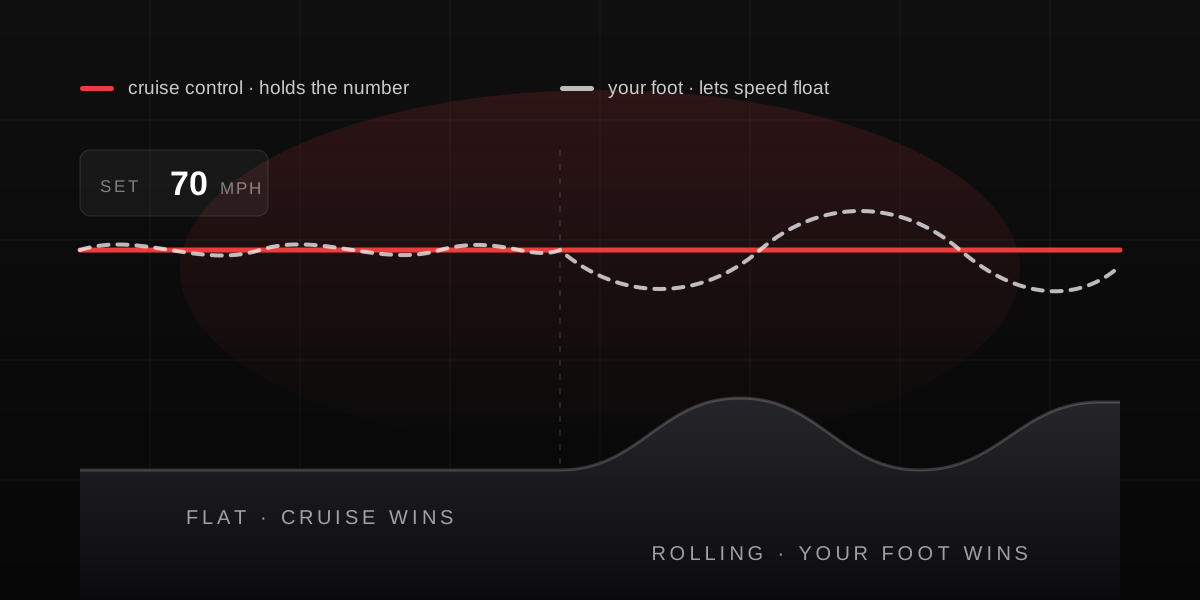
The official answer is one sentence long. The US Department of Energy's fuel economy guidance says that using cruise control on the highway helps you maintain a constant speed and, in most cases, will save gas. That is genuinely the answer for most highway driving. The interesting part is the phrase in most cases, because there is a specific, common situation where holding an exact speed is the expensive choice, and because the button matters a good deal less than the number you set it to.
What cruise control actually fixes
Nobody holds a steady speed with their foot. Left alone, an ankle drifts: you creep up a couple of miles per hour without noticing, catch it, ease off, sag below where you started, then squeeze the throttle to recover. That cycle repeats every few minutes for the whole trip, and each recovery costs more fuel than the coast saved, because accelerating a car is always a worse deal than not slowing down in the first place.
This is the small, unglamorous version of a habit the DOE puts a large number on. Its guidance is that aggressive driving (speeding, rapid acceleration and braking) lowers gas mileage by roughly 15 to 30 percent at highway speeds and 10 to 40 percent in stop-and-go traffic. Nobody thinks of gentle speed drift as aggressive driving, and it is not; it sits at the far mild end of the same spectrum. Cruise control deletes it. That is the entire saving, and it explains both why the effect is real and why it is modest.
Where the saving disappears: rolling hills
Cruise control has exactly one instruction and no view of the road ahead. Hold the number. When a climb starts, it responds the only way it can: open the throttle further, and if that is not enough, downshift and hold the engine at higher revs until the crest.
A driver paying attention does something smarter. You let the speed bleed off three or four miles per hour going up, then let gravity give it back on the way down, which costs nothing. Over a single long grade the difference is small. Over a hundred miles of rolling terrain, the kind of road where the speed never settles for more than a minute, the pattern repeats often enough that your foot wins.
The rule of thumb worth remembering: cruise control is for roads where speed wants to stay constant anyway. Flat interstate, light traffic, no wind. That is where it pays. On rolling hills, in heavy traffic, or on a winding road, it is both less efficient and less pleasant, and on ice or standing water it is genuinely a bad idea for reasons that have nothing to do with fuel.
The bigger lever is the speed you set
Here is the part that gets lost in the question. Cruise control smooths out oscillations around a speed. Choosing that speed is a much larger decision, and the DOE numbers make the gap obvious:
- Gas mileage usually decreases rapidly above 50 mph.
- Each 5 mph you drive over 50 mph is like paying an additional $0.29 per gallon.
- Observing the speed limit is worth a 7 to 14 percent fuel economy benefit.
Setting the cruise to 75 instead of 65 undoes more than the cruise control gave you. We put actual dollars on that trade in is driving 80 instead of 70 worth it, which works out the fuel cost against the time saved on a 300-mile trip. The short version is that speed is not free and is not cheap either, but it is at least priced honestly once you do the arithmetic.
Adaptive cruise control is a different question
Adaptive cruise control is not holding a speed. It is holding a gap, and only holding your set speed when the road ahead is clear. In moving traffic that means every hesitation from the car in front becomes a deceleration and then an acceleration in yours. Your fuel consumption partly inherits the driving of a stranger.
There is a practical setting that helps: choose a longer following distance. A bigger gap gives the system room to absorb small changes ahead by coasting rather than by braking and re-accelerating, which is smoother for your passengers and cheaper for you. On an open road, adaptive cruise behaves exactly like the ordinary kind and none of this applies.
The quirk nobody mentions: it holds the wrong number
Cruise control does not hold your speed. It holds the speed your dashboard displays, because it reads the same signal the speedometer does, and that number is biased high on purpose. Regulations in most markets allow a speedometer to over-read but never to under-read, so manufacturers build in a margin and typical cars show 1 to 3 percent above true speed.
So setting the cruise to an indicated 70 mph usually means travelling at something closer to 68. Two consequences follow. The pleasant one: you are already being slightly more frugal than you think, since your real speed is below the number on the dial. The less pleasant one: if you ever calibrate your driving by GPS and set the cruise so your true speed is 70, you have quietly increased your fuel consumption relative to your old habit, and moved closer to the speed limit than the dashboard suggests.
Your own car's offset is easy to measure and takes about ten minutes. Hold a steady speed on the cruise, read the live GPS speedometer on your phone, and put the two numbers into the speedometer error calculator. The car speed test walks through the same comparison at three speeds, which is a better test than one reading.
Electric cars change the arithmetic
In an EV, the argument for cruise control is weaker, because the waste it prevents is partly recovered anyway. Regenerative braking turns an unwanted deceleration back into charge instead of heat, so drifting above your target speed and easing off is not the pure loss it is in a petrol car.
What has not changed is drag, which grows with the square of speed and dominates highway consumption. Fleet data we went through in EV range vs speed has an electric sedan covering 226 miles at 70 mph and 200 miles at 80. That is a 26-mile penalty for 10 mph, and no cruise control strategy comes anywhere near recovering it. In an EV, the set speed is not the bigger lever. It is very nearly the only one.
The takeaway
Use cruise control on flat highway and it will save you a little fuel and a lot of attention. Turn it off on rolling hills, in dense traffic and on anything slippery. Then remember that the button is a rounding error next to the number you set: five miles per hour of restraint is worth more than any amount of throttle smoothing, and the honest way to know what speed you are actually holding is to check it against GPS rather than against a dial designed to flatter you.
If the cruise control has stopped engaging altogether, that is a different problem with a short list of causes: see cruise control not working. And if you want the mechanism rather than the economics, how cruise control works covers the control loop, the stalk, and what adaptive systems can and cannot see.