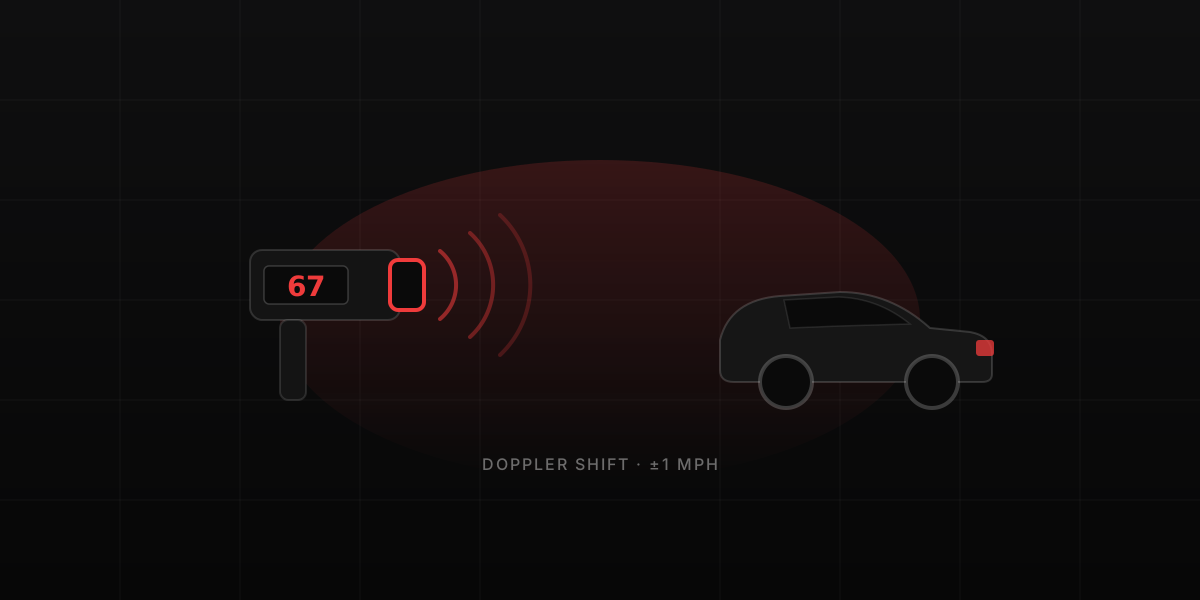
Police radar has a reputation for being infallible, and drivers often assume the number on the officer's display is simply the truth. The physics behind it is genuinely accurate, good to about 1 mph. But accuracy in a lab and accuracy on the shoulder of a highway are two different things. Here is how radar and lidar actually measure speed, where the real errors come from, and how your true GPS speed fits into whether a ticket is right.
How police radar measures speed
Radar works on the Doppler effect. The unit transmits a microwave signal at a fixed frequency, that signal reflects off your moving car, and it comes back shifted slightly higher because you are approaching. The size of that frequency shift is proportional to your speed, so the device does not estimate your speed from changing distance the way some people imagine. It reads velocity directly from the shift, which is why radar can produce a number almost instantly.
Because the measurement comes straight from the physics of the reflected wave, a radar unit that is calibrated and aimed properly is accurate to roughly 1 mph. That is better than your car's factory speedometer. The uncertainty in a real stop does not come from the underlying method. It comes from the conditions the method was used in, and that is where wrong readings are born.
The cosine effect
Radar measures the part of your motion that is aimed straight at the antenna. If the officer is parked at an angle to the road, the beam catches only a component of your true speed, reduced by the cosine of that angle. The practical result is that an angled measurement reads lower than your real speed, not higher, so the cosine effect almost always works in the driver's favor.
At the small angles typical of roadside enforcement the loss is only a few percent, so it rarely changes the outcome of a clear violation. It matters because it shows radar is not a perfect point reading, and because moving-mode radar, operated from a patrol car in traffic, has to combine the patrol car's speed and the target's speed, adding another step where an angle or a bad lock can distort the result.
Why a speeding ticket can still be wrong
A number on a display is not proof by itself. Several well documented errors can produce a reading that does not match your actual speed:
- Wrong-target error. Radar sends out a cone, not a pencil beam. In traffic it can lock onto a larger or closer vehicle, a truck behind you, and attribute that speed to your car. Lidar's narrow beam reduces this, but only if the officer holds a steady aim on the right vehicle.
- Calibration gaps. Units are supposed to be verified with certified tuning forks and an internal check before and after a shift. If that was skipped, or the certification lapsed, the reading loses its evidentiary weight.
- Interference. Strong radio sources, large metal signs, power lines, and even the patrol car's own electronics can inject spurious readings, sometimes called batching or scan error.
- Misidentification. In heavy traffic an officer may visually assign a reading to the wrong car, especially when several vehicles are moving at similar speeds.
None of this means radar is unreliable in general. It means a specific ticket depends on whether the device was calibrated, aimed correctly, and matched to the right car. Those are the questions a contested citation actually turns on, and the reason many jurisdictions require calibration logs and operator training records.
Radar versus lidar
Lidar, or laser, uses a very narrow beam of light instead of a microwave cone. That narrowness is its main advantage: it can isolate a single car in traffic where radar would see several, which largely removes the wrong-target problem. The trade-off is that lidar needs a steadier aim and a clear line of sight, and it is typically used from a stationary position rather than a moving car. Both technologies are accurate to about 1 mph when operated correctly, so the choice is more about targeting in traffic than about raw precision.
Your speedometer is not your defense
Drivers often reason that their dash showed the limit, so they could not have been speeding. That logic runs backward. By regulation your speedometer is allowed to read high but never low, so manufacturers deliberately calibrate it to read a few percent fast, typically 2 to 5 mph over your true speed at highway pace. When your dash reads the limit, your true speed is usually a little below it, which is good for staying legal but useless as proof, because the dash always claims a number higher than reality.
If you want to know what your speedometer's over-read actually is on your car, measure it with the car speed test, which walks through comparing your dash to true GPS speed on a straight road. Our breakdown of why your car speedometer reads higher than GPS explains where the gap comes from, and the recalibration guide covers what changes it, such as tire size and wear.
How GPS gives you the honest number
GPS measures your true ground speed from the Doppler shift in satellite signals, the same kind of physics radar uses, but referenced to the satellites rather than a roadside antenna. Under open sky it is accurate to within about 0.5 to 2 mph at highway speed, independent of your car, your tires, and the officer's equipment. That makes it the closest thing you have to a neutral record of how fast you were really going.
A GPS reading is not a magic ticket-killer. A bare screenshot rarely decides a case, and courts weigh how the data was captured. But a logged speed trace from the time and place of a stop is real evidence, and day to day a GPS speedometer keeps you honest about your actual pace, so you know whether a citation is even plausible. You can watch your true speed right now with the live GPS speedometer, no install required.
The same logic applies to automated enforcement. If you want the companion piece on fixed and average-speed cameras and the margins they apply, read speed camera tolerance: how many mph over the limit is safe. And if you are trying to settle what the limit even was where you were stopped, our US speed limits overview and the state-by-state pages spell out interstate, city, and school-zone limits.
The takeaway
Police radar is accurate to about 1 mph, and lidar is at least as precise, so the technology is not the weak point. The weak points are the conditions: the angle, the calibration, the target lock, and the traffic around you. A ticket can be wrong when any of those slips, which is why calibration logs and clear line of sight matter. Your speedometer will not prove your innocence because it reads high by design. The honest number, on both sides of the argument, is your true ground speed, and that is exactly what GPS measures.