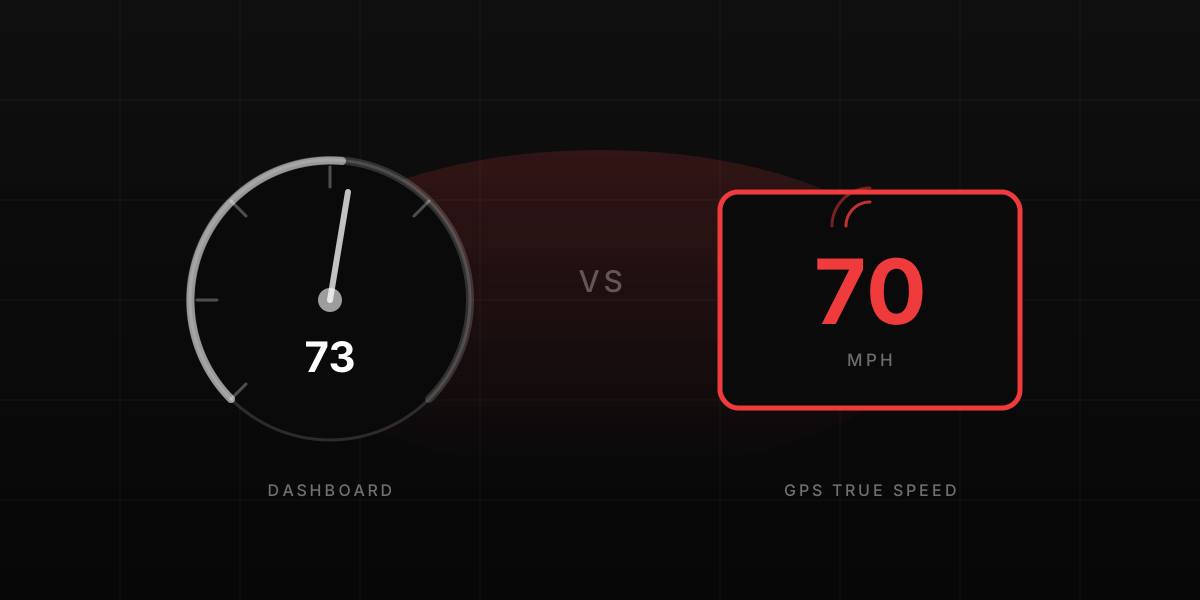
You glance at your dashboard, it says 70 mph. You glance at your phone running GPS, it says 67. Same car, same moment, three miles per hour apart. This is not a bug. It is a regulatory feature, and almost every car on the road does it. Here is the full story.
The short answer
Factory car speedometers are calibrated to read slightly high, almost always between 2 and 5 mph (3 to 8 km/h) above your true speed at highway speeds. They are never calibrated to read low, because in most countries that would be illegal. A GPS reading derived directly from your position relative to satellites is, by physics, far more accurate. Your dashboard is telling you a number with a built-in safety buffer; GPS is telling you the real number.
The regulation that causes this
In the European Union, vehicle speedometers are governed by UNECE Regulation 39. The rule is short and specific. The displayed speed must never be lower than the actual speed, and it must not be higher than the actual speed by more than 10 percent plus 4 km/h. So at a true 100 km/h, the dashboard is allowed to show anywhere from 100 km/h up to 114 km/h. It cannot show 99.
The United States uses a similar but slightly looser rule under FMVSS 49 CFR 571.101. The maximum allowed over-reading is around 5 mph at highway speeds. As in Europe, under-reading is not permitted. The UK, Japan, Australia, and Canada all have comparable margin rules.
From a manufacturer's perspective, the math is obvious. If you aim for true accuracy, half your production batch will accidentally read low, and that is a recall. If you aim a little high, the entire batch is comfortably inside the legal envelope. Setting the dial to read 3 to 5 percent over the truth is the safe industry default.
Where the over-reading comes from
A traditional speedometer measures the rotational speed of the wheels (or, in modern cars, the transmission output shaft) and multiplies by the assumed wheel circumference. Three things determine how that turns into a displayed number:
- The rotation count per second from the sensor
- The assumed tire circumference programmed into the ECU
- The intentional offset coded into the firmware
Modern cars do not have an analog cable; the engine control unit reads a wheel speed sensor and computes the displayed number digitally. The intentional positive offset is set in firmware, and it stays the same whether the car is brand new or 200,000 km old.
Why tire size matters even more than the offset
The factory offset gives you 3 to 5 percent over the truth. Tire changes can move the reading several percent in either direction on top of that.
A worn tire has a smaller circumference than a new one. If your tires are halfway through their life, they are probably 1 to 2 percent smaller than the day you bought them. Smaller circumference at the same wheel rpm means you are actually moving slower than the car thinks, so the speedometer over-reads even more. A car set to read 3 percent high from the factory, with tires worn 2 percent, will read closer to 5 percent high.
Aftermarket wheels and tires move the reading more dramatically. Plus-sized wheels with lower-profile tires often have a slightly larger overall diameter than stock; the speedometer then under-reads. This is one of the few ways your dashboard can drift out of legal compliance, and many car magazines specifically test for it when reviewing wheel upgrades.
Tire pressure also matters in a small way. An under-inflated tire has a very slightly smaller rolling diameter (the contact patch flattens, the effective radius drops). The effect is on the order of 0.5 percent at most, so it is below noticeable on the dial, but it is real.
Why GPS is more accurate
GPS speed does not depend on tire circumference, transmission ratios, or factory firmware decisions. It is calculated from your position relative to a fleet of satellites with atomic clocks. The modern receivers in phones use both position differences and the Doppler shift of incoming satellite signals, giving a velocity accurate to roughly 0.1 m/s when the sky is clear. That is about 0.2 mph or 0.3 km/h, well below the resolution of any car's dial. For a deeper dive into the physics, see our explainer on how a browser measures your speed.
When a car magazine measures real-world acceleration, they use GPS-based timing equipment, not the dashboard. When highway police measure your speed for a citation, they use radar or laser, not your dashboard. Both methods are calibrated to read true. Your dashboard is the one number that is intentionally wrong.
When the dashboard still wins
Legally, your car's speedometer is the relevant instrument. If you are pulled over for speeding, the officer is comparing their radar reading to whatever your dial shows, not to whatever your phone shows. The same is true in court. A "but my GPS said I was only going 65" defense does not work.
The practical takeaway: drive by the dial, not by the GPS. The dial is conservative, which keeps you on the safe side of the posted limit. Use GPS to verify the offset on your specific car, not to drive faster than the law.
How to test your specific car
You can do this in 10 minutes with a phone:
- Open gpsspeedometer.io in your phone's browser. Mount the phone where you can glance at it without taking your eyes off the road for too long.
- Find a flat, straight road with no traffic. A highway with steady cruise control is ideal.
- Set cruise to 30 mph. Wait 30 seconds for both readings to stabilize. Note the GPS reading. Repeat at 50, 70, and 90 mph if it is safe.
- Calculate the offset at each speed:
(dashboard − GPS) /
              GPS × 100
gives you the percentage error.
A typical result for a recent factory car: the dashboard reads 1 to 2 mph high at 30, 2 to 3 high at 50, 3 to 5 high at 70, and 4 to 6 high at 90. The error grows with speed because the offset is usually a percentage, not a flat number.
If your numbers are wildly off (say, 10 percent over or any amount under), check your tires. Compare your installed tire size to the factory specification listed in your owner's manual or on the door sticker. Plus-sized aftermarket wheels are the most common cause of large discrepancies.
Should you recalibrate?
Most factory cars: no. The 3 to 5 percent over-reading is exactly what the manufacturer intended, and it is well within the legal envelope. Drive by the dial.
Cars with non-stock wheels and tires: maybe. If you have changed to a substantially different tire diameter, your speedometer is almost certainly off. A scan tool can correct the firmware offset to match your new tire circumference. Your local performance shop will know how. The cost is typically less than 100 USD.
Older mechanical speedometers (pre-2000 cars): the cable, the gears, and the spring can all wear and drift. A specialist shop can recalibrate, but it is rarely worth it unless the error is large.
Quick reference
- Factory speedometers read 2 to 5 mph (3 to 8 km/h) high. This is normal.
- EU rule: never under, never over by more than 10% + 4 km/h.
- US rule: similar, around 5 mph max over-read.
- Tire wear adds another 1 to 2 percent of over-read.
- Plus-size wheels usually under-read; stock wheels with worn tires over-read more.
- GPS is accurate to roughly 0.5 mph in clear sky. It is the honest reading.
- Drive by the dashboard. Use GPS to verify the offset on your specific car.
You can run the test right now: open the live speedometer in your phone, take a steady drive, and watch the two numbers. Or convert your top speed back and forth with the MPH to KPH and KPH to MPH tools.