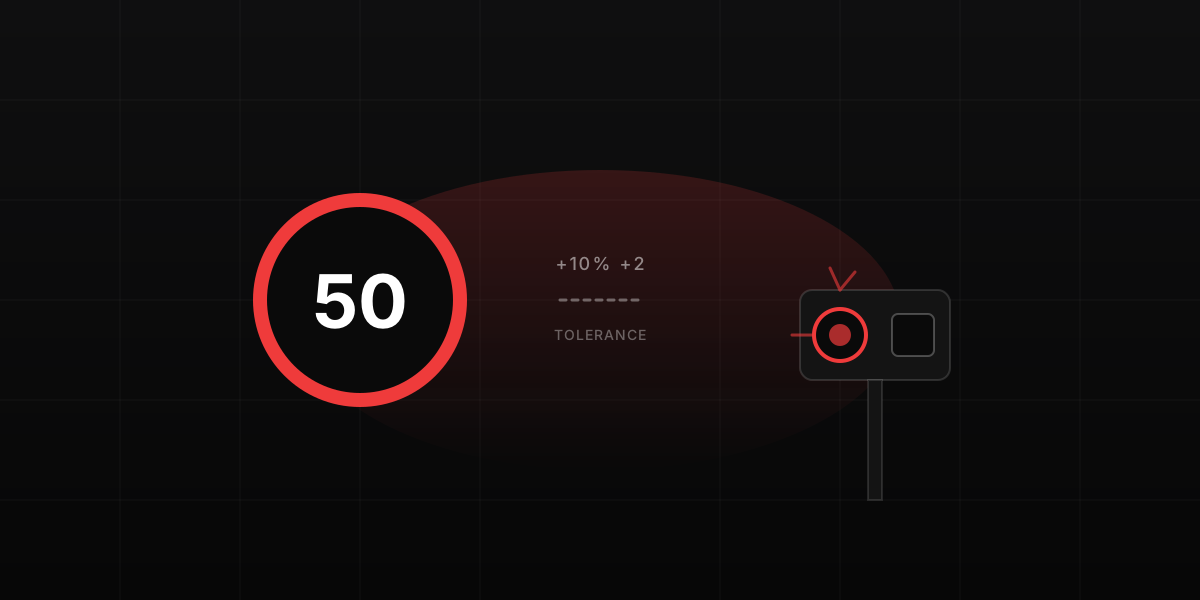
You have probably heard the rule of thumb: a speed camera will not trigger until you are past the limit plus 10% plus 2 mph. It sounds precise, and it gets repeated as if it were the law. It is not. It is a guideline about when police might consider acting, it varies by country and even by camera, and it is not a guarantee that you will escape a ticket. Here is what speed camera tolerance actually is, why it exists, and the only number that is genuinely safe to drive.
What speed camera tolerance actually is
Every speed measurement carries some uncertainty. A camera, like any instrument, can be off by a small amount, and the law generally does not want to convict a driver on a figure that might be measurement noise rather than real speeding. So enforcement systems apply a margin: a few percent, or a few km/h, deducted or allowed before a recorded speed counts as a violation.
That margin is the tolerance. It is a technical and legal safeguard, not an official permission to exceed the limit. The legal limit is the posted number on the sign. The tolerance exists so that the system is fair when measuring, not so that drivers have a few free mph to spend. Treating it as headroom is exactly the misunderstanding that gets people fined, because the margin is small, it is not published as a promise, and the authority can change or tighten it at any time.
It also helps to separate two things that often get blurred together. One is the camera's own measurement accuracy, the tiny device error the margin is designed to absorb. The other is the discretion a police force or prosecutor applies on top of that, the human decision about whether a recorded speed is worth pursuing at all. The rule of thumb people quote usually folds both into a single comforting number. In practice they are set by different people for different reasons, and either can shift without notice, which makes the combined figure far less dependable than it sounds.
The common UK guideline (limit plus 10% plus 2)
In the UK, the most quoted figure is the limit plus 10% plus 2 mph. In a 30 mph zone that works out to roughly 35 mph; on a 70 mph motorway, roughly 79 mph. This comes from guidance issued to police forces, historically associated with ACPO and now under the NPCC, about when prosecution should be considered.
The key word is guidance. It is advisory, not statutory. The legal limit remains the posted limit, and you can in principle be prosecuted for exceeding it by 1 mph. The 10% plus 2 figure simply reflects how police discretion has often been applied, giving room for speedometer error and measurement uncertainty. Individual forces set their own thresholds, fixed cameras in some areas are configured to enforce closer to the posted number, and average-speed cameras can be unforgiving. The guideline tells you how the system tends to behave, not what you are entitled to do.
How it varies by country
There is no universal tolerance. Each country sets its own margin, and the differences are large enough that a habit learned in one place can earn you a ticket in another.
Germany deducts a small measurement tolerance before the recorded speed is calculated, commonly described as around 3 km/h up to 100 km/h and roughly 3% above that, so the margin shrinks in absolute terms as you go faster. France applies a margin in a similar spirit, a small fixed allowance at lower speeds and a percentage at higher ones. The Netherlands is well known for strict enforcement with a tight margin and dense camera coverage. The United Kingdom leans on the discretionary guideline above rather than a fixed statutory deduction.
These numbers are general and they change over time, so treat them as a reason to be cautious rather than a lookup table to drive by. The one rule that travels safely across every border is to drive the posted limit and not chase the margin.
Your speedometer already eats into the margin
Here is the part most drivers miss. Your car speedometer is not telling you the truth, and it never was meant to. By regulation in most of the world, a speedometer is allowed to read high but never low. To stay on the safe side of that rule, manufacturers calibrate the dash to read a few percent fast, typically 2 to 5 mph over your true speed at motorway pace.
That over-read works in your favour with cameras. When your dash reads exactly the limit, your true ground speed is usually a little below it, which means you are already sitting inside whatever margin the camera applies, without trying. We explain where this over-read comes from, and how much to expect, in our breakdown of why your car speedometer reads higher than GPS.
The catch is that you cannot rely on a specific amount. The over-read depends on tyre wear, tyre size, and how the particular car was calibrated, so it might be 2 mph on one vehicle and 4 on another. Leaning on it is guessing. The only way to know how much real margin you have is to know your true speed.
Why GPS speed is the honest number to watch
A camera is trying to measure your true ground speed. Your dash shows an inflated number. GPS shows the real one. That is why a GPS speedometer is the honest gauge to set your pace against: it closes the gap between what your car claims and what an enforcement system actually records.
GPS measures speed from the Doppler shift in satellite signals, which makes it accurate to within about 0.5 to 2 mph at highway speeds under open sky, more accurate than the factory dash. If you drive against true GPS speed and keep it at or below the posted limit, you stay comfortably inside any tolerance a camera applies, and you do it without guessing how much your speedometer is overstating.
You can see your true speed right now with the live GPS speedometer, no install needed, and you can measure exactly how far your dash over-reads using the car speed test walkthrough. Once you know your car's over-read, the relationship between your dash, your true speed, and any camera margin stops being a mystery.
Fixed, mobile, and average-speed cameras
Tolerance also interacts with the kind of camera. A fixed camera measures your speed at a single point, so a brief moment at the limit is all it captures. A mobile camera, often in a van or handheld by an officer, can be set up anywhere and is frequently used in spots where drivers assume there is no enforcement. An average-speed system reads your plate at two points and divides distance by time, so it is the hardest to game: slowing down only for the cameras does nothing, because it averages the whole stretch between them. Whatever margin applies, average-speed cameras leave the least room for a burst of speed between checkpoints.
The practical lesson is that the margin you imagine you have shrinks as the camera gets smarter. With a fixed point camera you might brush the limit for a second and pass; with an average-speed corridor there is nowhere to hide, because the system is measuring the whole journey, not a single frame. That is one more reason to set your pace at the limit and keep it there, rather than trying to read which type of camera you are approaching and adjust on the fly.
The safe takeaway
Speed camera tolerance is real, but it is a measurement safeguard, not a licence to speed. It is small, it varies by country and by camera, it can be tightened without notice, and the legal limit is always the posted number. The 10% plus 2 figure is guidance about discretion, not a right you can claim.
The reliable move is simple: drive the limit, measured against your true speed rather than your over-reading dash. Because the dash already reads a little high, holding the posted number on GPS keeps you safely inside any margin anyway, with no guessing and no reliance on a tolerance figure that was never meant for you to spend. It also means you never have to know which country's margin applies, which camera you are passing, or how much your particular car over-reads. You just hold the posted number against your true speed and let those details stop mattering. Open the live speedometer to watch the honest number, and let the camera margin be a backstop you never actually need.