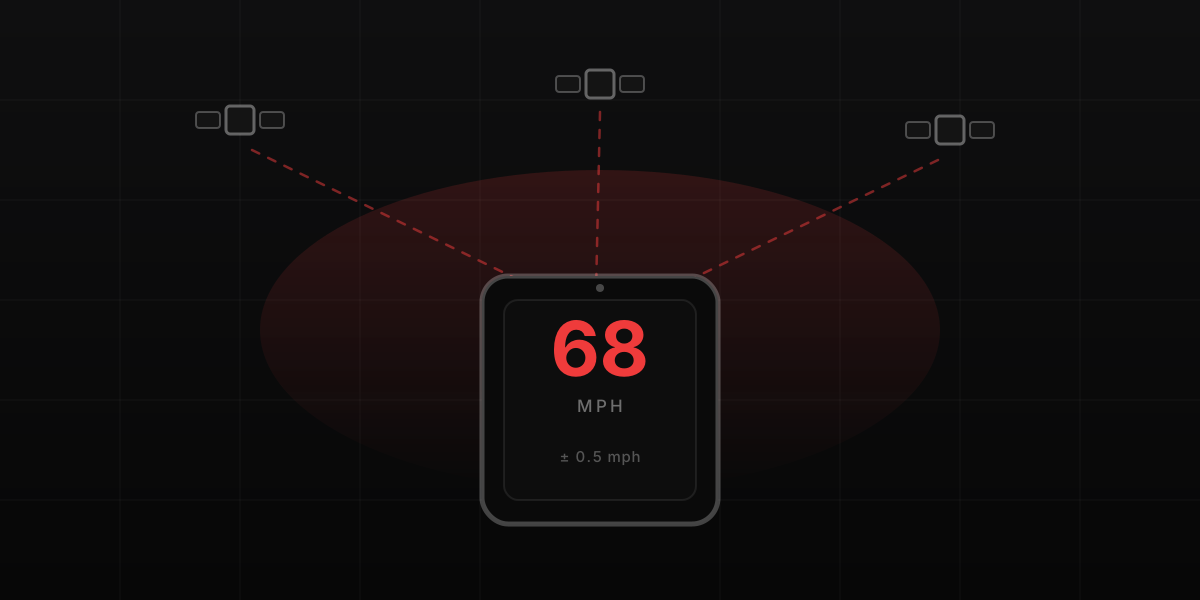
The short answer: in clear sky, modern phones read speed within half a mile per hour. The longer answer involves atomic clocks, Doppler shifts, and a physics trick from the 1970s that makes your phone surprisingly good at telling you how fast you are moving. Here is the full picture.
The number you can trust
For everyday driving, cycling, or running with an open view of the sky, the GPS speed shown on a recent iPhone or Android phone is accurate to roughly ±0.5 mph (about ±0.8 km/h). That is significantly better than the 3 to 5 mph error baked into every factory car speedometer, and far better than what people assume when they hear "GPS on a phone."
The accuracy comes from two independent measurements that the phone combines. Most explanations of GPS only describe the first one, which is why people often think GPS speed is much rougher than it really is.
Method 1: position over time
The naive way to compute speed from GPS is to record two positions a second apart, calculate the distance between them using the haversine formula (the proper formula for distances on a sphere), and divide by the time elapsed. Distance over time equals speed.
This works, but it is noisy. Each position reading has its own error of a few meters. When the phone takes the difference of two such readings, it amplifies that error. A 3-meter jitter on two consecutive readings, one second apart, produces a phantom speed of roughly 6.7 mph that has nothing to do with how fast you are actually moving. Older GPS apps that relied only on this method were famously twitchy at low speeds.
Method 2: the Doppler shift
Every GPS satellite broadcasts on a known carrier frequency, 1575.42 MHz for the L1 band. As you move toward or away from a satellite, the frequency arrives at your phone slightly compressed or stretched, exactly the way an ambulance siren changes pitch as it passes you. The amount of frequency shift, measured against the satellite's known orbital velocity, gives your phone the radial component of your motion relative to that satellite.
With shifts measured from four or more satellites simultaneously, your phone can solve for your three-dimensional velocity vector directly. Crucially, this calculation does not depend on the phone's position being accurate. It depends on frequency, which the phone measures with much better precision than position. Doppler-derived speed is typically accurate to 0.1 m/s, about 0.2 mph.
Modern GPS chips compute both numbers and report whichever is more reliable. At a steady highway cruise, the two methods agree closely. At a stop, the position method is essentially noise but the Doppler method correctly reports zero.
What erodes the accuracy
The ±0.5 mph figure assumes ideal conditions. Real-world accuracy depends on five factors, in roughly decreasing order of impact:
- Sky visibility. The phone needs a direct line of sight to at least four satellites to compute a fix, and seven or more for a robust velocity solution. Indoors, accuracy drops sharply or fails entirely.
- Multipath reflection. In a city with tall buildings, satellite signals bounce off glass and metal before reaching you. The reflected signals took a longer path, so the phone calculates a longer distance and your apparent position wanders. This is the classic "urban canyon" problem.
- Atmospheric delay. Signals travel slower through the ionosphere and troposphere than through vacuum. The phone applies a model to compensate, but on solar storm days the model can be off by a meter or two.
- Number of satellites. Modern phones listen to GPS, GLONASS, Galileo, BeiDou, and QZSS, often locking onto 10 to 20 satellites at once. Accuracy improves with more satellites because the geometry of the solution gets better.
- Cold start vs warm fix. When your phone has been off for a long time or stored in a Faraday-cage-like environment, the first GPS reading after waking up can take 30 to 90 seconds to converge. Once the chip has a warm fix, subsequent readings update many times per second.
What "accuracy" actually means in the API
When a webpage or app calls the browser's Geolocation API, every
position reading comes with a stated accuracy value
in meters. This is the half-width of a 68 percent confidence
circle. An accuracy of 5 meters means your true position is
almost certainly within 5 meters of the reading; an accuracy of
50 meters means your position is roughly known but not precise.
GPS Speedometer treats anything below 25 meters of accuracy as "GPS Ready" and shows a green status indicator. Above 25 meters, it shows "Acquiring" and waits for a tighter fix. In practice, you reach the green state within 5 to 30 seconds of stepping outdoors.
How phones compare to dedicated GPS receivers
A dedicated automotive GPS unit, a survey-grade receiver, or a racing telemetry box costs many times what a phone does and is often only marginally more accurate for speed. The phone's smaller antenna is offset by aggressive signal processing in the chip and by access to the multi-constellation system. For a casual user checking their car's speedometer or recording a bike ride, the gap between a phone and a dedicated GPS box is negligible.
Where dedicated receivers win is in survey-grade accuracy (centimeters, not meters), in continuous operation under heavy tree cover, and in raw bandwidth (logging at 100 Hz or more for drag racing). Casual speed-checking does not need any of that.
How phone GPS compares to your car
A factory car speedometer reads 2 to 5 mph high by design. A phone's GPS speed reads true within 0.5 mph. So when the two disagree, GPS is the honest one. We covered this in detail in why your car's speedometer reads different from GPS.
How phone GPS compares to a tape measure
For a fun home test: drive at a steady 30 mph for exactly one minute. Note your start and end odometer reading. The expected distance is 0.5 miles. If your car's odometer is calibrated honestly, the GPS-derived distance from a logging app will match to within a few percent. Older cars with worn or non-stock tires can show several percent of error. Modern cars usually agree to within 1 percent.
When phone GPS is wrong
There are real failure modes you should know about:
- Tunnel exits. The phone's GPS chip caches the last known velocity. When you exit a tunnel, the cached velocity is shown for a second or two before the new fix arrives. If you decelerated sharply inside the tunnel, the shown speed is too high until the new fix lands.
- Train rides. Inside a metal carriage with window glass that reflects signal, the phone may report your speed as much lower than the train's real speed. The same applies to elevators and metal-roofed parking garages.
- Sudden stops on a long descent. The Doppler shift assumes a continuous motion model. Very sudden velocity changes can produce a brief overshoot in either direction before the chip stabilizes.
- Older devices. A 5+ year old phone may have an older GPS chipset that does not support multi-constellation or accurate Doppler. These phones are noticeably worse at low speeds.
The practical takeaway
For all the everyday cases (driving, cycling, running, hiking, boating with sky visibility), a modern phone running GPS is accurate enough to trust. It will tell you your real speed within half a mile per hour, in real time, with no calibration needed. The web speedometer at gpsspeedometer.io uses exactly the value the browser hands it from the OS GPS stack, smoothed slightly so it does not flicker.
For the technical deep dive into how the browser exposes GPS speed to the page, see how a browser measures your speed. To check your own car's speedometer against GPS, see our guide to testing speedometer accuracy.