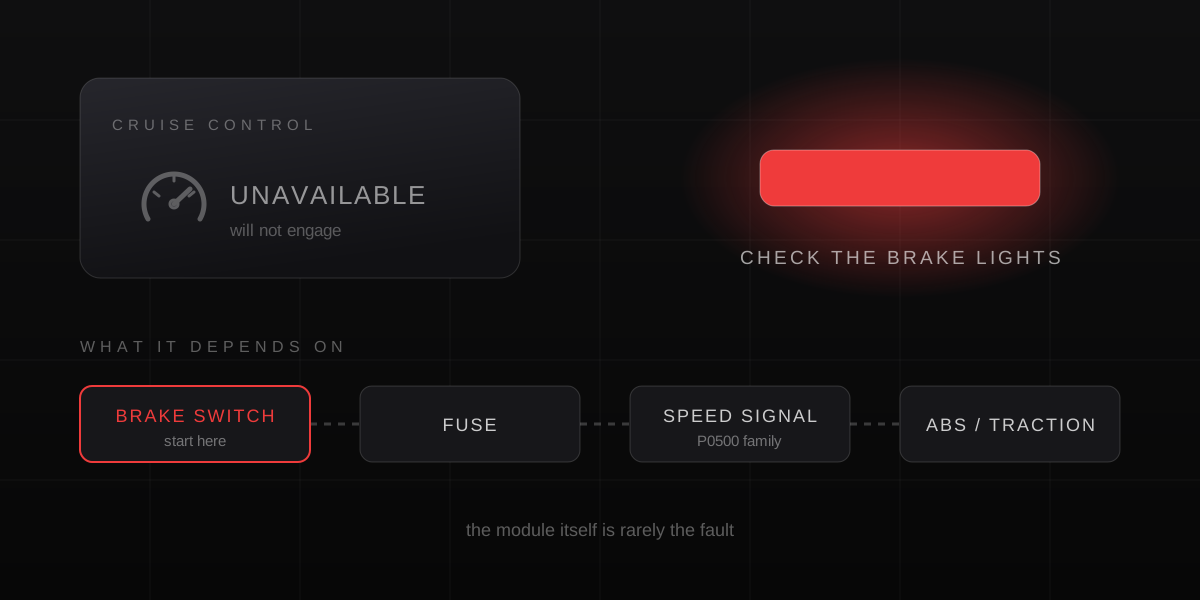
Cruise control almost never fails on its own. It sits at the end of a chain of inputs (a brake switch, a clutch switch, a speed signal, and on most modern cars the ABS and stability systems) and it is designed to give up the moment any of them looks wrong. So when it stops engaging, the useful question is not "what happened to the cruise control" but "which of its inputs went quiet". That reframing is worth money, because the inputs are mostly cheap and the module is not.
Three questions that narrow it down fast
- Does the speedometer still work properly? If it is dead, jumpy or frozen, stop here: you have a speed signal fault, and the cruise control is a symptom rather than the problem.
- Do the brake lights behave? Have someone watch them while you press and release the pedal. Stuck on, not coming on, or slow to release all point at the brake light switch, which has a veto over cruise control.
- Are any warning lights on? ABS, traction control, stability control or check engine. On most modern cars a fault in any of those disables cruise control deliberately, and the dashboard is telling you where to look.
If all three come back clean, work down the list below in order.
The usual causes, cheapest first
1. The brake light switch
A small plunger switch above the brake pedal, and the single most rewarding thing to check. The brake pedal cancels cruise control through it, so a switch that has failed or drifted out of adjustment can report a permanently pressed pedal, in which case the system will not engage at all, or will drop out the instant you press SET.
The reason it goes first is that the same switch controls the brake lights and, on many automatics, the shift interlock. That gives you free evidence from outside the car. The part is inexpensive, and on many vehicles adjustment alone fixes it.
2. A blown fuse
Unlikely, cheap, and quick to eliminate, which is exactly why it sits near the top. Find the cruise control or engine control fuse in your owner's manual and inspect the metal strip. A fuse that blows again immediately after replacement is telling you about a short circuit rather than about the fuse.
3. The clutch switch, on manual cars
Manuals have a second veto: a switch on the clutch pedal that cancels cruise control so the engine cannot be revved into space with the drivetrain disconnected. Same failure modes as the brake switch, same symptom, and it can fail without any visible external clue at all.
4. The vehicle speed signal
Cruise control cannot hold a speed it cannot measure. That number comes from a sensor on the transmission on older cars, and from the wheel speed sensors via the ABS module on newer ones, the same signal that feeds your speedometer. A failed sensor, a chafed wire or a corroded connector takes out both.
The relevant OBD-II codes are short and worth pulling before anyone buys parts:
| Code | Meaning |
|---|---|
| P0500 | Vehicle speed sensor A malfunction |
| P0501 | Signal present but out of range or implausible |
| P0502 | Input too low |
| P0503 | Intermittent, erratic or high |
If the speedometer is misbehaving too, the fuller diagnosis is in speedometer not working, which works the same chain from fuse to sensor to instrument cluster.
5. An ABS, traction or stability control fault
On most cars built this century, cruise control is switched off deliberately whenever the stability systems are unhappy, because they share the wheel speed data and because handing throttle authority to software with a known bad input is a poor idea. A single failing wheel speed sensor can therefore light the ABS lamp and kill cruise control while the speedometer, which may be using a different source, carries on normally. Diagnosing this needs a scan tool that reads ABS codes, not just engine codes.
A related and much less alarming case: some cars suspend cruise control after a traction or stability intervention, such as a wheel spinning on ice or a hard corner, and restore it after a restart. If it disappeared once, in bad weather, and came back the next morning, that was the system working as designed.
6. Steering wheel controls and the clock spring
If the buttons themselves have died, the clock spring is the usual suspect: a coiled ribbon cable behind the airbag that keeps the wheel electrically connected while it rotates, and eventually wears through. The giveaway is company: the horn, the audio buttons or the airbag warning light failing at the same time as the cruise controls. On its own, a worn button contact is also possible and considerably cheaper.
7. Throttle actuation, mostly on older cars
Pre-drive-by-wire systems moved the throttle with a vacuum servo and a cable. Cracked vacuum hoses, a leaking servo diaphragm or a seized cable all produce a system that engages and then cannot hold speed. On a modern electronic throttle this failure mode has essentially vanished, since the module just asks the engine computer for more throttle, so if your car is recent, this is not your problem.
If it is adaptive cruise control
Adaptive systems add a radar behind the grille and usually a camera at the top of the windscreen, and both need a clear, correctly aimed view. That introduces failures that have nothing to do with the classic list:
- Blockage. Snow, ice, road salt, mud, insects, a number plate frame or a sticker in front of the radar. Usually announced with a "sensor blocked" or "cruise unavailable" message that clears after cleaning.
- Weather. Heavy rain, fog and spray degrade both radar and camera. Temporary and normal.
- Alignment. A minor front-end knock, or bumper work after one, can move the radar a couple of degrees, which is enough. Realignment is a workshop procedure with a target board.
- Windscreen replacement. If the forward camera was not recalibrated after new glass, the system can be unavailable or behave strangely. This is a common and easily missed cause.
None of these mean the cruise control module is faulty, and all of them are worth mentioning before authorising diagnostic time.
Things that are not faults
Before booking anything, rule out the ordinary:
- You are below the minimum speed. Most systems will not engage below roughly 25 mph, or 40 km/h.
- The system is switched off. On many cars ON/OFF is separate from SET, and turning the ignition off clears the stored speed so RES has nothing to resume.
- You are in limiter mode. European cars often share one stalk between cruise control and a speed limiter. In limiter mode the dash shows a set speed and the car quite correctly refuses to accelerate by itself. The mechanism is covered in how cruise control works.
- The gearbox disagrees. Manual in too low a gear, or an automatic that has dropped out of drive, will refuse.
Meanwhile, and afterwards
Losing cruise control is an inconvenience rather than a safety problem, unlike losing the speedometer, which usually accompanies it when the speed signal is the cause. If the dial has gone too, your phone covers the gap immediately: the live GPS speedometer works in any browser with nothing to install, and derives speed from satellite Doppler shift rather than from the sensor that just failed, so it is accurate to within about 0.5 to 2 mph.
After the repair, it is worth confirming the speed signal is not just present but correct. Run the car speed test and compare the dash against GPS in the speedometer error calculator. A healthy result is a dashboard reading a couple of percent high; anything wilder suggests the wrong sensor or the wrong calibration went in.
The takeaway
Work the inputs, not the module. Brake switch, fuse, clutch switch, speed signal, ABS, in that order, cheapest first, and check the speedometer and brake lights before anything else, because between them they identify most faults for free. On an adaptive system, clean the sensors and mention any recent windscreen or bumper work before the diagnostic clock starts. And once it is fixed, see does cruise control save gas for where it is actually worth switching on.