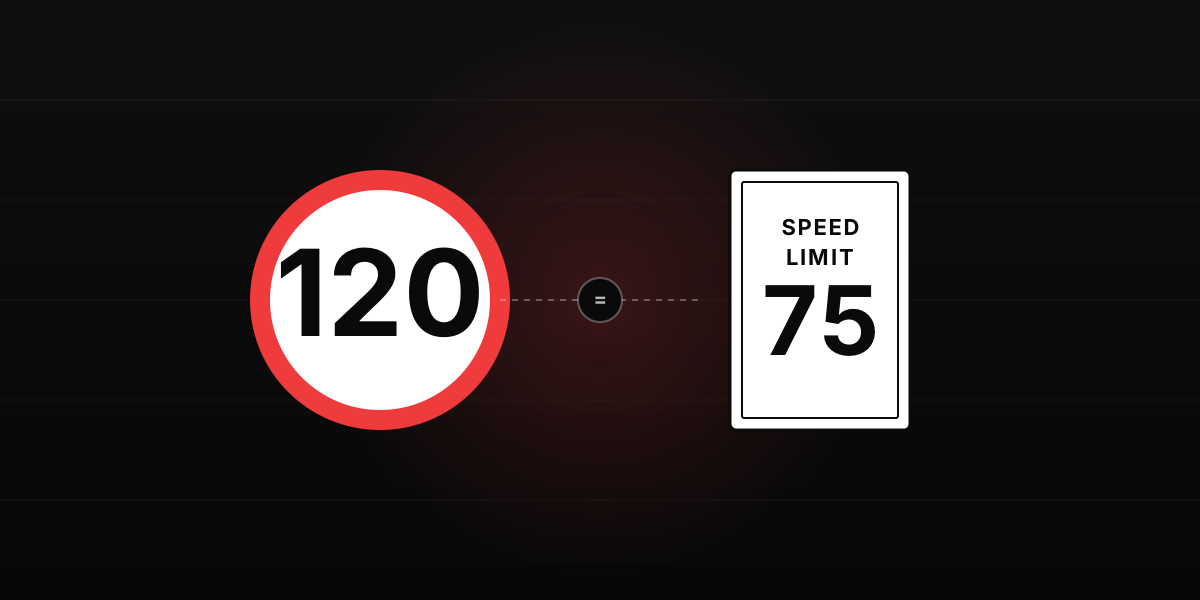
Illinois posts a maximum of 70 mph on rural interstates and tollways, a limit raised from 65 mph in 2014. Four-lane divided highways generally allow 65 mph, undivided rural roads run at 55 mph, and interstates through major metro areas such as Chicago drop to 55 mph. Illinois is an absolute-limit state, so any speed over the posted number is technically a violation.
Illinois speed limits at a glance
| Road type | Limit |
|---|---|
| Cities, towns, business districts | 30 mph (48 kph) |
| Residential / school zones | 30 mph (48 kph) |
| Rural highways | 55 mph (89 kph) |
| Interstates / freeways | 70 mph (113 kph) |
About speed limits in Illinois
Illinois raised its top interstate limit to 70 mph on January 1, 2014, though individual counties in the Chicago collar region were allowed to opt out and keep 55 mph on their stretches. The 70 mph maximum applies to rural interstates and to the Illinois Tollway system outside the metro core, while urban interstates near Chicago, St. Louis and other cities stay at 55 mph. Four-lane divided highways commonly carry 65 mph, and undivided two-lane rural highways default to 55 mph. Trucks and buses may be held to lower posted limits on some corridors.
Illinois treats serious speeding as a crime rather than a simple traffic fine. Under the aggravated speeding statute, driving 26 to 34 mph over the limit is a Class B misdemeanor and 35 mph or more over is a Class A misdemeanor, both carrying possible jail time and a criminal record. This makes Illinois notably stricter than states that treat all speeding as an infraction, and court supervision is often used to keep a first offense off a permanent record.
In urban areas the unposted default is 30 mph, and residential districts follow the same 30 mph baseline unless a lower limit is signed. School zones are 20 mph on school days between 7 a.m. and 4 p.m. when children are present, and alleys carry a 15 mph limit. Local municipalities can lower residential limits by ordinance, and Chicago in particular has pushed 20 mph and 25 mph zones on many neighborhood streets.
Chicago runs one of the largest automated speed-enforcement networks in the country, with cameras concentrated in Children's Safety Zones within an eighth of a mile of a school or park. Camera tickets are civil penalties tied to the vehicle rather than points on a license. The city has expanded coverage and, controversially, lowered the automated ticketing threshold to 6 mph over the limit at many locations.
Enforcement
Illinois State Police use radar and laser on interstates and highways, and marked patrol is heavy on tollway corridors. Automated cameras are largely a Chicago and suburban phenomenon rather than a statewide tool, so most rural enforcement is officer-issued.
Tolerance
On open highways officers commonly ignore speeds within about 5 mph of the limit, but this is discretionary and not a legal buffer. Chicago safety-zone cameras can ticket starting at 6 mph over.
Speeding fines in Illinois
A basic petty speeding ticket typically runs from roughly $120 to $160 plus court costs depending on the county. Speeding 26 to 34 mph over is a Class B misdemeanor with fines up to $1,500, and 35 mph or more over is a Class A misdemeanor with fines up to $2,500 plus possible jail. Chicago camera fines are $35 for 6 to 10 mph over and $100 for 11 mph or more over.
Frequently asked questions
What is the maximum speed limit in Illinois?
The maximum is 70 mph on rural interstates and the Illinois Tollway outside the Chicago metro area. Urban interstates near major cities are posted at 55 mph, and four-lane divided highways are usually 65 mph.
What is aggravated speeding in Illinois?
Aggravated speeding is driving 26 mph or more over the limit, which is a criminal misdemeanor rather than a petty offense. 26 to 34 mph over is a Class B misdemeanor and 35 mph or more over is a Class A misdemeanor, both carrying possible jail time.
What is the residential speed limit in Illinois?
The default urban and residential limit is 30 mph unless a lower speed is posted. Many Chicago neighborhood streets are signed at 20 or 25 mph, and school zones drop to 20 mph when children are present.
Does Illinois use speed cameras?
Automated speed cameras are used mainly in Chicago inside Children's Safety Zones near schools and parks, plus some suburbs. They are not deployed statewide, so most highway enforcement is done by state and local officers using radar and laser.
City speed limits in Illinois
- Chicago speed limit — city defaults, school zones, and camera enforcement.
Speed limits in nearby states
- Wisconsin speed limit — interstate, rural highway, and city limits.
- Indiana speed limit — interstate, rural highway, and city limits.
- Missouri speed limit — interstate, rural highway, and city limits.
- Iowa speed limit — interstate, rural highway, and city limits.
- Kentucky speed limit — interstate, rural highway, and city limits.
Related tools
- Convert MPH to KPH — convert any speed reading between units.
- Car speed test — verify your speedometer accuracy.
- Live GPS speedometer — see your actual speed in the browser.
- Stopping distance calculator — how far you need to brake from each speed.
- US speed limits overview — federal background and national patterns.