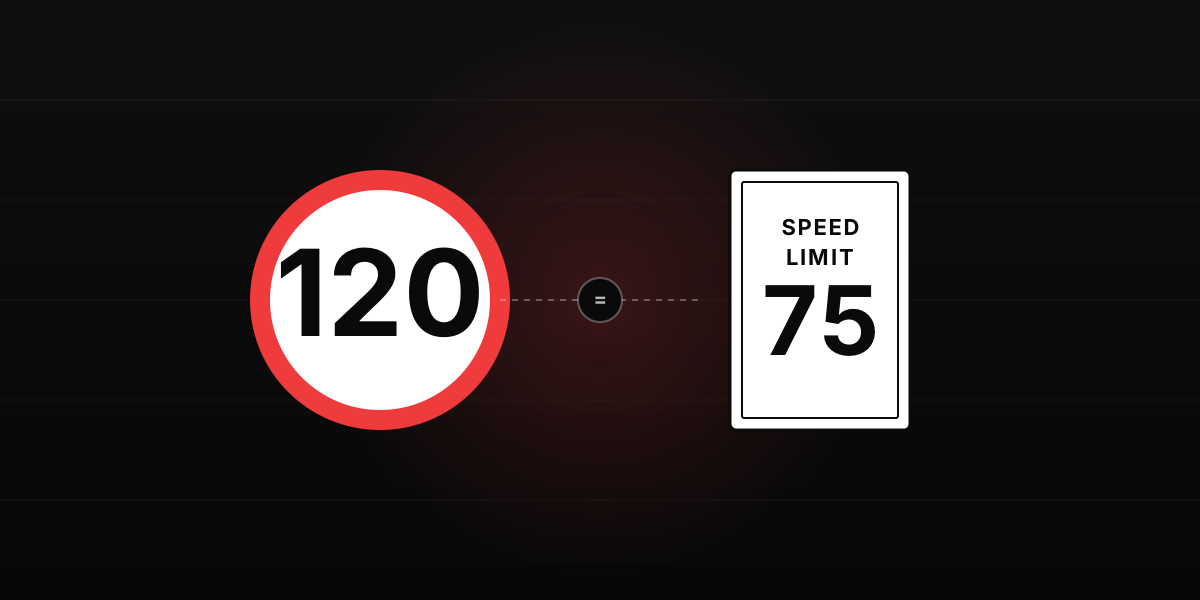
Indiana posts a maximum of 70 mph on rural interstates, with heavy trucks capped at 65 mph — one of the few remaining split car/truck limits in the US.
Indiana speed limits at a glance
| Road type | Limit |
|---|---|
| Cities, towns, business districts | 30 mph (48 kph) |
| Residential / school zones | 30 mph (48 kph) |
| Rural highways | 55 mph (89 kph) |
| Interstates / freeways | 70 mph (113 kph) |
About speed limits in Indiana
Indiana's maximum speed limit is 70 mph, applied on rural sections of interstates such as I-65, I-70, I-69 and the Indiana Toll Road (I-80/90). Under Indiana Code 9-21-5-2, vehicles with a declared gross weight over 26,000 pounds are limited to 65 mph on those same rural interstates, making Indiana one of only a handful of states that still runs a differential car/truck limit. Interstates through urbanized areas such as Indianapolis, Fort Wayne and Gary typically drop to 55 mph, and non-interstate divided highways are generally posted at 55 to 60 mph. Where no limit is posted, the statewide default is 55 mph outside urban areas and 30 mph inside an urban district.
The 5 mph truck differential is Indiana's most distinctive rule: on a 70 mph interstate, a loaded semi passing at 70 is technically speeding even though surrounding cars are not. Lawmakers have debated repealing the split limit several times, arguing the speed differential between cars and trucks creates more overtaking conflicts, but the two-tier system remains in force on rural interstates.
Inside cities and towns the default limit is 30 mph in an urban district unless a different limit is posted, and many residential streets in Indianapolis and other municipalities are signed at 25 or 30 mph. School zones are commonly reduced to 25 mph when children are present, and alleys are limited to 15 mph. County roads outside urban areas fall back to the 55 mph statutory default even when unposted, so drivers should not assume a lower limit applies on gravel or rural two-lane roads.
Indiana does not allow general-purpose speed cameras, but a 2023 law created a pilot program allowing automated speed enforcement in interstate work zones when workers are present. Under the pilot, registered owners receive a warning for a first offense and civil fines for subsequent violations, and cameras must be signed in advance. Outside of that narrow work-zone program, all speeding tickets in Indiana are issued by officers making traffic stops.
Enforcement
Enforcement is handled by the Indiana State Police on interstates plus county and city officers locally, relying on radar, lidar and aircraft-assisted patrols rather than cameras. The only automated enforcement is a limited work-zone speed camera pilot on interstate construction zones.
Tolerance
Officers have discretion and many drivers report a practical cushion of roughly 5 mph on interstates, but nothing in Indiana law guarantees a grace margin. Troopers regularly ticket at lower thresholds in work zones and urban areas.
Speeding fines in Indiana
A basic speeding ticket in Indiana typically costs in the neighborhood of 140 to 200 dollars once court costs are included, rising with the speed over the limit. Driving 30 mph or more over the limit can be charged as reckless driving, a misdemeanor with fines up to about 1,000 dollars and possible jail time, and work-zone violations carry sharply higher penalties.
Frequently asked questions
What is the maximum speed limit in Indiana?
The maximum is 70 mph on rural interstates such as I-65, I-70 and I-69. Vehicles over 26,000 pounds are limited to 65 mph on those roads, and interstates through urban areas generally drop to 55 mph.
Why do trucks have a lower speed limit in Indiana?
Indiana Code sets a 65 mph limit for vehicles with a declared gross weight above 26,000 pounds on 70 mph rural interstates. It is one of the few remaining split car/truck limits in the country, kept on the theory that heavy vehicles need longer stopping distances, though critics argue the speed differential causes more lane-change conflicts.
What is the residential speed limit in Indiana?
The default limit in an urban district is 30 mph unless otherwise posted, and many residential streets are signed at 25 or 30 mph. Alleys are limited to 15 mph and school zones are commonly 25 mph when children are present.
Does Indiana use speed cameras?
Not for general enforcement. A pilot program that began under a 2023 law allows automated speed cameras only in interstate work zones when workers are present, with a warning for the first offense. Everywhere else, tickets come from officer traffic stops.
Speed limits in nearby states
- Illinois speed limit — interstate, rural highway, and city limits.
- Ohio speed limit — interstate, rural highway, and city limits.
- Michigan speed limit — interstate, rural highway, and city limits.
- Kentucky speed limit — interstate, rural highway, and city limits.
Related tools
- Convert MPH to KPH — convert any speed reading between units.
- Car speed test — verify your speedometer accuracy.
- Live GPS speedometer — see your actual speed in the browser.
- Stopping distance calculator — how far you need to brake from each speed.
- US speed limits overview — federal background and national patterns.