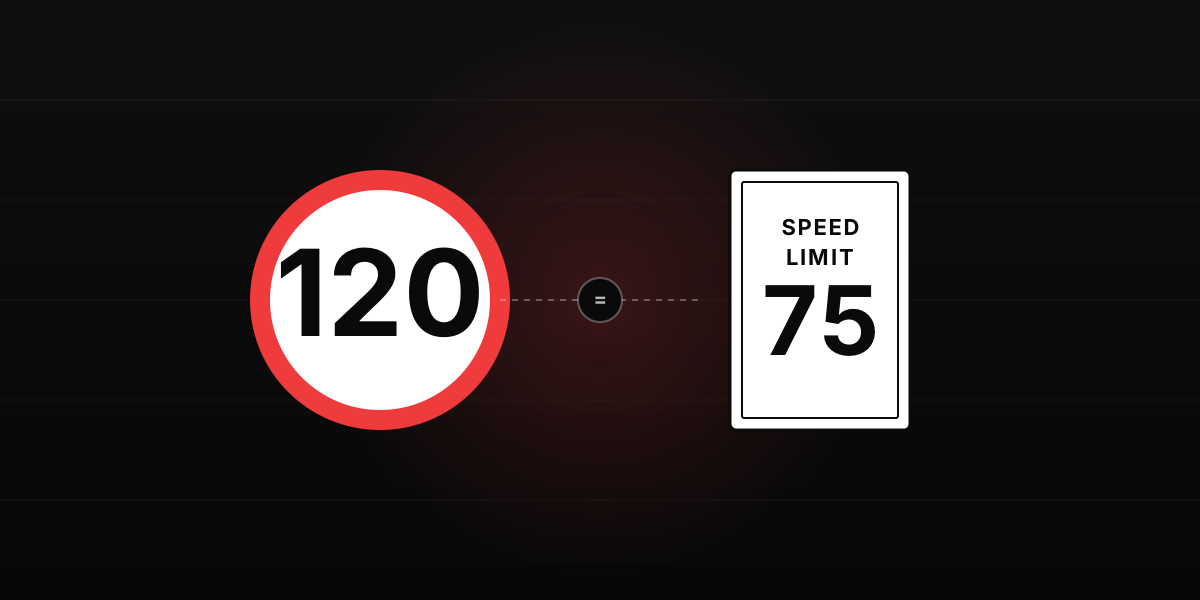
Michigan posts a maximum of 70 mph on most limited-access freeways, with 75 mph on roughly 600 miles of rural freeway raised under a 2016 law and implemented in 2017. The general statewide highway limit is 55 mph, and business and residential districts default to 25 mph. Michigan also enforces a basic speed law requiring a careful and prudent speed regardless of the posted number.
Michigan speed limits at a glance
| Road type | Limit |
|---|---|
| Cities, towns, business districts | 25 mph (40 kph) |
| Residential / school zones | 25 mph (40 kph) |
| Rural highways | 55 mph (89 kph) |
| Interstates / freeways | 70 mph (113 kph) |
About speed limits in Michigan
Michigan's top freeway limit is 75 mph, set under Public Act 445 of 2016 which directed MDOT and the Michigan State Police to raise limits based on engineering studies. By the end of 2017 the 75 mph limit had been applied to 614 miles of rural limited-access freeway, mostly in the northern Lower Peninsula and Upper Peninsula. The remainder of the freeway system stays at 70 mph, and the general statutory limit on other highways is 55 mph. Speed limits are supposed to reflect the 85th-percentile speed of traffic under state law.
Michigan relies heavily on the basic speed law, which requires driving at a speed that is careful and prudent and no greater than is reasonable for conditions. This means a driver can be cited even when travelling at or below the posted limit if fog, ice or standing water make that speed unsafe. Combined with prima facie limits on unposted roads, the law gives officers wide discretion, and gravel roads without signs default to 55 mph.
In urban areas the residential and business-district default is 25 mph unless a different limit is posted, and motorists are expected to know these prima facie limits even when signs are absent. School zones carry reduced limits during posted hours, and local authorities can set modified limits following a traffic engineering study rather than picking numbers arbitrarily.
Michigan historically banned automated speed enforcement, but a 2024 law package signed by Governor Whitmer authorized speed cameras in highway work zones. Enforcement begins with cameras targeting vehicles going at least 10 mph over the posted work-zone limit, phased in primarily on freeway construction areas. Radar detectors remain legal for private passenger vehicles statewide.
Enforcement
The Michigan State Police use both radar and laser speed-measurement devices, and marked and unmarked patrols work the freeway system. Automated cameras have historically been prohibited and are only now being introduced in work zones, so nearly all enforcement is officer-issued.
Tolerance
There is no official grace margin, but officers frequently overlook speeds within roughly 5 to 10 mph of the limit on open freeways. The basic speed law means driving too fast for conditions can still draw a ticket even below the posted number.
Speeding fines in Michigan
Speeding fines are relatively modest and scale with how far over the limit you were, typically running from about $125 for 1 to 5 mph over up to roughly $190 for 36 mph or more over, plus court costs. Each offense also adds license points, from 1 point for minor speeding up to 4 points for higher speeds, and work-zone violations carry heavier penalties.
Frequently asked questions
What is the maximum speed limit in Michigan?
The maximum is 75 mph on about 600 miles of rural limited-access freeway raised under a 2016 law. Most other freeways are posted at 70 mph, and the general statewide highway limit is 55 mph.
What is Michigan's basic speed law?
The basic speed law requires driving at a careful and prudent speed that is reasonable for conditions. A driver can be ticketed even at or below the posted limit if weather, traffic or road conditions make that speed unsafe.
What is the residential speed limit in Michigan?
The default residential and business-district limit is 25 mph unless a different speed is posted. These prima facie limits apply even where no sign is present, and drivers are expected to know them.
Does Michigan use speed cameras?
Michigan long prohibited automated speed enforcement, but a 2024 law authorized cameras in highway work zones targeting drivers going at least 10 mph over the limit. Outside work zones, enforcement remains officer-issued with radar and laser.
Speed limits in nearby states
- Ohio speed limit — interstate, rural highway, and city limits.
- Indiana speed limit — interstate, rural highway, and city limits.
- Wisconsin speed limit — interstate, rural highway, and city limits.
Related tools
- Convert MPH to KPH — convert any speed reading between units.
- Car speed test — verify your speedometer accuracy.
- Live GPS speedometer — see your actual speed in the browser.
- Stopping distance calculator — how far you need to brake from each speed.
- US speed limits overview — federal background and national patterns.