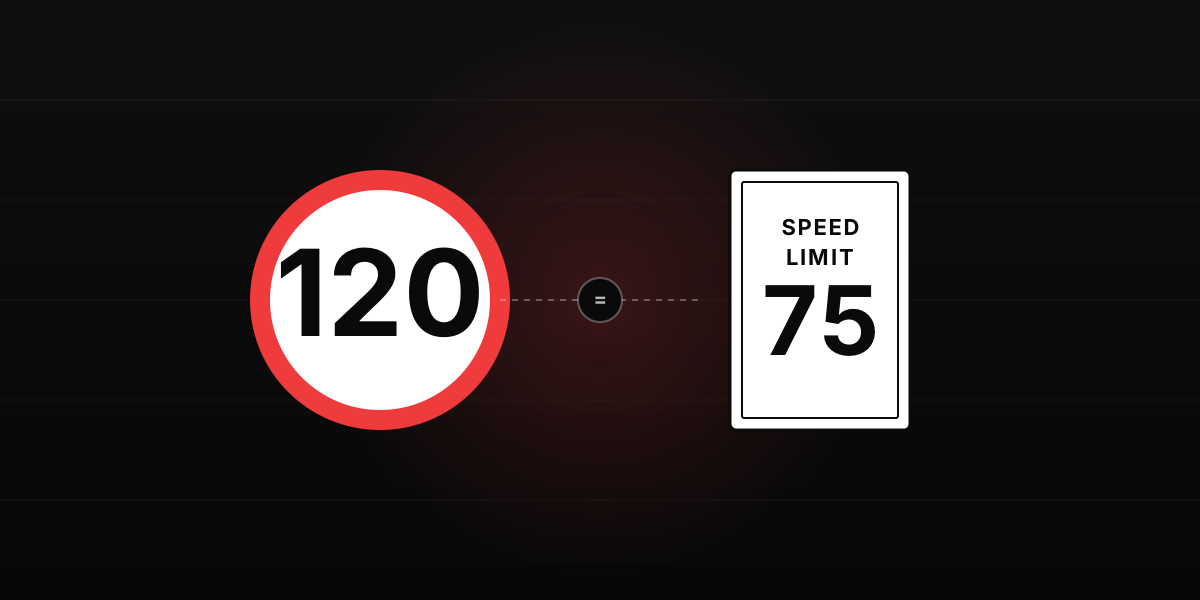
Louisiana posts 70 mph on most interstates, with a 75 mph zone covering roughly 154 miles of rural I-49, and 55 mph on undivided two-lane highways.
Louisiana speed limits at a glance
| Road type | Limit |
|---|---|
| Cities, towns, business districts | 25 mph (40 kph) |
| Residential / school zones | 25 mph (40 kph) |
| Rural highways | 55 mph (89 kph) |
| Interstates / freeways | 70-75 |
About speed limits in Louisiana
Louisiana caps most of its interstate network — I-10, I-12, I-20, I-49, I-55, I-59 and the urban loops — at 70 mph, but the state stands out for a single faster corridor: after a 2010 law authorized the Department of Transportation and Development to approve higher limits where studies supported them, DOTD posted 75 mph in 2011 along roughly 154 miles of rural I-49 between the Opelousas area and Shreveport, crossing St. Landry, Evangeline, Avoyelles, Rapides, Natchitoches, DeSoto and Caddo parishes. Limits drop back to 70 mph on I-49 near Lafayette and to 60 mph through Alexandria and Shreveport, so the corridor changes speed several times end to end.
Louisiana treats speeding 25 mph or more over the posted limit as potential reckless operation, a criminal charge that can bring higher fines and even jail time rather than a simple traffic ticket. The state also enforces its limits absolutely: Louisiana Revised Statutes 32:61 through 32:64 make any speed above the posted number a violation, and elevated bridges such as the Atchafalaya Basin Bridge on I-10 carry a reduced 60 mph limit with separate truck-lane rules.
Inside cities, business and residential districts are typically posted at 25 mph, with New Orleans using 25 mph as its default on most neighborhood streets. School zones drop to 20 mph or lower during posted hours, and Louisiana raises school-zone fines roughly 50 percent above the standard schedule, so a moderate violation near a school costs substantially more than the same speed elsewhere.
Louisiana has no statewide ban on automated enforcement, and New Orleans runs one of the larger municipal camera programs in the South: more than 40 school zones use speed cameras that issue citations automatically during active school-zone hours, alongside fixed cameras on some arterial streets. Baton Rouge and a few other jurisdictions also operate camera programs, so limits in Louisiana cities are enforced by mail as well as by patrol.
Enforcement
Louisiana State Police patrol the interstates with radar, lidar and aircraft-assisted details, while New Orleans, Baton Rouge and several other cities add automated speed cameras, especially in school zones. Rural parishes rely mainly on sheriff and local police radar patrols.
Tolerance
There is no legal grace margin — the limits are absolute — though troopers on 70 and 75 mph rural stretches often focus on drivers well above the limit. In camera-enforced New Orleans school zones, citations are issued at small margins over the posted speed.
Speeding fines in Louisiana
A basic first offense starts around 115 dollars for less than 10 mph over, rising past 200 dollars for larger margins, and court costs of roughly 165 dollars are usually added on top. School-zone violations cost about 50 percent more, and 25 mph or more over the limit can be charged as reckless operation with steeper penalties.
Frequently asked questions
What is the maximum speed limit in Louisiana?
The maximum is 75 mph, posted on about 154 miles of rural I-49 between the Opelousas area and Shreveport. All other Louisiana interstates, including I-10, I-12 and I-20, are capped at 70 mph, with lower limits through cities and on elevated bridges.
Why is part of I-49 in Louisiana posted at 75 mph?
A 2010 state law let the Department of Transportation and Development raise limits where engineering studies showed it was safe. In 2011 DOTD applied 75 mph to the long, flat rural stretch of I-49 across central and northwest Louisiana, and it remains the only 75 mph corridor in the state.
What is the residential speed limit in Louisiana?
Business and residential districts are generally posted at 25 mph, and New Orleans uses 25 mph as the default on most neighborhood streets. School zones drop to 20 mph or lower during posted hours, with fines about 50 percent higher than standard.
Does Louisiana use speed cameras?
Yes, at the local level. New Orleans operates speed cameras in more than 40 school zones plus fixed cameras on some streets, and Baton Rouge runs its own program. There is no statewide camera network on the interstates, where enforcement is by Louisiana State Police patrol.
Speed limits in nearby states
- Texas speed limit — interstate, rural highway, and city limits.
- Mississippi speed limit — interstate, rural highway, and city limits.
- Arkansas speed limit — interstate, rural highway, and city limits.
Related tools
- Convert MPH to KPH — convert any speed reading between units.
- Car speed test — verify your speedometer accuracy.
- Live GPS speedometer — see your actual speed in the browser.
- Stopping distance calculator — how far you need to brake from each speed.
- US speed limits overview — federal background and national patterns.