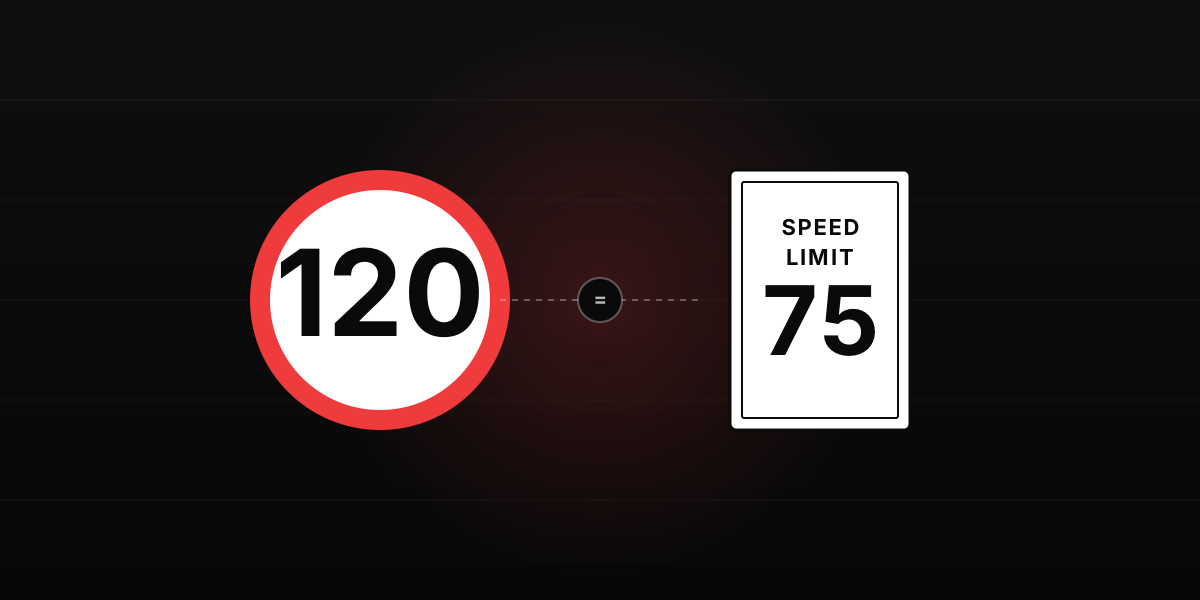
Texas posts the highest speed limit in the United States: 85 mph on a 41-mile stretch of the SH-130 toll road southeast of Austin. Most rural interstates run at 75 mph, with 80 mph permitted on sections of I-10 and I-20 in West Texas. The statewide default on other highways is 70 mph, dropping to 30 mph on urban and residential streets.
Texas speed limits at a glance
| Road type | Limit |
|---|---|
| Cities, towns, business districts | 30 mph (48 kph) |
| Residential / school zones | 30 mph (48 kph) |
| Rural highways | 70 mph (113 kph) |
| Interstates / freeways | 75-85 |
About speed limits in Texas
Texas law sets a base maximum of 70 mph, but the Texas Transportation Commission may raise limits to 75, 80, or 85 mph where an engineering and traffic study shows a road is designed for it. The 85 mph section of SH-130 between SH-45 and I-10 is the only stretch in the country posted that high, and remains the highest posted limit in the Western Hemisphere. A separate provision allows 80 mph across ten counties on I-10 and I-20 in the sparsely populated west of the state, so long-distance interstate travel across Texas is genuinely faster than almost anywhere else in the US.
Texas sets state-highway speeds using the 85th-percentile rule: TxDOT surveys how fast free-flowing traffic actually moves and posts the limit near the speed that 85 percent of drivers stay at or below. This engineering-first approach is why rural Texas limits tend to be high. Texas also uses a prima facie framework on many roads, meaning the posted number is a presumption of what is safe rather than an absolute ceiling in every circumstance, though driving over the posted limit is still treated as unlawful.
In cities the default is 30 mph on urban streets and residential districts unless a sign says otherwise, with alleys often at 15 mph. School zones are typically posted at 20 to 35 mph and enforced only when lights flash or during posted hours; fines roughly double in an active school zone. Neighborhood associations and cities can petition to lower residential limits to 25 mph on request.
Texas does not authorize automated speed cameras for enforcement, and a 2019 state law banned red-light cameras statewide, so speeding is enforced by patrol officers using radar and laser. Drivers should expect traditional traffic stops rather than mailed camera tickets. Enforcement is heaviest on urban interstate loops and in small-town speed traps along US highways.
Enforcement
Enforcement is done entirely by DPS troopers and local police using radar and laser guns; Texas has banned automated speed cameras and red-light cameras statewide, so there are no mailed speed tickets. Small towns along US and state highways are known for aggressive patrol enforcement.
Tolerance
There is no official grace margin, but on open highways officers commonly overlook a few mph and often act at roughly 10 mph over. In school and construction zones tolerance is minimal.
Speeding fines in Texas
Base speeding fines generally start around $165 and, with court costs, commonly total $200 to $500 depending on the county and how far over the limit you were. Driving 100 mph or more can be charged as reckless driving, a Class B misdemeanor carrying possible jail time; fines are also roughly doubled in active school and work zones.
Frequently asked questions
What is the maximum speed limit in Texas?
The maximum is 85 mph, posted only on a 41-mile section of the SH-130 toll road near Austin, which is the highest speed limit in the United States. Rural interstates are generally 75 mph, with 80 mph allowed on parts of I-10 and I-20 in West Texas.
Where is the 85 mph speed limit in Texas?
The 85 mph limit applies to the toll section of State Highway 130 between SH-45 and I-10, southeast of Austin. It is the only road in Texas, and the only one in the Western Hemisphere, posted at 85 mph.
What is the residential speed limit in Texas?
The default limit on urban and residential streets is 30 mph unless otherwise posted, and alleys are usually 15 mph. Cities and neighborhoods can petition to lower residential streets to 25 mph.
Does Texas use speed cameras?
No. Texas does not permit automated speed cameras, and red-light cameras were banned statewide in 2019. All speeding tickets are issued by officers using radar or laser during a traffic stop.
City speed limits in Texas
- Houston speed limit — city defaults, school zones, and camera enforcement.
- San Antonio speed limit — city defaults, school zones, and camera enforcement.
- Dallas speed limit — city defaults, school zones, and camera enforcement.
Speed limits in nearby states
- Oklahoma speed limit — interstate, rural highway, and city limits.
- New Mexico speed limit — interstate, rural highway, and city limits.
- Louisiana speed limit — interstate, rural highway, and city limits.
- Arkansas speed limit — interstate, rural highway, and city limits.
Related tools
- Convert MPH to KPH — convert any speed reading between units.
- Car speed test — verify your speedometer accuracy.
- Live GPS speedometer — see your actual speed in the browser.
- Stopping distance calculator — how far you need to brake from each speed.
- US speed limits overview — federal background and national patterns.