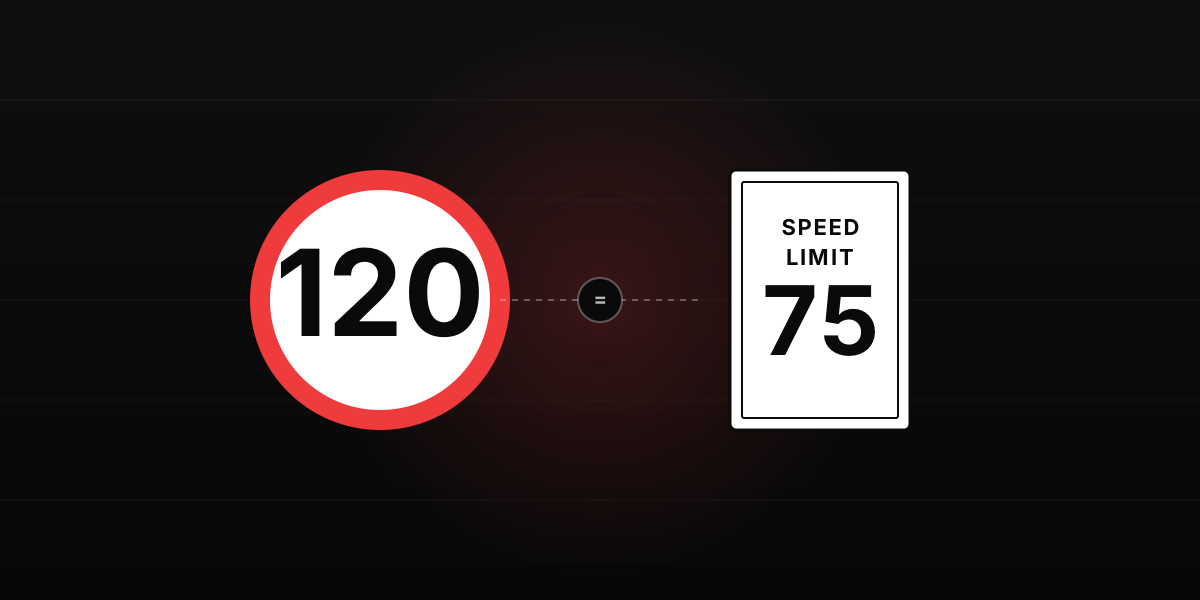
New Mexico posts 75 mph on most rural sections of I-10, I-25 and I-40, with 55-65 mph on two-lane highways and a 30 mph default in business and residence districts. Base fines are among the lowest in the country, but they double in construction zones and posted safety corridors.
New Mexico speed limits at a glance
| Road type | Limit |
|---|---|
| Cities, towns, business districts | 30 mph (48 kph) |
| Residential / school zones | 30 mph (48 kph) |
| Rural highways | 55 mph (89 kph) |
| Interstates / freeways | 75 mph (121 kph) |
About speed limits in New Mexico
New Mexico's statutory maximum is 75 mph, and it covers most of the rural interstate mileage: I-40 across the high plains and desert between Arizona and Texas, I-25 between Albuquerque, Santa Fe and the Colorado line, and I-10 in the boot heel. Limits drop to 55-65 mph as the interstates pass through Albuquerque, Las Cruces and smaller towns, and US highways such as US 550 and US 285 typically carry 55-70 mph depending on the segment. Long sight lines and sparse traffic mean prevailing speeds often sit near or above the posted number, which is one reason the state relies on doubled-fine corridors rather than higher limits to manage its worst crash zones.
The state long carried a reputation for relaxed speed enforcement, helped by base fines that start at just $25 for up to 10 mph over the limit, among the cheapest tickets in the nation. The counterweight is New Mexico's safety corridor program: on posted segments with high fatal-crash rates, such as parts of US 550 and I-25, fines are doubled and patrols concentrated, the same doubling that applies in construction zones with workers present.
In cities and towns, the default is 30 mph in business and residence districts unless posted otherwise, higher than the 25 mph typical of neighboring states, though Albuquerque and Santa Fe post many neighborhood streets at 25 mph. School zones are typically 15-20 mph during posted hours, and New Mexico applies license points to speeding convictions, with suspension possible as points accumulate.
Automated enforcement has made a comeback centered on Albuquerque. The city's Automated Speed Enforcement program has operated fixed radar cameras since April 2022 and has kept expanding, with additional cameras added across the city through 2025, issuing civil citations to vehicles well over the limit. Bernalillo County runs its own photo speed program, and Las Cruces and other cities have used camera enforcement, while the interstates themselves remain patrolled by New Mexico State Police rather than cameras.
Enforcement
New Mexico State Police patrol the interstates with radar and lidar, concentrating on safety corridors and construction zones where fines double. Albuquerque and Bernalillo County operate fixed automated speed cameras on city streets, issuing civil citations, but there are no cameras on the open interstate.
Tolerance
Enforcement on rural interstates has historically been forgiving of small overages, and the $25 base fine for up to 10 mph over reflects that. In safety corridors, work zones and Albuquerque's camera zones, the practical margin is much tighter.
Speeding fines in New Mexico
Base fines are unusually low: typically $25 for up to 10 mph over, rising in steps to roughly $125-200 for 26+ mph over, before court costs and fees. Fines double in construction zones with workers present and in posted safety corridors. Extreme speeds can be charged as reckless driving, a misdemeanor carrying possible jail time and license consequences.
Frequently asked questions
What is the maximum speed limit in New Mexico?
The maximum is 75 mph, posted on most rural sections of I-10, I-25 and I-40. Limits fall to 55-65 mph through Albuquerque and other cities, and two-lane highways generally carry 55-65 mph.
What are New Mexico safety corridors?
They are posted segments of highways with high fatal-crash histories, such as parts of US 550, where speeding fines are doubled and patrols are concentrated. The same fine-doubling applies in construction zones when workers are present.
What is the residential speed limit in New Mexico?
The statutory default is 30 mph in business and residence districts unless otherwise posted, though Albuquerque and Santa Fe sign many neighborhood streets at 25 mph. School zones typically drop to 15-20 mph during posted hours.
Does New Mexico use speed cameras?
Yes, at the city level. Albuquerque has run fixed Automated Speed Enforcement cameras since April 2022 and expanded the program through 2025, and Bernalillo County operates its own photo speed program. The interstates are patrolled by State Police, not cameras.
Speed limits in nearby states
- Texas speed limit — interstate, rural highway, and city limits.
- Arizona speed limit — interstate, rural highway, and city limits.
- Colorado speed limit — interstate, rural highway, and city limits.
- Oklahoma speed limit — interstate, rural highway, and city limits.
- Utah speed limit — interstate, rural highway, and city limits.
Related tools
- Convert MPH to KPH — convert any speed reading between units.
- Car speed test — verify your speedometer accuracy.
- Live GPS speedometer — see your actual speed in the browser.
- Stopping distance calculator — how far you need to brake from each speed.
- US speed limits overview — federal background and national patterns.