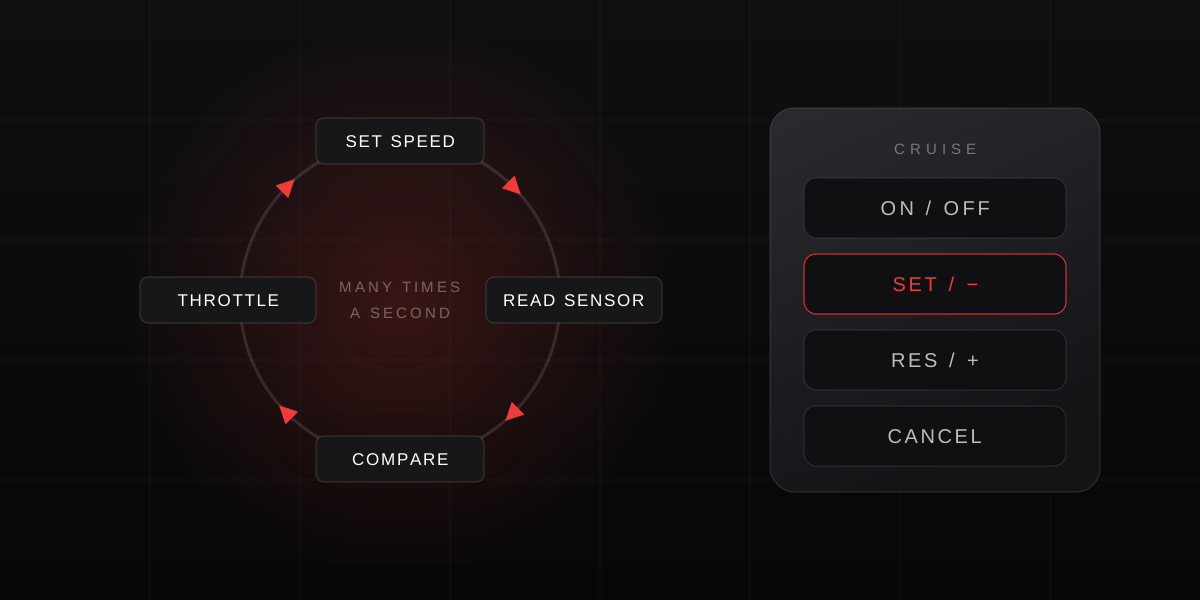
Cruise control holds your car at a speed you choose without you touching the accelerator. That is the whole feature, and it has been on cars since the 1950s. What has changed is everything underneath: a vacuum servo tugging a throttle cable has become a software loop talking to an electronic throttle, and on newer cars a radar has been added so the system watches the traffic as well as the speedometer. Here is what happens when you press SET, what every button does, and where the system stops being helpful.
What cruise control is
You accelerate normally to the speed you want, press SET, and take your foot off. The car now holds that speed, adding power on inclines and easing off on descents, until you brake, cancel, switch it off, or, in a manual, press the clutch.
It controls one thing: how fast the car goes. Steering is yours. Watching for traffic is yours. On a basic system, braking is entirely yours too: ordinary cruise control cannot slow the car below its set speed except by lifting off the throttle, which is why a long descent can carry you past your setting until you touch the brake.
The loop underneath
Everything cruise control does comes out of a four-step cycle that repeats many times a second:
- Store the target. Pressing SET writes your current speed into the module's memory.
- Measure the actual speed. The module reads the vehicle speed signal: wheel speed sensors passed through the ABS module on most modern cars, a dedicated sensor on the transmission on older ones. This is the same signal that drives your speedometer, a detail that matters more than it sounds.
- Compare. Subtract one from the other. Too slow, too fast, or close enough.
- Correct. Command a different throttle opening, in proportion to the size of the error and how long it has persisted, so the car converges on the target without hunting around it.
On any car with drive-by-wire, effectively everything built in the last twenty years, step four is a message on the vehicle network asking the engine computer for a new throttle position, and on a steep enough climb it will also request a downshift. On older mechanical systems, a servo used engine vacuum to physically pull the throttle cable, which is why those systems sometimes lost the ability to hold speed when a vacuum hose cracked.
Because the loop is fed by the speedometer's own signal, a fault in that signal takes out both. If your speedometer misbehaves and the cruise control refuses to engage on the same day, that is not a coincidence: see speedometer not working.
The controls, and what each one does
Labels vary but the functions are near-universal. They sit on a stalk behind the wheel or on the wheel's spokes.
| Control | What it does |
|---|---|
| ON / OFF | Wakes the system. Nothing is being held yet, but a light or a speed icon appears on the dash. |
| SET / − / COAST | Stores your current speed and engages. While engaged, a tap trims the target down by about 1 mph; holding it lets the car coast until you release. |
| RES / + / ACCEL | Resumes the last stored speed after a cancel. While engaged, a tap raises the target by about 1 mph; holding it accelerates until you release. |
| CANCEL | Disengages but keeps the stored speed, so RES picks it up again. The brake pedal does the same thing, as does the clutch on a manual. |
Two things worth knowing. Switching the system fully OFF, or turning off the ignition, usually erases the stored speed, so RES has nothing to return to. And the brake pedal cancels through the brake light switch, a cheap part that is the reason a surprising number of cruise control faults turn out to be electrical rather than mechanical.
Using it well
- Get to speed first. Accelerate with your foot, settle, then press SET. Setting low and holding RES to climb is slower and thirstier.
- Expect a minimum speed. Most systems will not engage below roughly 25 mph (about 40 km/h). The exact figure is in your owner's manual and adaptive systems that handle traffic jams often go much lower.
- Keep your feet where they belong. Resting a foot near the pedals rather than on the floor keeps your reaction time honest.
- Cancel early, not late. If traffic is closing in, cancel before you need the brake. The system will not do it for you unless it is adaptive.
Cruise control is not a speed limiter
These share a stalk on many European cars and get confused constantly. A speed limiter caps how fast you can go while you keep driving with your foot: set it to 30 mph in town and the throttle simply stops responding beyond that point. Cruise control takes over the throttle and drives to the number itself. If your car has both, there is a mode button switching between them, and the dash icon changes accordingly, which explains the common complaint that "the car shows 70 but isn't accelerating".
Adaptive cruise control
Adaptive cruise control (ACC, and about a dozen manufacturer brand names) adds a forward-facing radar behind the grille, a camera at the top of the windscreen, or both. Instead of holding only a speed, it holds a speed and a gap, whichever is more restrictive.
On an open road it behaves exactly like ordinary cruise control. When it detects a slower vehicle ahead, it eases off, settles into your chosen following distance, usually selectable across three or four steps, and then resumes your set speed once the lane clears. Many current systems work in stop-and-go traffic all the way to a standstill and pull away again, either automatically or after a tap of the throttle.
What it is not: an autonomous driving system. Radar-based systems are poor at reacting to stationary objects at speed, both radar and camera can be degraded by heavy rain, snow, mud or ice on the sensor, and a tight bend can make the system briefly lose the car in front and accelerate at exactly the wrong moment. ACC does not steer. If your car also holds a lane, that is a separate system with its own limits.
One economy note: because ACC is chasing a gap rather than a speed, in dense traffic it inherits somebody else's driving. We looked at what that does to consumption in does cruise control save gas.
The number it holds is the flattering one
Since cruise control reads the speedometer's signal, it inherits the speedometer's bias. Regulations in most markets permit a car's speedometer to over-read but never to under-read, so manufacturers leave themselves a margin and typical cars display 1 to 3 percent above true speed. Set the cruise to an indicated 70 and you are probably doing about 68.
That is worth knowing in both directions: you have a little more headroom below a limit than you thought, and a car that seems to cruise "faster" than another at the same setting may simply have a more optimistic dial. Measuring your own offset takes minutes: hold a steady cruise, compare against the live GPS speedometer, and run the numbers through the speedometer error calculator. GPS derives speed from the Doppler shift of satellite signals rather than from your wheels, which is why it lands within about 0.5 to 2 mph of true ground speed and does not care what size tyres you fitted.
When to leave it off
Rain, snow and ice come first: on a slippery surface, a system trying to defend a set speed can spin a wheel at precisely the wrong moment, and reclaiming control costs time you may not have. Then heavy traffic, where you will be cancelling constantly; winding roads, where the system fights the corner; and steep, repeated hills, where it is both jerky and wasteful. Add one more that is easy to rationalise away: if you are tired, cruise control removes one of the few tasks keeping you engaged.
The takeaway
Cruise control is a simple loop (store a speed, compare it with the speed sensor, adjust the throttle) dressed up in newer cars with a radar that watches the car ahead. Learn the four controls, respect the minimum speed, know whether your car is in cruise or limiter mode, and remember that the speed it defends is the one your dashboard chose to show you, not the one you are travelling at. If it has stopped engaging at all, cruise control not working runs through the causes from cheapest to worst.