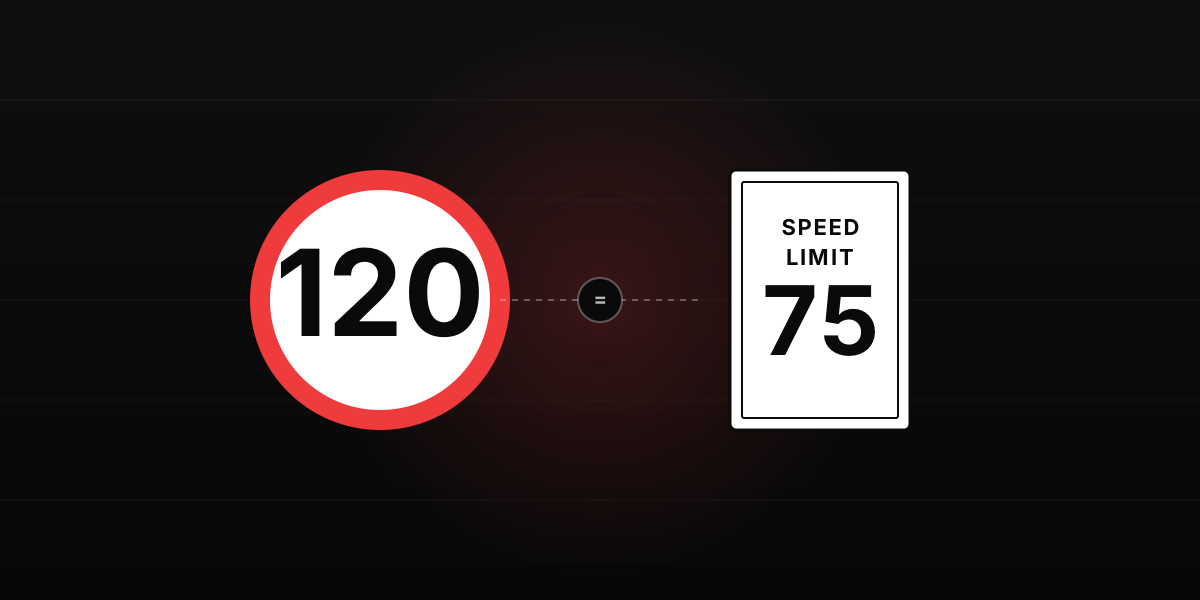
Portugal maintains the European standard: 50 kph in towns, 90 on rural roads, and 120 on auto-estrada motorway. Most Portuguese motorways are tolled — including the entire main network connecting Lisbon, Porto, and the Algarve. New drivers face reduced limits for their first 3 years.
Speed limits at a glance
| Road type | Limit |
|---|---|
| In built-up areas (cities, towns) | 50 kph (31 mph) |
| Residential / school zones | 30 kph (19 mph) |
| Outside built-up areas (rural) | 90 kph (56 mph) |
| Motorways / expressways | 120 kph (75 mph) |
About speed limits in Portugal
Portuguese motorways (auto-estradas) are nearly all toll roads, with electronic Via Verde or traditional toll booths. The toll network spans the main A1 (Lisbon-Porto), A2 (Lisbon-Algarve), A3 (Porto-Spanish border), and most other major routes. Foreign cars need to register for Via Verde or pay manually; non-payment leads to substantial fines.
New drivers (condutores recém-habilitados, first 3 years) face limits 10 kph below standard: 110 kph on auto-estrada, 80 on dual carriageway, 80 on rural single carriageway. They must display the visible "90" or sticker indicating their status. Foreign drivers visiting Portugal use their own country's limit unless their license is less than 3 years old at home.
Rural roads (estradas nacionais and estradas municipais) carry the 90 kph default but vary widely in actual quality. Coastal roads near tourist areas are often heavily congested in summer; mountain roads in the interior can be slow due to switchbacks regardless of posted limit.
The Algarve summer enforcement is notably strict. Police mobile radar operates routinely on the A22 and N125 between Faro and the western Algarve. Tourist drivers are common ticket targets. The Algarve also has its own toll system on the A22 separate from the rest of the network.
Enforcement
Portugal uses fixed cameras (radares de velocidade) and mobile radar (radares móveis) extensively. The GNR (Guarda Nacional Republicana) operates rural patrol; the PSP (Polícia de Segurança Pública) operates urban. Cross-border enforcement with EU is robust.
Tolerance
Tolerance is 5 kph below 100 kph and 5 percent above. So 127 kph on a 120 limit becomes 121 — lowest fine band. Standard European practice.
Fines for speeding
€60 for under 20 kph over on auto-estrada, rising to €500+ plus license suspension for 60+ kph over. Foreign drivers must pay before leaving the country in some cases; hire cars debit the driver. License point system (12 points) loses 1 to 5 per offense.
Frequently asked questions
Are Portuguese motorways tolled?
Most are. The A1, A2, A3, A6, A22, and most other auto-estradas use either electronic Via Verde or traditional toll booths. Foreign cars need to register for Via Verde or pay manually. Non-payment leads to substantial fines. The Algarve A22 uses a separate toll system from the main network.
What is the Portuguese motorway speed limit?
120 kph (74 mph) on auto-estrada. New drivers in their first 3 years face 110 kph. The limit drops in rain (some sections post 110 in wet weather, though not as systematically as France or Italy). Variable signs on some sections can lower further.
What is Via Verde?
The Portuguese electronic toll system. Vehicles fitted with a Via Verde transponder pay tolls automatically; the system also handles parking and some fuel payments. Foreign cars can register temporarily online or rent a transponder. Without Via Verde, foreign drivers must pay at toll booths or face fines.
Are speed limits in Algarve enforced?
Strictly, especially in summer. The GNR operates mobile radar routinely on the A22 motorway and N125 coastal road. Tourist drivers are common ticket targets. The Algarve has its own toll system on the A22 — non-payment leads to fines plus toll charges.
Speed limits in other countries
Limits, tolerances and fines differ sharply across borders. These pages cover the same ground for every country we have researched.
- Australia
- Austria
- Belgium
- Canada
- Denmark
- France
- Germany
- Italy
- Japan
- Netherlands
- Norway
- Spain
- Sweden
- Switzerland
- Turkey
- United Kingdom
- United States
Related tools
- Convert KPH to MPH — convert any speed reading between units.
- Car speed test — verify your speedometer accuracy.
- Live GPS speedometer — see your actual speed in the browser.
- Stopping distance calculator — how far you need to brake from each speed.