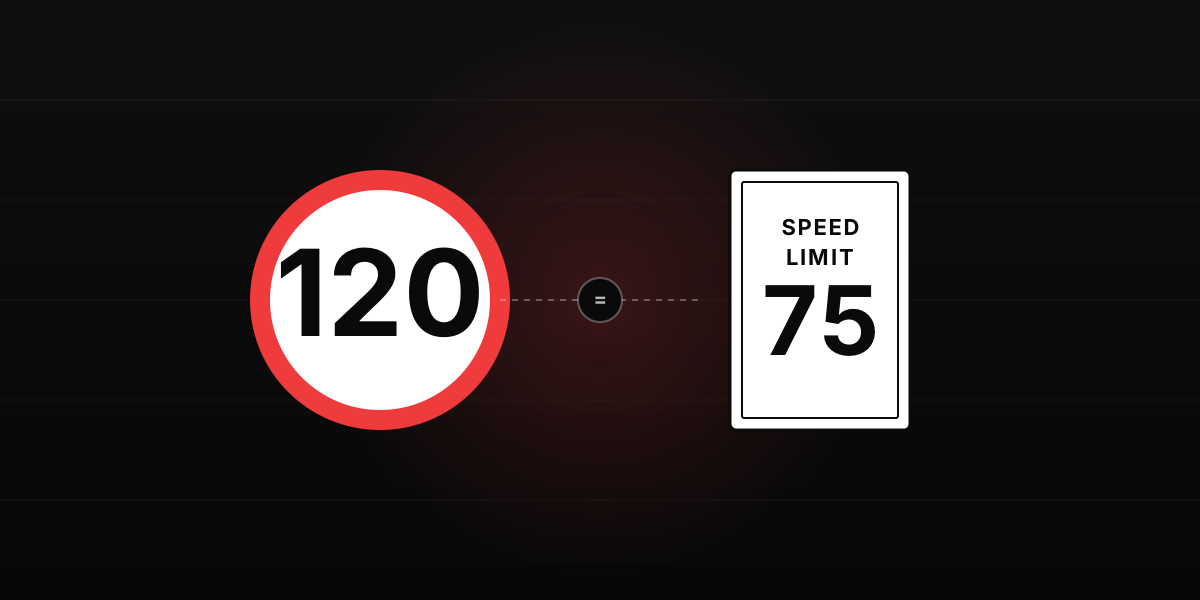
Germany is one of the few countries in the world with no general speed limit on its motorways. About 70 percent of the Autobahn network is unrestricted, with a 130 kph advisory speed; the rest carries posted limits typically between 100 and 130 kph. City and rural limits follow standard European patterns.
Speed limits at a glance
| Road type | Limit |
|---|---|
| In built-up areas (cities, towns) | 50 kph (31 mph) |
| Residential / school zones | 30 kph (19 mph) |
| Outside built-up areas (rural) | 100 kph (62 mph) |
| Motorways / expressways | unrestricted (130 advisory) |
About speed limits in Germany
The Autobahn unrestricted sections (about 13,000 km of the 13,200 km total network) carry an advisory speed of 130 kph (81 mph). Exceeding it is legal but reduces your insurance coverage in the event of a crash: German courts consistently rule that drivers exceeding 130 kph share fault even when not technically the cause. About 30 percent of the network has posted limits, typically near urban areas, construction zones, or in mountainous terrain.
Inside cities the default is 50 kph (31 mph), with extensive Tempo 30 zones in residential areas and around schools. Tempo 30 zones cover roughly 70 percent of urban streets in most German cities by length. Rural roads outside built-up areas default to 100 kph (62 mph). Trucks above 3.5 tonnes are limited to 80 kph on rural roads and 60 kph through towns.
Recent debate has centered on whether to impose a general 130 kph Autobahn limit for CO2 reduction. The 2021 federal coalition agreement specifically excluded such a limit, and as of 2026 no general motorway limit exists. Environmental groups and parts of the SPD continue to push for one; the FDP and CDU have consistently opposed.
Winter speed limits apply automatically in some länder when conditions degrade: from October to Easter, motorway sections may be reduced to 100 or 80 kph by electronic signage. These changes are real-time and binding when displayed.
Enforcement
Germany uses fixed and mobile radar widely. Speed cameras (Blitzer) are common on motorways near construction and city entrances. Mobile vans operate from unmarked positions; police laser is standard. The Bundeskartellamt maintains a public list of high-traffic camera locations.
Tolerance
Up to 50 kph: 3 kph tolerance subtracted from measured speed. Above 100 kph: 3 percent tolerance. So a measured 137 kph on a 130 kph limit becomes 133 kph after tolerance — 3 kph over, lowest fine band.
Fines for speeding
Fines range from €30 (10 kph over in town) to €800 plus 3-month license suspension (70+ kph over). At 31+ kph over in built-up areas, a 1-month license suspension is automatic. Driving 41+ kph over inside cities or 61+ kph elsewhere can mean immediate license forfeit at the roadside.
Frequently asked questions
Is the Autobahn really unlimited?
About 70 percent of the Autobahn network has no general speed limit, with a 130 kph advisory. The remaining 30 percent has posted limits, typically 100 to 130 kph. The advisory speed is not enforced but does affect insurance liability after a crash.
What happens if I exceed the Autobahn advisory speed in a crash?
German courts apply Mitverschulden (shared fault) to drivers exceeding 130 kph on unrestricted sections. Even if the other driver is technically at fault, your insurance payout can be reduced 25 to 50 percent. Above 150 kph the share rises further.
Are German speed limit fines stiff?
Compared to the Netherlands or Scandinavia, German fines are moderate: €30 for 10 kph over in town, escalating to several hundred euros plus license points. The Punktekonto (points system) ramps quickly — eight points means license loss.
Does Germany use camera enforcement?
Yes, extensively. Fixed and mobile radar both operate. Section control (average speed over a stretch) is being expanded on accident-prone roads. Drivers occasionally face combined ticketing for one offense detected at two camera points within minutes.
Speed limits in other countries
Limits, tolerances and fines differ sharply across borders. These pages cover the same ground for every country we have researched.
- Australia
- Austria
- Belgium
- Canada
- Denmark
- France
- Italy
- Japan
- Netherlands
- Norway
- Portugal
- Spain
- Sweden
- Switzerland
- Turkey
- United Kingdom
- United States
Related tools
- Convert KPH to MPH — convert any speed reading between units.
- Car speed test — verify your speedometer accuracy.
- Live GPS speedometer — see your actual speed in the browser.
- Stopping distance calculator — how far you need to brake from each speed.