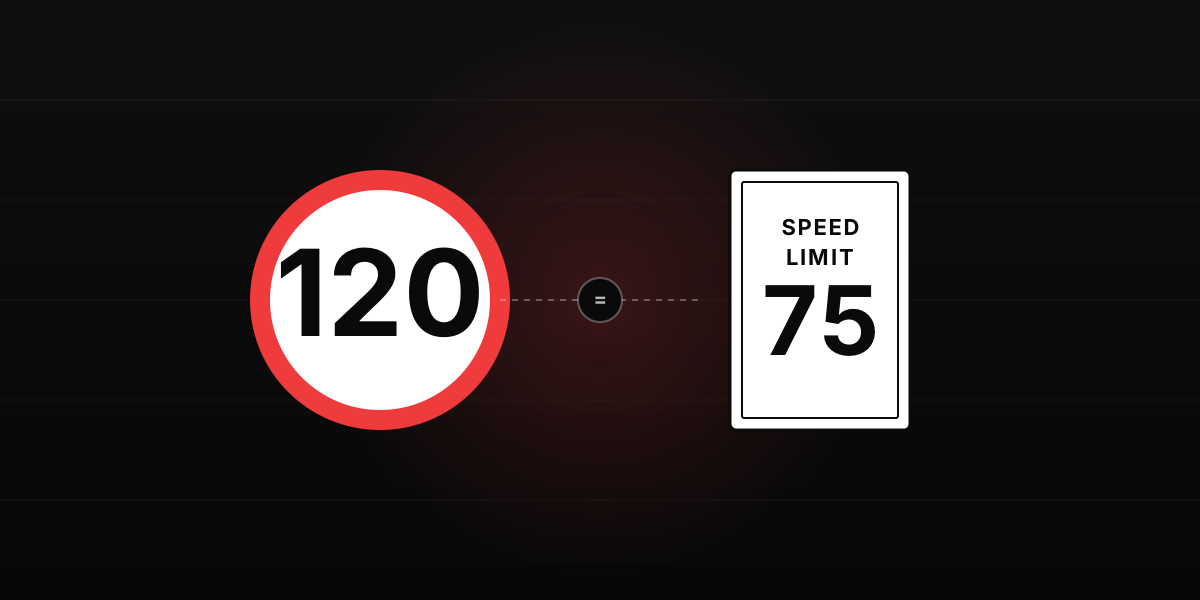
Turkey uses standard European-style speed limits: 50 kph in towns, 90 on rural roads, and 120 on otoyol (motorway). Proposals to raise some otoyol sections to 140 kph have been discussed since the early 2020s but not adopted as of 2026. Enforcement has expanded with growing camera coverage.
Speed limits at a glance
| Road type | Limit |
|---|---|
| In built-up areas (cities, towns) | 50 kph (31 mph) |
| Residential / school zones | 30 kph (19 mph) |
| Outside built-up areas (rural) | 90 kph (56 mph) |
| Motorways / expressways | 120 kph (75 mph) |
About speed limits in Turkey
Turkey's motorway network (otoyol) has expanded rapidly since 2000, now totaling over 3,700 km. Major routes include the O-1 (Istanbul ring), O-4 (Istanbul-Ankara), O-21 (Bolu Tunnel section), and the newer Yavuz Sultan Selim Bridge and Osmangazi Bridge connections. The 120 kph limit applies universally on these modern routes.
The Turkish General Directorate of Highways (KGM) has proposed raising specific otoyol sections to 140 kph based on road quality and safety data. As of 2026 the proposal remains under review; current law caps at 120. Some politicians have publicly supported the increase; safety advocates oppose.
Urban speed limits in Turkey are 50 kph default, dropping to 30 in residential and school areas. Major cities (Istanbul, Ankara, Izmir) have introduced 30 kph zones in historic neighborhoods. Camera coverage in cities is uneven — some districts heavily monitored, others almost none.
Rural roads in Turkey vary widely in quality. Modern duble yol (dual carriageway) sections post 110 kph; older single-lane state roads (devlet yolu) post 90. Mountain roads can drop to 50 or even 30 depending on conditions.
Enforcement
Turkey uses fixed cameras (otomatik hız kontrol sistemi) and mobile radar (radar). The EDS (Elektronik Denetleme Sistemi) network has expanded substantially since 2010. Mobile police units with handheld radar operate throughout. Cross-border enforcement with EU is patchy.
Tolerance
Tolerance is approximately 10 percent above the limit before cameras trigger in practice, though official tolerance is 5 kph minimum. Mobile patrol enforcement varies by location.
Fines for speeding
Speeding fines (hız ihlal cezası) range from TRY 600 (around USD 20) for under 10 percent over to TRY 5,000+ plus license suspension for 50+ percent over. License point system loses 10 to 20 points per offense (100 maximum). Loss of all points means license suspension and retesting.
Frequently asked questions
What is the Turkish motorway speed limit?
120 kph (74 mph) on otoyol throughout Turkey. Proposals to raise specific sections to 140 kph have been discussed since the early 2020s but not adopted. The 120 limit applies on modern motorway routes including the O-1 Istanbul ring and O-4 Istanbul-Ankara.
Are Turkish speed cameras strict?
Moderate. Camera coverage has expanded substantially since 2010 with the EDS system. Tolerance is approximately 5 kph or 10 percent in practice. Mobile radar enforcement varies by district. Major motorway routes are well-monitored; rural roads less so.
What is duble yol in Turkey?
A dual carriageway road — physically two roads with median between them, but lower-grade than otoyol motorway. Duble yol typically posts 110 kph compared to otoyol's 120. Older single-lane state roads (devlet yolu) post 90 kph.
Do Turkish license points work like Europe?
Yes, similar concept. Each driver has up to 100 points (the system was simplified in 2017). Speeding offenses cost 10 to 20 points depending on severity. Loss of all points means license suspension and retesting. Recovery requires waiting periods.
Speed limits in other countries
Limits, tolerances and fines differ sharply across borders. These pages cover the same ground for every country we have researched.
- Australia
- Austria
- Belgium
- Canada
- Denmark
- France
- Germany
- Italy
- Japan
- Netherlands
- Norway
- Portugal
- Spain
- Sweden
- Switzerland
- United Kingdom
- United States
Related tools
- Convert KPH to MPH — convert any speed reading between units.
- Car speed test — verify your speedometer accuracy.
- Live GPS speedometer — see your actual speed in the browser.
- Stopping distance calculator — how far you need to brake from each speed.