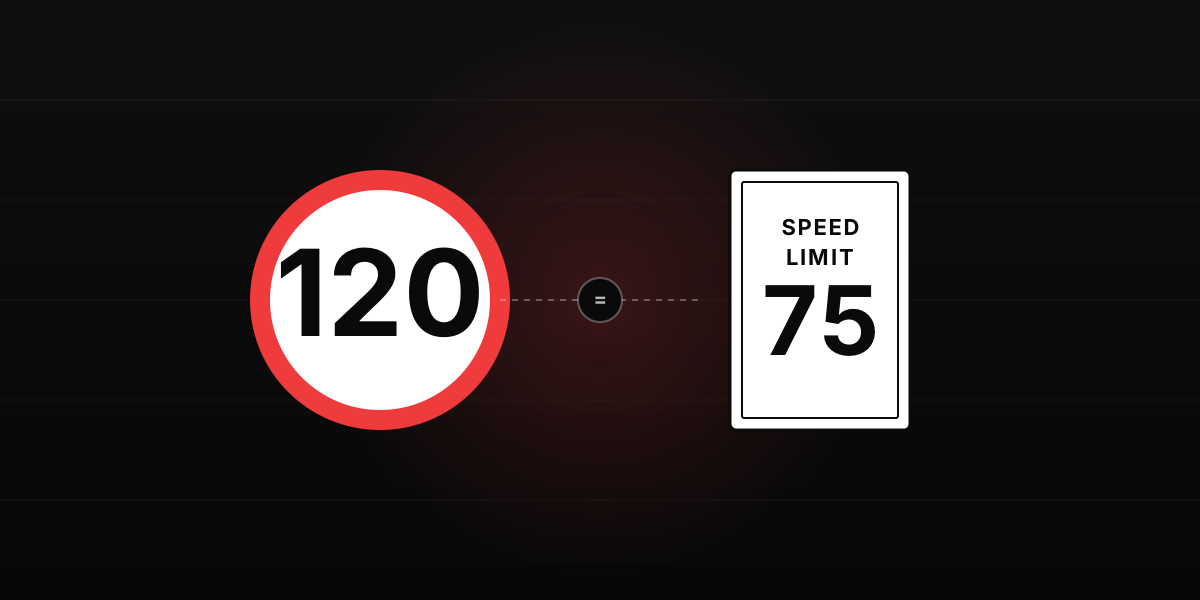
The Netherlands famously lowered its motorway daytime limit from 130 to 100 kph in March 2020 — primarily as a nitrogen-emissions measure tied to the European Habitats Directive ruling. The 130 kph limit returns between 19:00 and 06:00 on most motorway sections, an unusual time-based scheme found nowhere else in Europe at scale.
Speed limits at a glance
| Road type | Limit |
|---|---|
| In built-up areas (cities, towns) | 50 kph (31 mph) |
| Residential / school zones | 30 kph (19 mph) |
| Outside built-up areas (rural) | 80 kph (50 mph) |
| Motorways / expressways | 100 day / 130 night |
About speed limits in Netherlands
The 100 kph daytime motorway limit was implemented in March 2020 after the Council of State ruled the Netherlands was exceeding nitrogen emission thresholds under the EU Habitats Directive. The measure was political theater as well as substance: cars contribute a small share of total nitrogen emissions, but the speed reduction was the visible action the government could take quickly. The 130 kph night limit (19:00-06:00) preserves some original character.
The 50 kph urban default is more strictly enforced than in many neighbors. The Dutch police use both fixed and mobile cameras, and the rondweg (ring road) sections of major cities have section-control averaging. The infamous A2 from Utrecht to Den Bosch is among the most camera-monitored stretches in Europe.
Cyclists have unusual priority in Dutch traffic law. Cars share many urban streets with cyclists, and the 30 kph zone (woonerf in residential, fietsstraat for cycle-priority streets) is common. Drivers are presumed at fault in any collision involving a cyclist or pedestrian, regardless of speed.
Dutch fines are among the highest in Europe in absolute terms. Many drivers describe Dutch speed enforcement as the strictest practical experience in Europe, even compared to Switzerland or Norway. The combination of dense camera coverage, low tolerance, and high fine amounts produces a disciplined driving culture.
Enforcement
Dutch police use extensive fixed cameras (flitspalen), mobile radar (radarwagens), and section control (trajectcontrole). The trajectcontrole system covers many motorway stretches including the entire A2 from Utrecht to Maastricht in some configurations. Average-speed enforcement makes evasion through brief slowdowns impossible.
Tolerance
Tolerance is 3 kph for limits up to 100 kph and 3 percent above 100. So 103 kph measured on a 100 limit becomes 100 — no fine. 134 kph on a 130 night limit becomes 130. Below 100, the 3 kph minimum is rigidly applied.
Fines for speeding
Among the highest in Europe. €30 for under 10 kph over rises to €330+ for 30+ kph over plus license suspension. 50+ kph over is criminal (artikel 162 of the Wegenverkeerswet) with fines up to €9,750 and 3-year license loss possible. Foreign plates pay the same; cross-border EU enforcement is robust.
Frequently asked questions
Why is the Dutch motorway limit 100 kph during the day?
In March 2020 the Netherlands lowered its daytime motorway limit from 130 to 100 kph (the night limit of 130 remains 19:00-06:00). The change was driven by the EU Habitats Directive nitrogen-emissions ruling: the Dutch government needed visible action to reduce nitrogen oxide deposition in protected areas. The day/night switch is enforced by camera.
When does the 130 kph night limit start?
19:00 in the evening. The 100 kph daytime limit applies 06:00 to 19:00. Variable electronic signs over most motorway sections automatically display the active limit; the sign is binding regardless of clock time visible to the driver.
How strict are Dutch speed camera fines?
Among the strictest in Europe. Tolerance is 3 kph below 100 and 3 percent above. Fines start at €30 for under 10 kph over and rise sharply: €330+ for 30 kph over with license suspension. 50+ kph over is criminal (artikel 162) with fines to €9,750 and license loss up to 3 years.
What is trajectcontrole?
Section-control averaging. The system records you entering and leaving a measured stretch and computes average speed. Common on Dutch motorways including the A2, A4, and A12. Average-speed cameras catch many drivers who slow for fixed cameras then accelerate; you are charged based on the computed average over the whole section.
Speed limits in other countries
Limits, tolerances and fines differ sharply across borders. These pages cover the same ground for every country we have researched.
- Australia
- Austria
- Belgium
- Canada
- Denmark
- France
- Germany
- Italy
- Japan
- Norway
- Portugal
- Spain
- Sweden
- Switzerland
- Turkey
- United Kingdom
- United States
Related tools
- Convert KPH to MPH — convert any speed reading between units.
- Car speed test — verify your speedometer accuracy.
- Live GPS speedometer — see your actual speed in the browser.
- Stopping distance calculator — how far you need to brake from each speed.