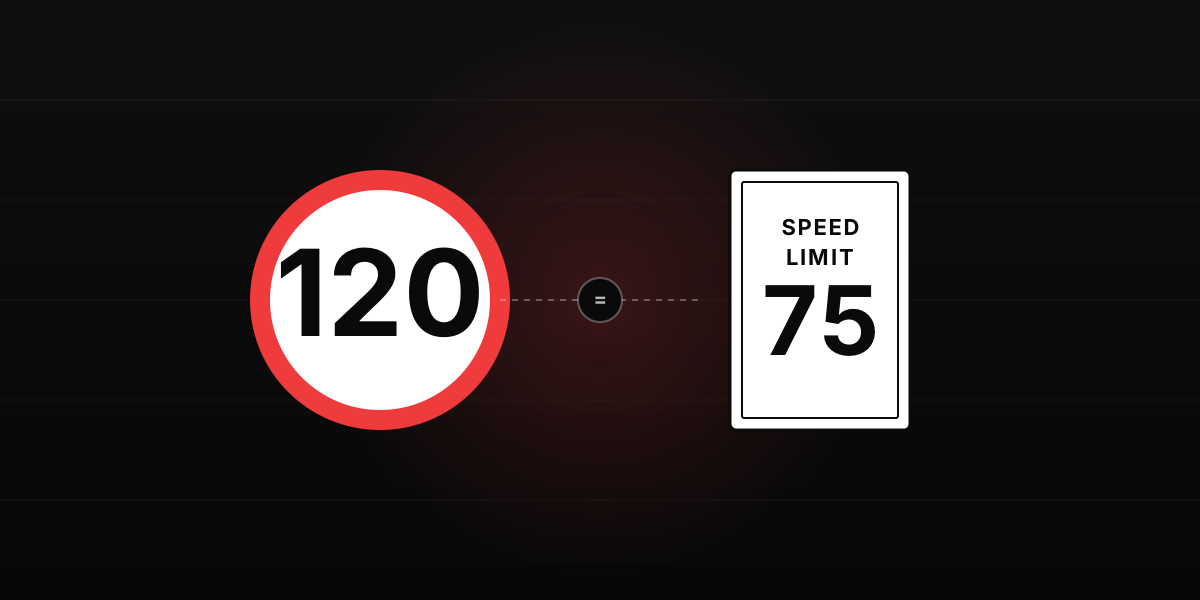
Japan keeps speed limits low by international standards: city streets are typically 40 to 60 kph, rural highways 60 kph, and expressways 100 to 120 kph. The 120 kph maximum is recent — the Shin-Tomei Expressway between Nagoya and Tokyo had its limit raised from 100 to 120 in March 2020 after a 6-year trial showed acceptable safety data.
Speed limits at a glance
| Road type | Limit |
|---|---|
| In built-up areas (cities, towns) | 40-60 |
| Residential / school zones | 30 kph (19 mph) |
| Outside built-up areas (rural) | 60 kph (37 mph) |
| Motorways / expressways | 100-120 |
About speed limits in Japan
The Shin-Tomei Expressway (新東名高速道路) became the first Japanese expressway to post 120 kph (75 mph) in March 2020. Before that, the maximum was 100 kph nationwide, unchanged since the 1960s. The 6-year trial period collected enough data to satisfy the National Police Agency that 120 was safe on this modern, six-lane stretch. Other modern expressways have followed.
Urban speed limits in Japan are exceptionally low because Japanese cities are dense and pedestrian-heavy. Tokyo arterials are typically 50 to 60 kph; smaller streets are 40, and many residential lanes drop to 30. School zones are 30 kph and strictly enforced. The combination of low limits, narrow streets, and intense police presence produces very disciplined urban driving.
Rural roads in Japan default to 60 kph — lower than most countries because road design tends toward narrow, winding routes. Mountain roads can drop to 30 or 40 even at posted level. Modern bypass highways carry 60 to 80 kph limits depending on grade and curvature.
Speed enforcement is heavy. The Japanese Police use Oshushizei radar (mobile) and an extensive network of fixed cameras (Orbit, LH systems). Detection is unforgiving: cameras trigger at the limit with minimal tolerance, and the Japanese license-points system (累積点数) accumulates quickly.
Enforcement
Fixed speed cameras (Orbit, LH systems) cover expressways and main urban arterials. Mobile radar (Oshushizei) operates everywhere. Japanese Police hide behind overpasses and in unmarked vehicles. Section-control cameras have been introduced on some new expressway sections. License point accumulation is enforced strictly.
Tolerance
Tolerance is approximately 5 to 10 kph above the limit in practice for fixed cameras, but this is unofficial and varies by region. The license-points system loses 1 point at under 15 kph over, 3 points at 15-25 over, 6 points at 25+ over. 6 points within 1 year means license suspension.
Fines for speeding
Fines start at JPY 9,000 (around USD 60) for under 15 kph over, rising to JPY 100,000+ for 50+ kph over. Excessive speeding (30+ kph over on general roads, 40+ on expressway) is criminal under the Road Traffic Act with up to 6 months prison theoretical and JPY 100,000 fine. License loss for criminal cases.
Frequently asked questions
What is the highest speed limit in Japan?
120 kph (75 mph) on the Shin-Tomei Expressway between Nagoya and Tokyo, raised from 100 in March 2020 after a 6-year safety trial. Other modern expressways (some sections of New Meishin) have followed. Most Japanese expressways remain at 100 kph; the 120 zones are exceptions on specifically engineered routes.
Why are Japanese urban speed limits so low?
Japanese cities are extremely dense with high pedestrian and cyclist traffic. Tokyo arterials post 50-60 kph, smaller streets 40, residential 30. School zones are 30 strictly enforced. The low limits combined with intense police presence and a strong license-point system produce disciplined urban driving.
Does Japan use speed cameras?
Yes, extensively. Fixed Orbit and LH cameras cover expressways and main urban arterials. Mobile radar operates everywhere. Section-control cameras have been introduced on some new expressway sections. Japan also uses unmarked patrol cars heavily on expressways.
What happens if I lose my license in Japan?
The license-point system (累積点数) tracks 6-point cycles. Accumulating 6 points within 1 year means automatic suspension (30 days minimum). 15 points means license revocation. Recovery requires waiting periods and retesting. Foreign drivers face the same system; convert and use an IDP for short stays.
Speed limits in other countries
Limits, tolerances and fines differ sharply across borders. These pages cover the same ground for every country we have researched.
- Australia
- Austria
- Belgium
- Canada
- Denmark
- France
- Germany
- Italy
- Netherlands
- Norway
- Portugal
- Spain
- Sweden
- Switzerland
- Turkey
- United Kingdom
- United States
Related tools
- Convert KPH to MPH — convert any speed reading between units.
- Car speed test — verify your speedometer accuracy.
- Live GPS speedometer — see your actual speed in the browser.
- Stopping distance calculator — how far you need to brake from each speed.