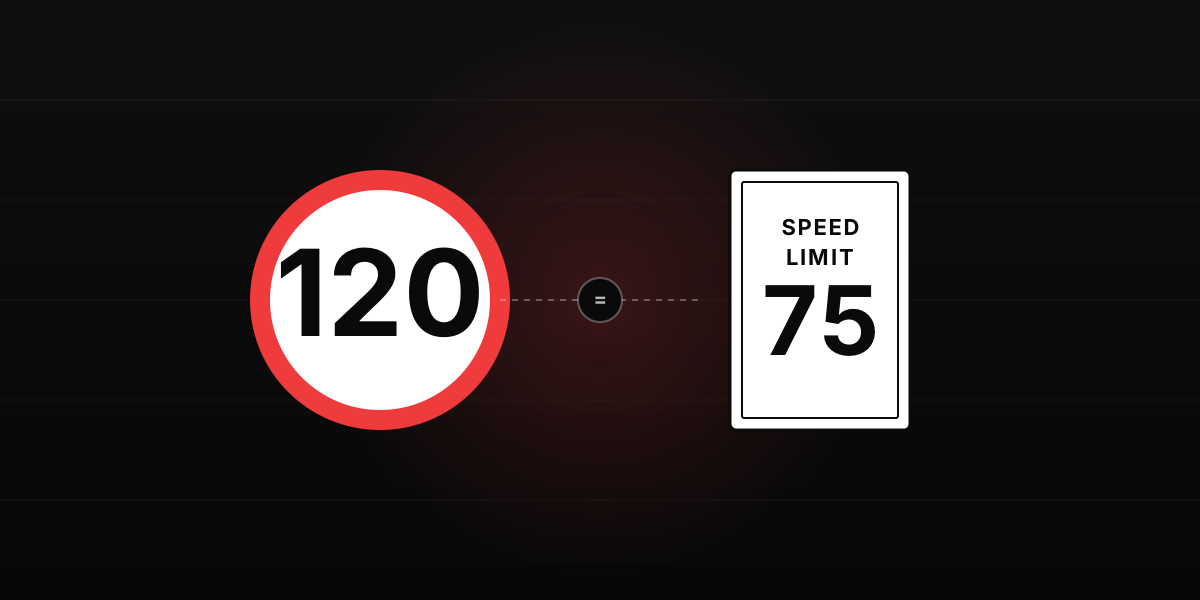
Switzerland keeps its motorway limit at 120 kph — lower than most EU neighbors and unchanged for decades. The Swiss are famous for fines based on the offender's income: a multi-million-franc speeding ticket made world news in 2010. The vignette (annual sticker) is required for any motorway use.
Speed limits at a glance
| Road type | Limit |
|---|---|
| In built-up areas (cities, towns) | 50 kph (31 mph) |
| Residential / school zones | 30 kph (19 mph) |
| Outside built-up areas (rural) | 80 kph (50 mph) |
| Motorways / expressways | 120 kph (75 mph) |
About speed limits in Switzerland
Switzerland's motorway limit of 120 kph is lower than France, Germany, and Italy (130). The Swiss Federal Roads Office has repeatedly resisted raising it, citing safety data and the country's mountainous terrain. The 120 limit applies to all autoroutes regardless of grade.
Swiss speeding fines are notoriously income-based for serious offenses. The 2010 Mercedes SLS AMG case (driver caught at 290 kph in a 120 zone) resulted in a 290,000 CHF fine because of the driver's reported income. Bern courts assess wealth and adjust fines accordingly. This is rare in Europe — most countries use fixed fine schedules.
The vignette (motorway sticker) costs CHF 40 per year and is required for any motorway use — no exceptions for transit. Foreign cars need it from the moment they enter a Swiss motorway. The vignette is a separate enforcement target: driving without one is CHF 200 fine plus immediate purchase requirement.
Swiss traffic enforcement is famously strict. The cantons of Vaud, Geneva, and Zürich operate dense fixed camera networks. Mobile radar is universal. Section-control averaging is used on Alpine tunnels and key transit routes. The combination of dense enforcement and high fines produces among the most disciplined driving cultures in Europe.
Enforcement
Switzerland uses fixed cameras, mobile radar, and section-control averaging extensively. The Gotthard, Lötschberg, and other Alpine tunnels have entry-to-exit average-speed measurement. Cantonal police operate independently with their own radar fleets. Section control on the A2 transit route is well-known among long-haul drivers.
Tolerance
Tolerance is 5 kph for limits up to 100 kph and 5 percent above. So 127 kph on a 120 limit becomes 121 — fine territory. Below 100, the 5 kph minimum dominates. Section-control averaging uses the same tolerance on the computed average.
Fines for speeding
Among the highest in Europe in absolute terms, especially for serious offenses where income adjustment applies. CHF 40 for under 5 kph over on motorway, rising to CHF 580+ plus license suspension for 30+ kph over. 25+ kph over in town or 30+ on rural or 35+ on motorway triggers automatic court referral. Wealthy offenders have faced 100,000+ CHF fines.
Frequently asked questions
Is the famous "income-based fine" real in Switzerland?
Yes. For serious speeding offenses, Swiss courts assess the offender's income and adjust fines accordingly. A 2010 case at 290 kph resulted in a 290,000 CHF fine. This applies mainly to court-referred cases (30+ kph over the limit on motorway). Standard ticket fines are not income-adjusted.
What is the Swiss motorway vignette?
An annual sticker (CHF 40) required for any Swiss motorway use, regardless of how briefly. Foreign cars need it from the moment they enter. Driving without is CHF 200 fine plus mandatory purchase. The vignette is universally available at border posts, gas stations near borders, and online.
Why is the Swiss motorway limit only 120?
The Swiss Federal Roads Office cites safety data and the country's mountainous, weather-variable terrain. The 120 limit has been unchanged for decades. Switzerland has consistently resisted raising it, even as German and Italian neighbors run 130 kph or higher on equivalent infrastructure.
Are Swiss speed cameras strict?
Among the strictest in Europe. Tolerance is 5 kph below 100 kph and 5 percent above. Section-control averaging covers major Alpine tunnels and transit routes. Cantonal enforcement varies but the federal baseline is rigid. Foreign plates pay the same; cross-border EU enforcement is robust.
Speed limits in other countries
Limits, tolerances and fines differ sharply across borders. These pages cover the same ground for every country we have researched.
- Australia
- Austria
- Belgium
- Canada
- Denmark
- France
- Germany
- Italy
- Japan
- Netherlands
- Norway
- Portugal
- Spain
- Sweden
- Turkey
- United Kingdom
- United States
Related tools
- Convert KPH to MPH — convert any speed reading between units.
- Car speed test — verify your speedometer accuracy.
- Live GPS speedometer — see your actual speed in the browser.
- Stopping distance calculator — how far you need to brake from each speed.