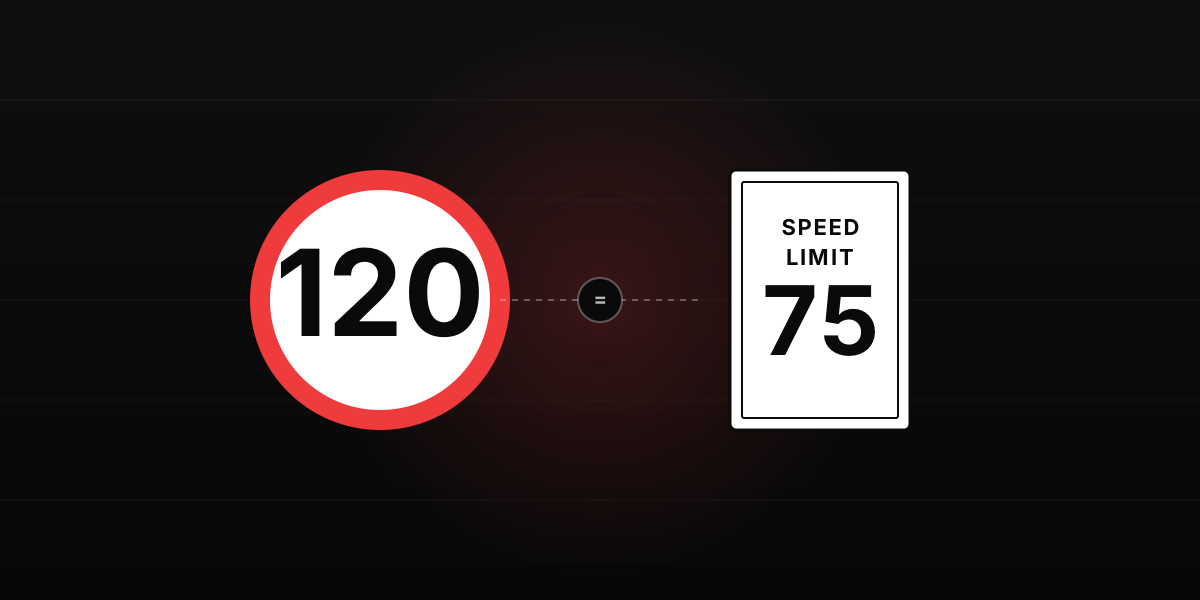
Spain lowered its urban default from 50 to 30 kph in May 2021, becoming the first major European country to make 30 the standard. Single-lane streets are 30; streets with one lane each direction are 30; only main roads with median dividers stay at 50. The autopista limit remains 120 kph.
Speed limits at a glance
| Road type | Limit |
|---|---|
| In built-up areas (cities, towns) | 30 kph (19 mph) |
| Residential / school zones | 20 kph (12 mph) |
| Outside built-up areas (rural) | 90 kph (56 mph) |
| Motorways / expressways | 120 kph (75 mph) |
About speed limits in Spain
The 2021 urban speed change was the most aggressive in Europe. Streets are classified by lane count: single-lane any direction (most urban streets) are 30 kph; streets with one lane each direction (next tier up) are also 30; only streets with median dividers and two lanes each direction stay at 50. The DGT (Dirección General de Tráfico) reported a 13 percent reduction in urban road deaths in year one.
Spanish autopista limits are 120 kph (74 mph), same as much of the EU. The autovía (slightly lower-grade motorway, usually free) carries the same 120. Toll autopistas (AP) and free autovías (A) are physically similar but the toll-payment infrastructure is the visual distinguisher.
New drivers (first 2 years) face 90 kph on autopista, 80 on dual carriageway, 70 on rural. The Spanish license is on a points system (since 2006): every driver starts with 12 points, and offenses subtract. Recover points by clean driving (2 years for partial recovery, 3 for full).
Trailers and vehicles with caravans drop 20 kph from base limits on rural roads and 10 kph on autopista. Heavy goods vehicles over 3.5 tonnes are limited to 90 kph on autopista and 70 on rural. Bus limits depend on passenger count.
Enforcement
Spain operates a national network of fixed radar (Cinemómetro) supplemented by mobile units (Pegaso vans) and police helicopters with downward radar. Average-speed control (control de velocidad por tramo) is in use on some autopista sections. Cross-border EU enforcement covers foreign vehicles.
Tolerance
Fixed radar tolerance is 5 percent (minimum 7 kph) for limits ≤100 kph and 5 percent for higher limits. Mobile radar same. So 127 kph on a 120 limit becomes 121 after tolerance — 1 kph over, lowest band fine.
Fines for speeding
Speeding fines range from €100 (under 20 kph over) to €600+ and license suspension (40+ kph over). License-point loss: 0 (below threshold), 2-6 (moderate), 6 (40+ kph over). Drivers losing all 12 points must complete a recovery course before driving again. Loss of license is for 4 months for total point depletion.
Frequently asked questions
Why is the urban speed limit 30 in Spain?
In May 2021 Spain lowered the default urban speed limit from 50 to 30 kph on most streets, becoming the first major European country to make 30 the standard. Streets with one lane each direction or single lanes are 30; only divided multi-lane arterials stay at 50. The change cut urban road deaths by about 13 percent in year one.
What is the autopista speed limit?
120 kph on Spanish autopista (toll motorway) and autovía (free motorway-grade road). The limit is the same on both. New drivers in their first 2 years face 90 kph on autopista; trailers drop 10 kph; heavy trucks 90 maximum.
How does the Spanish license points system work?
Each driver starts with 12 points. Speeding offenses subtract 2 to 6 points depending on severity. Other infractions (phone use, no seatbelt) subtract 3-4. At zero points the license is suspended pending a recovery course. Clean driving for 2 to 3 years restores points automatically.
Are Spanish speed cameras strict?
Moderate: 5 percent tolerance (minimum 7 kph below 100 kph, 5 percent above) before the cinemómetro triggers. So 127 kph in a 120 zone becomes 121 after tolerance, which is the lowest-band fine. Mobile patrol uses the same tolerance.
Speed limits in other countries
Limits, tolerances and fines differ sharply across borders. These pages cover the same ground for every country we have researched.
- Australia
- Austria
- Belgium
- Canada
- Denmark
- France
- Germany
- Italy
- Japan
- Netherlands
- Norway
- Portugal
- Sweden
- Switzerland
- Turkey
- United Kingdom
- United States
Related tools
- Convert KPH to MPH — convert any speed reading between units.
- Car speed test — verify your speedometer accuracy.
- Live GPS speedometer — see your actual speed in the browser.
- Stopping distance calculator — how far you need to brake from each speed.