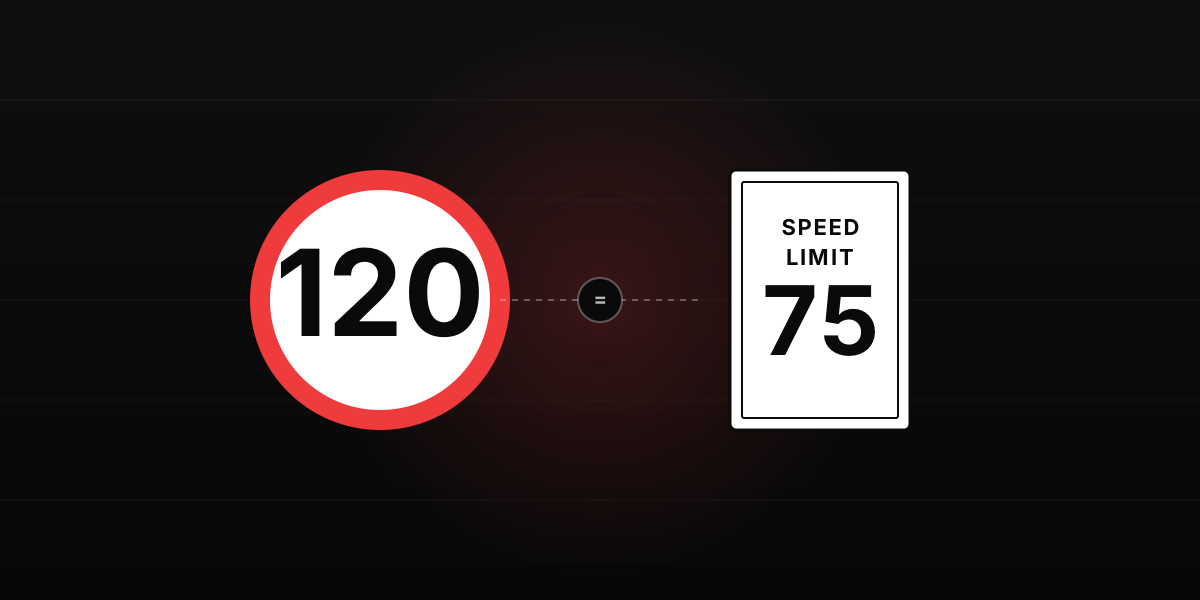
Sweden originated the Vision Zero road safety initiative in 1997 — the policy goal of zero traffic deaths and serious injuries. Speed limits are calibrated to that vision: 50 kph in towns, 70-90 kph rural depending on road type, and 110-120 kph on motorways. The 120 kph maximum is recent (raised from 110 on select sections starting 2008).
Speed limits at a glance
| Road type | Limit |
|---|---|
| In built-up areas (cities, towns) | 50 kph (31 mph) |
| Residential / school zones | 30 kph (19 mph) |
| Outside built-up areas (rural) | 70-90 |
| Motorways / expressways | 110-120 |
About speed limits in Sweden
Vision Zero (Nollvisionen) was adopted by the Swedish Riksdag in 1997 and has shaped Swedish road policy ever since. The framework treats traffic deaths as fundamentally preventable system failures rather than individual error. Speed limits, road design, vehicle safety, and enforcement are all tools toward zero deaths. Sweden's road death rate fell from 6.8 per 100,000 in 1997 to 2.0 by 2020.
Rural speed limits in Sweden are road-specific rather than default. Two-lane rural roads typically post 70 or 80 kph; rural roads with center barriers (2+1 roads, common in Sweden) post 100. The 2+1 design — three lanes alternating which direction has two — was pioneered in Sweden and has spread to Finland, Ireland, and elsewhere.
Motorway maximum was 110 kph nationwide until 2008, when the Swedish Transport Administration began raising specific sections to 120 kph based on road quality and accident history. The 120 zones are well-engineered, with median barriers and good sight lines. The 110 limit remains the default; 120 requires specific authorization.
Winter conditions trigger automatic limit reductions on many roads. Variable electronic signs display the active limit. Drivers are also legally required to use winter tires from December through March on most roads (tire law). Compliance is high and enforcement strict.
Enforcement
Sweden uses fixed cameras (ATK, Automatisk Trafiksäkerhetskontroll) extensively — the network is among the densest in Europe per kilometer. Mobile radar operates everywhere. Section-control averaging is being expanded. The Polismyndigheten (national police) and Trafikverket (transport agency) coordinate enforcement.
Tolerance
Tolerance is 4 kph below 100 kph and 4 percent above. So 124 kph on a 120 motorway becomes 119 — no fine. Stricter than the European 5 percent norm. Cameras are tuned tightly.
Fines for speeding
SEK 1,500 for under 10 kph over on motorway, rising to SEK 4,000+ plus license suspension for 30+ kph over. License loss at the roadside applies at 30+ kph over in town or 40+ on rural roads. Sweden does not have an income-adjusted system like Switzerland but fines are high in absolute terms.
Frequently asked questions
What is Vision Zero in Sweden?
Vision Zero (Nollvisionen) is the Swedish road safety framework adopted in 1997, treating traffic deaths as preventable system failures rather than individual error. Speed limits, road design, vehicle safety, and enforcement are all calibrated to zero road deaths. Sweden's road death rate fell from 6.8 per 100,000 in 1997 to 2.0 by 2020.
What is the highest speed limit in Sweden?
120 kph (75 mph) on specifically authorized motorway sections. The default motorway limit remains 110 kph. The 120 zones are well-engineered with median barriers and good sight lines; they have been added selectively since 2008.
What are 2+1 roads in Sweden?
Rural roads with three lanes alternating which direction has two — the lane configuration switches every few kilometers, allowing safe overtaking sections. Pioneered in Sweden, the design has spread to Finland, Ireland, and other Nordic and Celtic countries. They typically post 100 kph.
Are Swedish speed cameras strict?
Among the strictest in Europe. Tolerance is 4 kph below 100 kph and 4 percent above — stricter than the European 5 percent norm. The ATK fixed camera network is dense. Mobile radar operates everywhere. License loss at the roadside applies at 30+ kph over in town.
Speed limits in other countries
Limits, tolerances and fines differ sharply across borders. These pages cover the same ground for every country we have researched.
- Australia
- Austria
- Belgium
- Canada
- Denmark
- France
- Germany
- Italy
- Japan
- Netherlands
- Norway
- Portugal
- Spain
- Switzerland
- Turkey
- United Kingdom
- United States
Related tools
- Convert KPH to MPH — convert any speed reading between units.
- Car speed test — verify your speedometer accuracy.
- Live GPS speedometer — see your actual speed in the browser.
- Stopping distance calculator — how far you need to brake from each speed.