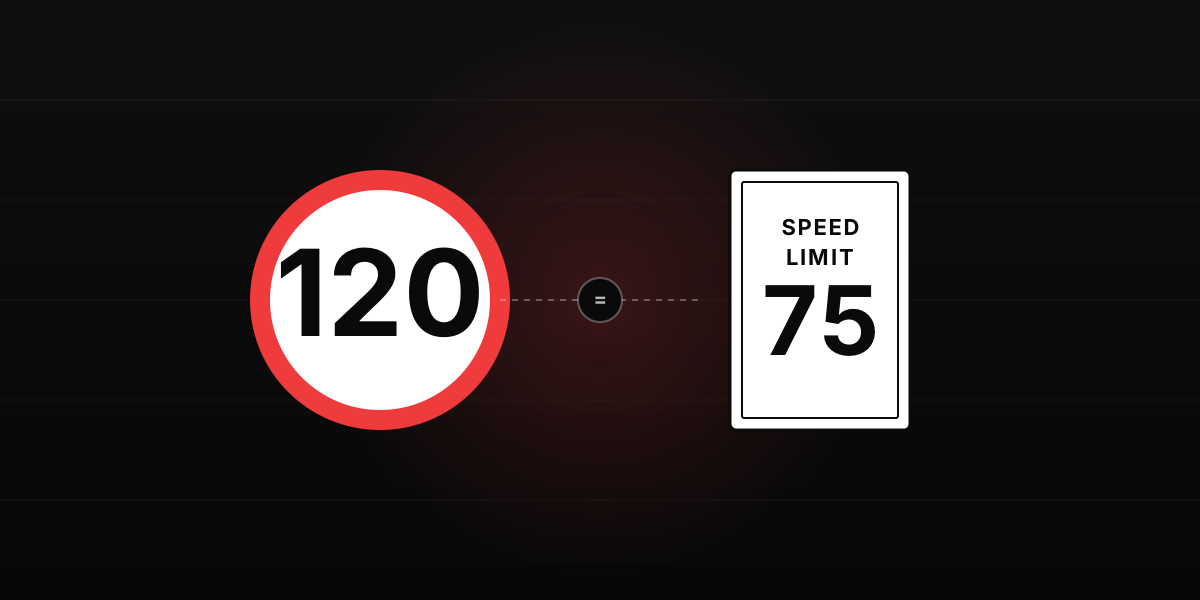
France lowered its rural default from 90 to 80 kph in July 2018 to reduce road deaths. After significant rural opposition, some départements were allowed to revert to 90 starting in 2021 — leaving France with a mosaic of 80 and 90 kph rural roads. Autoroute remains 130 kph, dropping to 110 in rain.
Speed limits at a glance
| Road type | Limit |
|---|---|
| In built-up areas (cities, towns) | 50 kph (31 mph) |
| Residential / school zones | 30 kph (19 mph) |
| Outside built-up areas (rural) | 80 kph (50 mph) |
| Motorways / expressways | 130 kph (81 mph) |
About speed limits in France
The 80 kph rural rollback was politically charged. The change was tied to the gilets jaunes protests in late 2018, when speed cameras were targeted and damaged across the country. By 2021 the Macron government allowed départements to opt for 90 kph on certain rural roads, leading to the current mixed landscape: roughly 40 départements stayed at 80, about 60 reverted some roads to 90. Signs are the only reliable guide.
The autoroute limit of 130 kph drops to 110 kph in rain — automatic and binding when the road surface is wet, not just when rain is falling. This catches many foreign drivers. Variable electronic signs over urban autoroutes show the active limit; that sign is the enforced number, not the road-side base figure.
New drivers (within their first 3 years post-permit) face lower limits: 110 kph on autoroute, 100 on dual carriageway, 80 on rural. They must display an A sticker (Apprenti) on the rear. Failure to display is itself a fine. Driving instruction in France emphasizes these reduced limits heavily.
Inside Paris, the city limit dropped to 30 kph for most streets in August 2021. Exceptions remain on a few périphérique-style ring roads and major arteries (70 kph). The aim was to make cycling safer and reduce noise pollution; data after two years showed mixed traffic-speed impact but measurable noise reduction.
Enforcement
France uses fixed radar (radars automatiques) and mobile radars extensively. The radar tronçon (section control) measures average speed across stretches, common on autoroute roadworks. Mobile patrol cars use both stationary and rolling radar. Foreign vehicle plates are pursued through EU cross-border enforcement agreements.
Tolerance
Radar measurement gets a 5 kph tolerance below 100 kph and 5 percent above 100 kph. So 137 kph measured on a 130 limit becomes 130 kph after the 5 percent tolerance — no fine. Mobile-radar tolerance is the same. Tolerance does not stack with the new-driver reduction.
Fines for speeding
Fines start at €68 for under 20 kph over and rise sharply: €135 for 20 to 50 kph over (40 to 50 kph over also means license suspension up to 3 years). 50+ kph over is a criminal offense (délit) with up to €3,750 fine and 3 months prison theoretical max. License points (12 total) are lost at 1 to 6 per offense.
Frequently asked questions
Why did France change its rural speed limit?
In July 2018 the government lowered the default rural single-carriageway limit from 90 to 80 kph to reduce road deaths, a high political priority at the time. The change was tied to gilets jaunes protests and partially reversed in 2021 when départements were allowed to opt back to 90. Currently about 60 départements have 90 kph segments while 40 stayed at 80.
What is the autoroute speed limit in rain?
110 kph in rain (down from 130 in dry conditions). The rule applies any time the road surface is wet — not only during active rainfall. Foreign drivers frequently miss this. Posted "110" signs in dry conditions on standard autoroute should be understood as the wet-weather limit; it remains binding even after rain stops while the surface is still wet.
Are French speed limit fines high?
Moderate by European standards. €135 for 20-50 kph over is typical. The bigger risk is license point loss (12 maximum, 1 to 6 per offense) and license suspension for 40+ kph over. The criminal threshold at 50+ kph over (délit grand excès de vitesse) makes serious speeding a misdemeanor on record.
Do French speed cameras work on foreign plates?
Yes. EU cross-border enforcement allows French authorities to forward tickets to drivers in other EU member states. Outside the EU (UK post-Brexit, Switzerland, USA), enforcement is more limited but France maintains agreements with most neighboring non-EU countries. Hire cars charge drivers for tickets and an admin fee.
Speed limits in other countries
Limits, tolerances and fines differ sharply across borders. These pages cover the same ground for every country we have researched.
- Australia
- Austria
- Belgium
- Canada
- Denmark
- Germany
- Italy
- Japan
- Netherlands
- Norway
- Portugal
- Spain
- Sweden
- Switzerland
- Turkey
- United Kingdom
- United States
Related tools
- Convert KPH to MPH — convert any speed reading between units.
- Car speed test — verify your speedometer accuracy.
- Live GPS speedometer — see your actual speed in the browser.
- Stopping distance calculator — how far you need to brake from each speed.