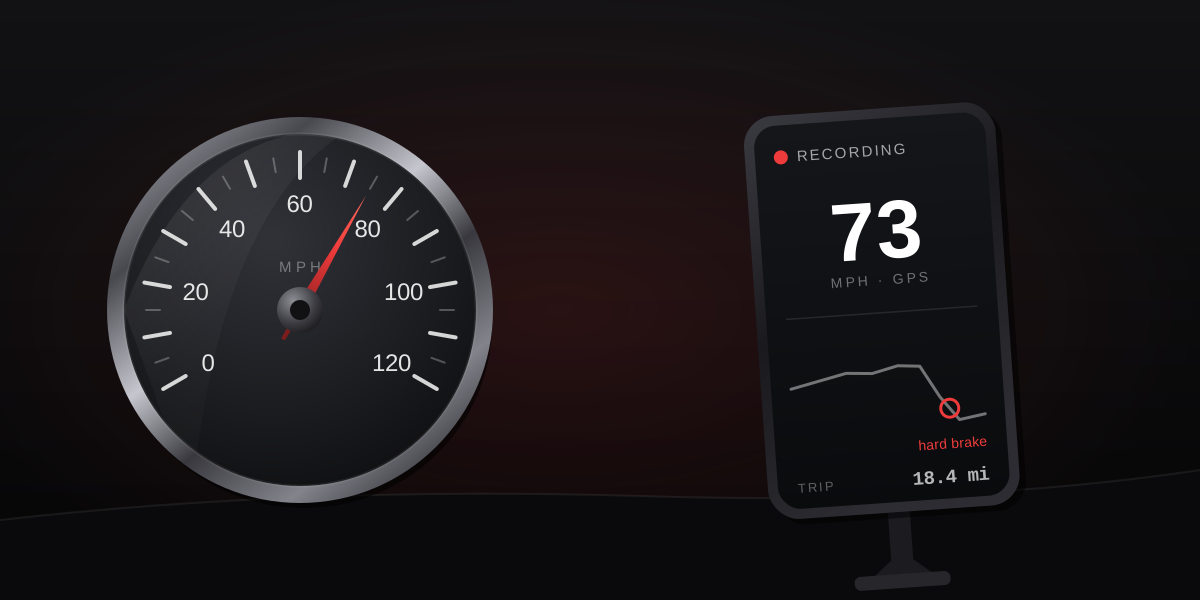
Yes, and the programs say so themselves. Progressive's terms list vehicle speed and GPS location among the data Snapshot collects. But the answer people actually want is narrower than that, and it is more interesting: on most programs, your speed is not what you are scored on. What is scored is how fast your speed changes. Those are different measurements, and confusing them is why so many careful drivers get scores they cannot explain.
Collected and scored are two different lists
Start with Progressive, because its documentation separates the two cleanly. The Snapshot terms describe the raw feed: Snapshot Data includes vehicle speed and location using GPS, time information, phone usage, and data from the phone's sensors. It then says that other information, including trip duration, trip regularity and rates of acceleration and braking, is derived from that speed, location and time information.
That word matters. Braking is not measured directly. It is calculated from how quickly your recorded speed falls between one reading and the next. The speed feed is the raw material; the score is built from its slope.
The rating factors Progressive publishes are a shorter list: the time of day you drive, sudden changes in speed meaning hard brakes and rapid accelerations, the amount you drive, and, for mobile app users in some states, handheld phone use behind the wheel. Progressive also states directly that where you drive is not used in determining your personalized rate.
So the location feed exists, and it is not a rating factor. Recorded and rated are separate questions, and the honest answer to "are they tracking me" is yes to the first and partly to the second.
One program does score the speed itself
State Farm's Drive Safe & Save is the counterexample, and it is specific about it. Its published list of measured behaviours is acceleration, braking, cornering, phone distraction, and speed, with speed described as: the app shows you when you have exceeded the speed limit by 8 miles per hour or more.
That is a real threshold with a real number, and it changes how you would drive if you cared about the score.
| Program | Speed itself | Also measured | Collection |
|---|---|---|---|
| Progressive Snapshot | Recorded; published factors centre on changes in speed | Time of day, amount driven, phone use (app, some states) | Plug-in device or mobile app |
| State Farm Drive Safe & Save | Yes, 8 mph over the limit is surfaced | Acceleration, braking, cornering, phone distraction, mileage | App plus a Bluetooth beacon on the windshield |
The practical consequence is that the same drive scores differently depending on whose software is running. A steady 78 mph cruise on an empty interstate is close to invisible to a program that only looks at slope, and lands squarely on a threshold that watches the limit. A slow city commute full of abrupt stops is the reverse.
Why the derivative, and not the speed
It looks strange until you think about what each quantity predicts. Speed is a state. Sudden deceleration is an event, and it usually means something went wrong: a gap closed faster than expected, a light was read late, a lane change was not seen. Hard braking is a record of situations that nearly became collisions.
Because it is a rate of change, it is indifferent to how fast you were going. Braking sharply from 30 mph can trip it. Holding 80 on an empty road does not. Progressive's plug-in device makes this audible: it beeps when it registers a hard brake, so drivers learn the threshold by hearing it.
This is also why following distance ends up mattering more than speed for these scores. Braking events come from arriving at a situation with no room left. Extra following distance removes the events, whatever your cruising speed is.
Your speedometer is lying, in your favour
Here is the part nobody mentions, and it is measurement rather than insurance.
Telematics reads GPS ground speed. Your dashboard does not: it counts wheel rotations against a stored tire circumference, and it is deliberately calibrated so the error lands high. Most cars read 1 to 3 percent more than you are really doing, which we cover in why your speedometer disagrees with GPS.
So the app always sees you moving slightly slower than your dash claims. Against a fixed threshold, that gap is worth having:
- Limit 70 mph, flag at 8 over, so the flag lands at a true 78 mph
- A dash reading about 2.5 percent high shows that as roughly 80 mph
- Keep the needle under 80 in a 70 zone and you stay under the threshold
The instrument error works for you here, which is unusual. It is worth knowing your own car's figure rather than assuming the middle of the band, and the GPS accuracy test gives you that number in one drive.
One caveat on the other side. A threshold expressed as "over the limit" needs to know the limit, and that comes from map data rather than from the road. Map speed limits go stale after re-signing, and a frontage road running parallel to a highway can inherit the wrong number. If a flag looks impossible, the limit in the database is a more likely culprit than your speed.
Phantom events, and where they come from
Drivers regularly report braking events they did not make. Two causes account for most of them, and both are measurement problems rather than driving problems.
GPS quality. Satellite-derived speed degrades between tall buildings, under overpasses and in tunnels. A dropout followed by reacquisition can produce a step in the recorded speed that never happened on the road. Our note on how accurate phone GPS speed is covers where the signal is reliable and where it is not.
The phone itself. App-based programs lean on the handset's accelerometer, and that sensor cannot distinguish the car decelerating from the phone sliding across a seat or being picked up out of a cupholder. Mounting the phone rigidly and not touching it while moving eliminates most of this category.
Can it actually raise your rate?
The comfortable belief is that the worst case is no discount. That is not what the programs publish.
Progressive states that riskier driving may result in a higher rate at renewal, depending on the state you live in. It also states that opting out more than 45 days after enrollment may bring a surcharge at the next renewal, which makes the decision to leave a program less free than it looks.
State Farm says changes in your driving are reflected in your adjusted amount, so it may increase or decrease at each renewal, and that if actual mileage exceeds the low mileage threshold of 7,500 miles, the premium may increase at future renewals. It also notes that mileage and odometer readings are excluded from the premium adjustment on certain policies in certain states.
The pattern across both is the same: the direction of travel is not guaranteed, and the details vary by state. Reading the terms for your own policy is the only way to know which version you are in.
Mileage is a rating factor too
It is easy to focus on behaviour and miss the simplest input. How much you drive is on both lists, and State Farm attaches a specific number to it at 7,500 miles.
That figure is worth checking rather than estimating, because a car odometer over-reads for the same reason it distorts everything else: it counts rotations against a stored circumference, so worn or smaller tires make the count run fast. If a mileage threshold is close, the difference between the dash total and true distance is not academic. The same issue shows up in mileage records for tax purposes, which we cover in does the IRS accept a GPS mileage log.
Watching the same number they do
None of this requires trusting anyone's description. The speed a telematics app reads is ordinary GPS ground speed, available to any app or browser through the same satellites and the same standard interface.
Running an independent readout beside your dashboard tells you two useful things: your own speedometer's error, so you know where a threshold really lands, and whether a stretch of road gives clean GPS or the kind of noisy signal that manufactures events. The live GPS speedometer shows the raw figure with nothing to install, and the GPS odometer gives the distance side.
The takeaway
Your insurer is reading your speed. On most programs it is not scoring it, because the predictive signal lives in the derivative: hard brakes and rapid accelerations, plus time of day, distance and phone handling. State Farm is the exception that watches the limit directly, at 8 mph over.
If you want a better score, following distance buys more than a slower cruise, because it removes the events rather than lowering a number. Mount the phone so it cannot move on its own. And know your speedometer's error, because the app is reading true ground speed while your dash quietly rounds in your favour.