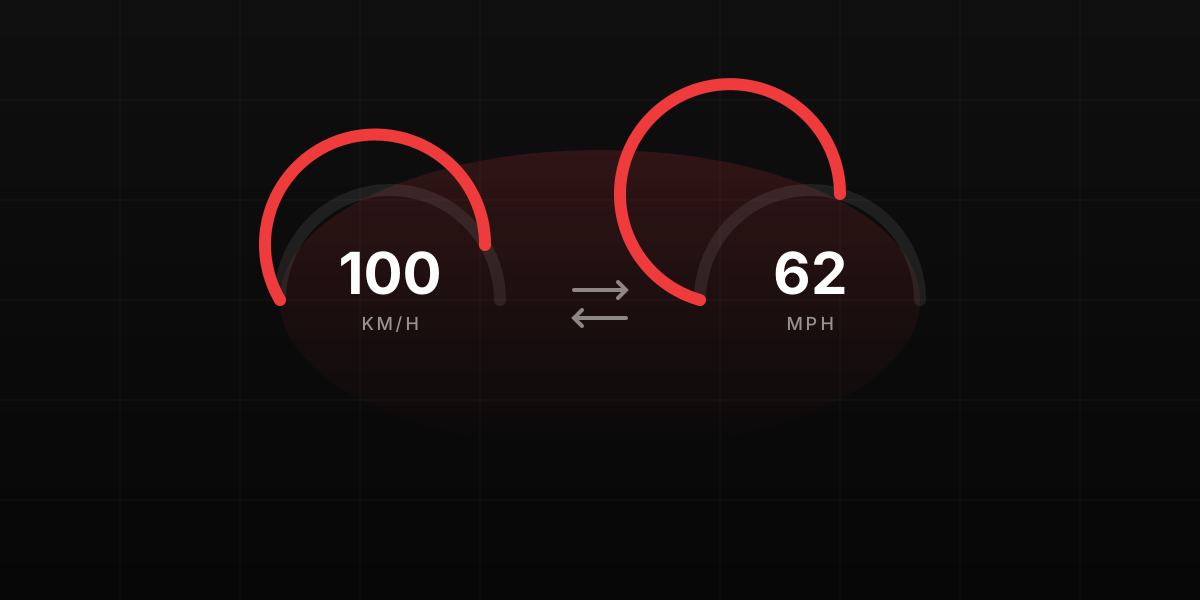
KPH means kilometers per hour. It is the unit of speed used by most of the world to measure how fast a car, train or runner is moving. If you have ever seen a speed limit sign abroad that read 50 or 100 and wondered what it meant next to your own dashboard, this is the short, clear answer to what KPH is and how it relates to MPH.
What KPH stands for
KPH stands for kilometers per hour. It tells you how many kilometers you would travel in one hour if you kept moving at your current pace. At 60 KPH, you would cover 60 kilometers in an hour. At 120 KPH, you would cover 120.
You will see this same unit written several ways:
km/h, kmh, kph and
KPH all mean exactly the same thing. The official
scientific abbreviation is km/h, which is what
appears on most road signs and car dashboards. KPH is simply an
informal English spelling of it. There is no difference in value
or meaning between them, so do not let the different spellings
confuse you.
The "kilometers" part is a distance: one kilometer is 1,000 meters, a little under two thirds of a mile. The "per hour" part is the time window. Put them together and KPH is a rate, the same way miles per hour, meters per second or knots are rates. The bigger the number, the more ground you cover in the same hour. That is the whole idea, and it is identical no matter which country prints it on a sign.
KPH vs MPH: which countries use which
The world is split into two camps on road speed, and the split is very lopsided. Almost everyone uses kilometers per hour. All of continental Europe, every country in Asia, Australia, New Zealand, Canada, most of Africa and nearly all of South America post their speed limits in km/h.
Only a small group of countries uses miles per hour (MPH). The two you are most likely to encounter are the United States and the United Kingdom. A few smaller territories also use mph, but for practical purposes, if you are driving anywhere outside the US or UK, you can assume the signs are in km/h.
This is why a rental car in Spain or Japan shows large numbers like 90 or 120 on the speedometer, while a car in Texas shows smaller numbers like 55 or 75. The cars are not faster or slower. They are just labeled in different units.
The reason the split exists at all is mostly historical. The mile traces back to the Roman mille passus, a thousand paces, and survived in countries shaped by the British Empire. The kilometer arrived with the metric system after the French Revolution and spread across most of the world through the twentieth century. The United Kingdom kept the mile on its roads even as it adopted metric units almost everywhere else, which is why British road signs still read in miles while a bag of flour in the same shop is sold in kilograms.
The exact conversion
The relationship between the two units is fixed and exact, because one mile is defined as exactly 1.609344 kilometers. That gives you two conversion factors to remember:
- 1 mph = 1.609344 km/h (exact). To turn mph into km/h, multiply by 1.609344.
- 1 km/h = 0.621371 mph. To turn km/h into mph, multiply by 0.621371.
You rarely need that many decimal places in your head. For a quick mental estimate, multiply km/h by 0.6 to get a rough mph figure, or multiply mph by 1.6 to get a rough km/h figure. So 100 km/h is roughly 60 mph (the exact answer is 62.14), and 60 mph is roughly 96 km/h (the exact answer is 96.56). Close enough to read a road sign, not close enough for a physics exam.
A slightly more accurate shortcut is to multiply km/h by 0.62 instead of 0.6. That gets you within a fraction of a mile per hour of the true value at any normal road speed. But for a glance at a foreign speed limit, the round 0.6 and 1.6 factors are quick to do in your head and never far enough off to matter. If you want a precise number, reach for a converter rather than mental math.
Common speeds in both units
Here are the speeds you are most likely to meet on the road, shown side by side. These cover typical city limits, rural roads and motorways across the km/h world.
| KPH (km/h) | MPH (exact) | Where you see it |
|---|---|---|
| 30 km/h | 18.6 mph | Quiet residential streets, school zones |
| 50 km/h | 31.1 mph | Standard city and town limit |
| 80 km/h | 49.7 mph | Open rural roads |
| 100 km/h | 62.1 mph | Common highway limit |
| 120 km/h | 74.6 mph | Motorways and expressways |
A useful anchor: 100 km/h, the speed at which carmakers often quote a zero-to-100 acceleration time, sits right around 62 mph. And 50 km/h, the default urban limit across much of the world, is just over 31 mph.
Why your car might show both
Many modern speedometers print both scales on the same dial, usually with km/h as the larger outer ring and mph as a smaller inner ring (or the reverse in US-market cars). Digital dashboards often let you switch the unit in the settings menu.
There are good reasons for the dual display. Cars are sold and driven across borders, rental fleets move between countries, and a single dashboard that reads both units saves the manufacturer from building two versions. If you cross from the UK into France, the same physical car needs to read mph on one side of the Channel and km/h on the other. Showing both, or letting you toggle, solves that cleanly.
Knowing both scales is also handy for travel. If you rent a car in a km/h country and your instinct is tuned to mph, glancing at the smaller inner ring (or switching the digital display) lets you keep a feel for how fast you are actually going while you adjust. Within a day or two, most drivers stop converting in their heads and simply learn that 50 means town speed and 120 means motorway speed, the same way they once learned 30 and 70 in mph.
How to convert instantly
You do not need to do the math yourself. To get an exact figure in either direction, use a converter. Our KPH to MPH converter turns any kilometers-per-hour value into miles per hour, and the MPH to KPH converter does the reverse. Both use the exact factors above, so the result is accurate to several decimal places.
If you want to see your own real-world speed rather than convert a number, the live GPS speedometer reads your actual pace from your phone's GPS and lets you flip between km/h and mph with a single tap. It is the simplest way to understand the difference: drive at a steady speed and watch the same motion shown in both units at once.
One more thing worth knowing: the number your dashboard shows and the number GPS shows are not always identical. Car speedometers are calibrated to read slightly high for legal reasons. If you are curious why, we explain it in car speedometer vs GPS speed.
The takeaway
KPH is kilometers per hour, the speed unit used almost everywhere on Earth. It is the same as km/h, kmh and kph, just spelled differently. The only widely used alternative is MPH, miles per hour, found mainly in the United States and the United Kingdom. To move between them, multiply km/h by 0.621371 for mph, or mph by 1.609344 for km/h, or just let a converter do it. The speed itself never changes. Only the label on it does.